
Tonight, I popped round to see a couple of friends, one of whom (Rich - the man on the left) had been to Athens in the summer. He showed me his pictures from the games. This one was my favourite. It features Rich and another friend of mine, Mik, singing the national anthem for Kelly Holmes after she received her gold medal for the 800 metres.
The picture was taken by one of three Canadians that Rich and Mik had befriended through the course of the evening. They had flown to Greece from Canada; they were staying in Athens for 36 hours; and then they were flying back home - a long weekend on the other side of the world. They hadn’t come for any event in particular, or to see any Canadian especially – they just wanted to be at the Olympics, no matter how little time they could spend there.
The picture sums up several things that I love about the Olympic Games. In general, I hate flag-waving and anthem bellowing, but, when it is done to salute the magical culmination of a lifetime of hard work, it can make my spine tingle. I ought to send the picture to the organisers of the London 2012 bid – I think it depicts exactly the support that could be expected if we got the Games.
I also enjoyed hearing about Mik and Rich meeting the Canadians. My wife and I went to watch London Wasps win the final of the Zurich Premiership (rugby) at Twickenham two years ago. Wasps scored an early try at the other end of the pitch and, predictably, the crowd rose to its feet. The man (for want of a better word) behind my wife put his hands on her shoulders and shoved her back down into her seat whilst shouting “If you stay sitting down, we can all see!”
Needless to say, we weren’t entirely delighted. I politely explained that until he had managed to spread his mysterious gospel of sedentary rugby watching to the other 74,999 people in the ground, he’d be as well to just stand up when everyone else did. I might have called him a name too. There’s an outside chance I may have sworn. One thing I definitely did do was spend the rest of the first half standing up at every opportunity and getting ready to lay him out if he said anything about it. I can’t remember any of the rugby.
So it’s nice to know that at the Olympics the people you meet in the crowd are nice folk who’ll spend a medal ceremony looking at you through the lens of your camera instead of at the action if you ask them to.
It’s also nice to know that they’ll travel halfway around the world to spend a few hours basking in the glow of the Games. The more I hear from all of my friends who were there; the more I wish I had gone too, and the more I resolve to go and set up that savings account for my trip to Beijing.
Athens Anthems
New Shoes
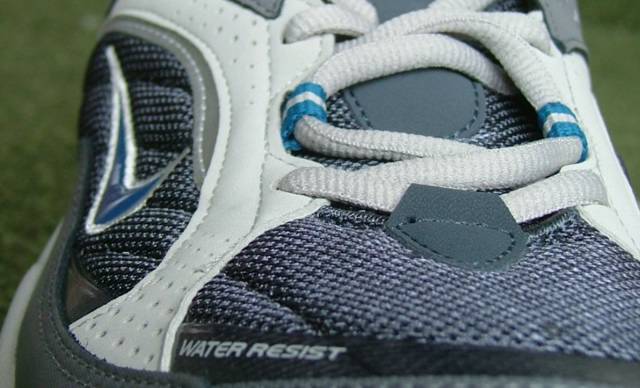
Almost everything was against me this morning.
Despite my route being more or less a loop, the wind seemed to be in my face throughout the run. It rained a little last night, so the grass in the park was heavy and the ground underneath it was soft.
My parents are over visiting this weekend, so last night I ate far too much and drank a bit more red wine than I meant to – I spent most of my run trying not to jiggle my stomach around too much.
After dinner last night, we went to the cinema and saw The Incredibles, which was disappointingly average and far too long. At the end of it, when I tried to walk to the car, something in my right knee had seized up and I could hardly bend my leg. Once I’d loosened it out, it was fine, and it didn’t hurt this morning.
But I’ve seen the footage of Ruud Van Nistleroy moving from a state of having a cruciate ligament to not having a cruciate ligament – it happened very fast and completely out of the blue – I spent most of my run wondering if it was about to happen to me and trying to think of Olympic events I could do lying down.
On top of all that, the Leftfield track I was listening to wasn’t quite fast enough and was making me run (I felt) too slowly.
The only thing in my favour was the new pair of shoes my folks very kindly contributed to the cause yesterday. They are made by Nike. They are Air Terra Sebecs. I might have to have them tested to make sure they’re legal; I knocked a couple of seconds off my best time and ran 07:13.2.
My Dark Nemesis

For Seb Coe, it was Steve Ovett. For Carl Lewis, it was Mike Powell. For Michael Phelps, it was Ian Thorpe. All great athletes have their nemesis – their one great foe that repeatedly thwarts their chances of achieving the greatness they seek. I have mine. Her name is Boo.
This morning, I ran my mile in seven and three-quarter minutes, but at least 20 seconds of that time were spent first trying to prevent Boo coming with me when I left, and then trying to stop her escaping when I returned. I time myself using my phone, which I leave just inside the front door. She sits and waits by it, knowing her moment will come.
She is allowed outside, but she’s still young and stupidly bold, so we try to restrict her outdoor pursuits to the back of the house, away from the road. But cats (kittens especially) don’t speak English, so, when I leave for my run and when I come back, I have to resort to wrestling her back from the door. This is about as easy as juggling spaghetti.
In terms of a progress report, this may look more like excuses again, but I do think I’m running faster than my recent times have reflected – I’m just not getting any better at outwitting the kitten.
Walk This Way
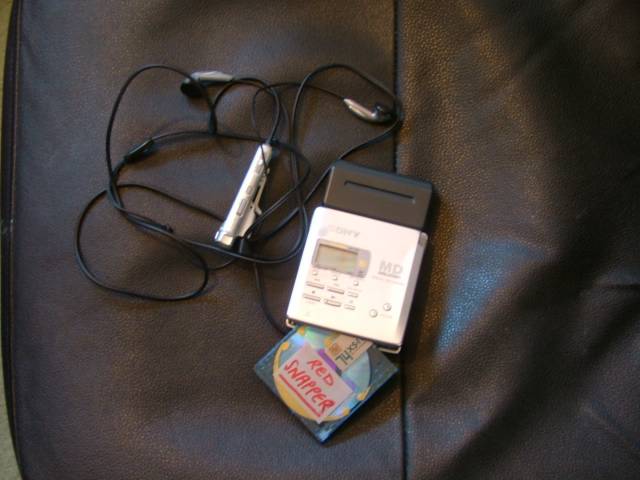
Following the success of rocksercise with the Kings of Leon on Monday night, I’ve started taking my mini disc player out on my morning run. I find the running pretty boring (even though it lasts less than 8 minutes), so having some music along really helps – plus you get to feel like you’re part of a BBC Sport montage.
As for the progress of the overall challenge - plans are afoot to get the 20km walk out of the way before Christmas. A colleague from work told me he had heard speed walking described at the Sydney Olympics as being like “a contest to see who could whisper the loudest”, which seems about right to me. A great debate is raging at the moment about just how much actual speed walking needs to be done in the course of the 20km walk – I’m all for trying it out, but the truth is that it hurts like hell.
Several nights ago, on my way home from work, I found myself walking down a badly lit side street and decided my chance had come; I tried to break into a speed walk. Firstly, it’s an incredibly unnatural action, and it took some powerful concentration to get my body to do it at all. Secondly, once I did convince my brain that no one was looking and that it really was OK to just speed walk, I made it about 20 yards before my body itself registered a complaint.
My shins began screaming at me – presumably trying to remind me that I have some comparatively enormous muscles in my thighs that are much better suited to propulsion. They really didn’t like it one little bit. I had to stop.
I walked on (at my normal pace) and realised there was a third issue; I was moving faster when walking normally than I had been when speed walking.
I’ve checked the rules, and all they say is that some part of your body must remain in contact with the ground at all times. Your leading foot must hit the ground before your trailing foot lifts off. In the words of countless schoolteachers down the ages therefore, “Walk! Don’t Run!”
I know there’s an issue here of entering into the spirit of things, and I do intend to give speed walking as much of a go as my startlingly ill-adapted calf muscles will allow, but I’m not going to feel too guilty if I have to crank it down to a brisk stroll in order to complete the distance. In accordance with the rules, I will walk – but there’s nothing in there to say that I have to look like a panicked duck in the process.
Miles More Fun Than Miles

I missed my run this morning, but I didn’t feel too guilty – I got a pretty good workout last night, courtesy of the mighty Kings of Leon. For the first time since I was about 17 and staring wide-eyed at Nirvana in the King’s Hall in Belfast, I let myself get hauled into the thick of the moshing.
The experience provides a fairly focused workout for the calf muscles as you pogo up and down, but threatens rib injury at all times as you push your elbows out to avoid getting crushed to death by a hundred sweaty bodies pressing in on you from all angles simultaneously.
I didn’t do my mile this morning because I was feeling a trifle delicate - beers and rock and roll on a school night – whatever next?
The Mile

"So, I'm quick, but tell me honestly, does my breath smell?"
Today, I ran my fastest mile yet – 07:15.6.
I was delighted.
Well, no… I was gasping for breath, a bit light-headed and felt almost certain I was going to be sick. As it turned out, I regained my composure reasonably quickly, but I’ve just been playing with some numbers (no one can say I don’t know how to have fun at the weekend) and now I feel sick again.
I appreciate several cold, hard facts. I appreciate the fact that I’m not a world-class athlete – in fact, I’m not an athlete at all. I appreciate the fact that in my entire life I’ve probably done less physical training than most decent distance runners would do in an average week of moderate training. I appreciate the fact that many aspects of this Olympic challenge aren’t going to be easy.
However, although my mind sees those words, still it thinks: “I’m tall, I’m skinny, I’ve watched it on TV – I should be good at middle-distance running.”
So, although I know that comparing the time it takes me to run a mile around the park at the end of my road to the time it has taken legendary runners in the past to run a mile round a track wearing all the proper gear is a fairly pointless exercise, I did it anyway.
Bannister ran 3:59.4 in 1954, so the first big barrier for me was the eight minute mile - any longer than that, and I could imagine Sir Roger running past to lap me for a second time (in black and white no less) as I neared the start/finish line after a mere 800 metres of my mile. Any time sub-eight minutes (or 7:58.8 if you’re being picky) would ensure that he only passed me once during the course of the race.
The next barrier I set myself was to achieve the same heady status (“He only lapped me once!”) in an imagined race with Hicham El Guerrouj, the current world record holder, who ran 3:43.13 in 1998. The time I needed to achieve for that to happen, assuming (entirely erroneously of course) that we both ran at a perfectly uniform pace throughout the mile, was 7:26.24. Today I beat that for the first time.
Amazingly, there were no salt tears cried – even at the height of my euphoria, I was aware somewhere in the back of my mind that there remain one or two worlds yet to be conquered.
In order to avoid getting lapped at all by Bannister, I need to run the mile in 5:19.19. In order to avoid the same fate at the hands of the gifted Moroccan, I need to run it in 4:57.49. Thankfully, I am only foolish enough to be attempting this whole challenge at all, and not foolish enough to be attempting to do any of it to any high standard.
Perhaps more worrying than anything I’ve mentioned so far is the fact that when Paula Radcliffe broke the world record in the marathon, she ran most of her 26 miles around two minutes faster than it takes me to run just one at the moment. And she’s a girl.
I’ve been told by people who should probably know that I will notice a vast improvement in my times very quickly if I stick at it. I can just about conceive of breaking the seven minute barrier – it was a bit wet under foot today, and I had to swerve violently twice; once to avoid a dog, and once to avoid what it had just been doing – but sub-six minutes seems like something from a dream, and sub-five seems frankly impossible.
I’ve also been told that I will find a pace at which I’ll feel like I could run indefinitely. At the moment, I’m achieving that pace somewhere between my bed and the shower in the morning.
Still - it's not all doom and gloom - the mile (1,600 metres, give or take) isn't even an Olympic event. The nearest equivalent race is the 1,500 metres, and, let's face it, it's usually only the last 100 metres of the mile I struggle with anyway!
London 2012
Today, Lord Coe & Co. released more details about London’s bid to host the 2012 Olympic games. Some of the facilities look wonderful.
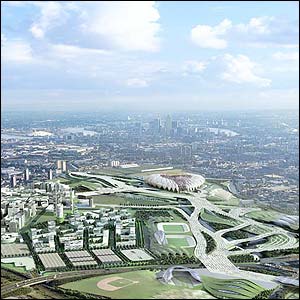
The first report I read suggested that tickets prices for the various events would begin at around £10, and that nothing would cost more than £30. The report I’ve just read says that they would begin at £15 and nothing will cost more than £50. If this rate of price inflation continues, it’s going to work out cheaper for us all to decamp to Beijing in 2008 instead.
It’s hard to tell how London’s chances of success are looking compared to the other candidates. Madrid didn't do itself any favours on Wednesday night when a large number of its inhabitants made monkey noises at the black players on the England team during their friendly with Spain.
Paris seems to be a front-runner in that, instead of having wonderfully impressive plans for new stadia, it just has wonderfully impressive new stadia.
I don’t imagine Condoleeza Rice is going to do much by way of softening US foreign policy, which (despite the claims of NYC2012) can’t be doing much to help New York’s bid.
And as for Moscow… well, Moscow’s just cold.
I’m all for it – I’d love the Olympics to be in London in 2012. I know that some people resent how much it will cost and they worry about London being left with a load of useless big buildings to find a use for when it's all over, but look at it this way – at least one useless big building would finally get to serve some worthwhile purpose - the Dome would be turned into the venue for the gymnastics.
The more observant amongst you will have noticed the subtle little link button on the right that will redirect you to the London 2012 website. Once there, you will be begged and beseeched by all manner of sports person and celebrity (and even the occasional celebrity sports person) to back the bid. Go there and do what they tell you - especially if you actually live anywhere near London.
Stitched Up
It’s supposed to get easier. I’m supposed to go quicker. I’m not supposed to get two stitches and take longer than I did before. What is a stitch anyway? In my case, I think it might be some sort of allergic reaction to see-saws – yesterday and today I was struck at exactly the same point in my run; just as I passed the see-saw. Or maybe it’s an anxiety disorder, brought on by a fear of running past the swings…
(In fact: "Pumping your legs increases the pressure on your abdominal muscles, which press up against the diaphragm. At the same time, rapid breathing expands your lungs, which press down on the diaphragm. The dual pinching from above and below shuts off the flow of blood and oxygen to the diaphragm." And, as Johnny Ball would say, that's how a stitch works. For more insight, including a handy list of remedies, click here)
The Running Man
This is how much I enjoyed getting up to go running at dawn this morning...
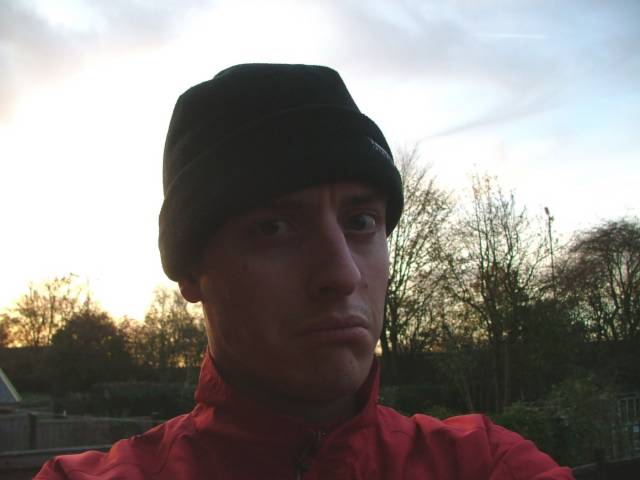
But I feel good about it now; even though it took me about a minute longer than it did the last time I ran a mile, and I got a stitch for the first time since I was 12.
Sportswoman of the Year 2004
The Sunday Times is running a text vote to determine the sportswoman of the year. The result is a bit of a foregone conclusion. The hot favourite won two golds in Athens this summer; she delighted everyone who watched her, and she should win this award by a country mile.
I’ve read the odd piece suggesting that Kelly Holmes might be in with a shout of winning this award too (having also won a pair of gold medals in Athens), but the sportswoman I’m talking about won five medals in all, claiming two silvers and a bronze as well as her two golds. Oh yeah, and she did all that despite having cerebral palsy. She is Paralympic swimmer, Nyree Lewis.
If you want to jump on the bandwagon and vote for the winner, call 0901 890 3405, or text the word “NYREE” to 84070.

Behind every great man, there's a great woman (with her finger in his ear).
Excuses, Excuses...
I had hoped to spare you the excuse-ridden drivel of yet another piece about why I've not done much toward becoming the Ultimate Olympian in the last few weeks, but it seems you're out of luck.
My wife was made redundant two weeks ago, and has now set about the exciting process of setting up her own business and finding a stop-gap job at the same time; needless to say, I've dipped the occasional oar of support into that effort. In my own job, the workload has increased just as the amount of time I have free to tackle it has declined thanks to a much-dreaded office move.
Added to that have been several niggles in knees, wrists, hands and back which, coupled with a hint of this half-cold that seems to circulate every year when the clocks go back, have left me somewhat less than eager to do anything other than sleep a lot.
Furthermore, it's cold, it's dark, it's usually raining, and, for all my pretension, I'm not an athlete. I keep using the giving-up-smoking analogy, but again it's helpful here - if you waited for a convenient time to do it, you never would. Training is much the same.
I'd like to say that I've been spending the time I've not been running or swimming doing other things to further the cause, but I haven't. I have watched the first two series of the West Wing; sadly though, last I checked, that isn't on the Olympic programme.
But enough of confessions and weak excuses - today we got a parcel in the post from the Lance Armstrong Foundation. Now I'm wearing my yellow 'Livestrong' wristband and thinking about two things - I'm thinking again about why I started doing all this in the first place, and I'm thinking about the athletic achievements of a man who had a lot more going against him than the mild dose of laziness I've succumbed to so easily.

Tomorrow is a new day.
Cake or Swimming?
I wouldn’t say that things have ground to a halt exactly, but Olympic developments have been few and far between in recent days. I have a wide range of excuses and have suffered all manner of distractions, but the truth lies closer to laziness and indulgence than unavoidable diversions.
To an extent, I am suffering a little from rabbit-in-the-headlights syndrome – the headlights being firmly fixed to the front of the task that lies ahead. If this challenge consisted solely of turning up to have a go at more than one hundred different Olympic disciplines in four years, it would still be tough, but it would clearly be achievable. The reality is that the organisation of most of these events is going to take a lot more time and effort than I had intially reckoned on, and, in many cases, a lot more time and effort than it will take to complete the event itself.
The 10m platform dive will be over in less than 3 seconds, but it will take a lot longer than that to persuade someone to teach me (and then to learn) how to do it without breaking my neck.
A fear of serious injury is my new neurosis. There seems to be a lot of it about at the moment. I have been looking forward to the Olympic football match I will have to play at some stage, and pretty much resting assured that I am fairly unlikely to get injured doing that one. Then I saw some pictures of Djibril Cissé and thought I might have underestimated the potential for disaster there [don’t click on that link if you’ve just eaten].
I also thought of the swimming as being fairly safe - I can take it as easily as I need to. No one ever gets seriously damaged in swimming, do they? Then I read that Grant Hackett, the Australian swimmer, successfully defended his 1,500m title in Athens despite having a collapsed lung. Frankly, I wonder sometimes if I’m hard enough for all this. I tend to view the collapse of any part of an internal organ as an indication that I need to be sitting on the sofa eating cake more and swimming 30 lengths of an Olympic pool less.
I suppose it’s one more lesson along the way though – these people put in the hours, not just in training, but also running around organising their schedules and trying to get sponsors to back their efforts. It’s like running your own business and being your own end product and the same time. The level of commitment goes beyond what most of us will ever see from the outside looking in, and in some cases probably borders on what would be considered psychological dysfunction for a non-athlete.
The BBC are running a competition on their Academy website to give readers the chance to train with the Great Britain gymnastics team. There are three age categories, with two winners to be selected from each category. I’m in the over 16 category. You are asked to write twenty words to tell them why you want to do it. I wrote:
"Doing 136 individual Olympic events between now and Beijing 2008 for charity. Need help or may die from my injuries!"
I don’t fancy my chances much to be honest, but if I win, perhaps they can teach me how to become the Pavlova of the Parallels without dislocating anything.
Focus
Remaining focused is a difficult thing. After my booster of inspiration at the parade in London last Monday, I ran on Tuesday and Wednesday morning; only a mile, but still, both days I ran at 6:30 in the morning in the dark and the cold and the rain. On Wednesday, I timed myself – a little over eight minutes – not too bad.
On Thursday morning I woke up after a restless night and spent the ten minutes I could have spent running around the park locked in the same old argument. This time, the part of me that reckons it probably isn’t ideal to run every single day in case I get injured prevailed. Missing Thursday made it so much easier not to run on Friday either.
Inspired by guilt, I did another timed run on Saturday morning. The whole way round I felt heavy and slow. On Wednesday, I had finished strongly and was thinking about how I ought to up my distance the next time – on Saturday, I had regressed to the "try not to be sick" stage. However, despite my heavy legs, I did it in less than seven and a half minutes on Saturday – El Guerrouj could have lapped me, possibly more than once, but I’m getting quicker.
My body is still a strange hybrid of several different kinds of athlete. I have the splayed feet and skinny, bandy legs of a distance walker. My belly is doing its best to balloon out like a top division weightlifter. My pectoral muscles are a long way from the chiselled perfection of a swimmer’s, and more closely resemble the concave chest of a marathon runner.
My arms should be good for swimming, at least in terms of length if not in terms of build. I read somewhere that Michael Phelps was an ideal build for a swimmer as he was 6'5" tall and 6'6" wide from fingertip to fingertip; I’m 6'4" tall (almost) and 6'7" wide. With a few light weights to build up my arms, and with my belly providing a degree of ballast Phelps so patently lacks, I should be up to his standard in no time.
Aside from my physical failings though, I need to build up again my ability to focus. When I used to play golf to a higher standard than I do now, I would practice pretty much every day. Some days the weather was dreadful - practicing in that can do your swing more harm than good as you compensate for wind and rain – but it was important to practice anyway; having done so, I was free to stand on the first tee at the weekend and feel like I’d worked harder than everyone else. That can give you confidence.
Similarly, I don’t imagine it will make a great deal of physical difference to a marathon I will try to run at some point in the next four years if I run one mile in the dark tomorrow morning or not, but maybe, as I arrive at the wall of pain that I am assured awaits me on that fateful day, I’ll remember how hard I worked, and I’ll remember getting up early in the morning to do something I don’t really like doing, and I’ll carry on running when I might otherwise have stopped.
Great Olympians don’t get to the pinnacle of their careers because they ran a mile in the dark one morning – they get there because they did it every morning while the rest of us stayed in bed.
Heroes On Parade
Today is a typical October day in the UK - it’s wet, it’s dark and it’s cold. Yesterday’s weather bucked the October trend with a sense of timing that any of the Olympic and Paralympic athletes parading through London would have died for - the sun was out, the temperature crept up and the wind stayed away.
Around three-quarters of a million people turned up to shout things about swinging chariots at the English rugby team when they paraded the World Cup through London last year; the police reckon about a third of that number turned up yesterday to cheer on the ‘Parade of Heroes’ – although, whether or not that number included the people hanging out of their office windows along the route isn’t clear.
I watched the whole thing from inside the ropes in Trafalgar Square, courtesy of Timo and his magic yellow wristbands. I pretty much just stood there for a couple of hours with my mouth open in glee and awe as Olympian after Paralympian was herded out onto the stage to exchange a bit of lively banter with Steve Rider and Sue Barker*, and then to sit down to one side and sign endlessly thrust autograph books and t-shirts. It was a privilege to be there so close to the action.
A greater privilege was to come though when the live broadcast had finished and we met up with Sascha and Nyree backstage and headed to the local Sports Café for a bite to eat. It took us the guts of half an hour to get 500 yards. It’s amazing how a few medals hanging around your neck will make complete strangers approach and ask you questions. It is also amazing just how patient two tired, hungry Paralympians can be with their public.
“Can I touch your medals?” - of course
“Will you sign this for me?” - of course
“Any chance of a photo?” of course
Nothing was too much trouble, nothing too intrusive. Every request was granted, and granted with a smile and with thanks for coming to the parade and for watching the Paralympics on TV.
And so, while Pinsent, Law, Holmes and Co. (and possibly Coe) headed to the Palace to meet Her Majesty, we hung out in the Sports Café with nothing to adorn our humble table but four golds, two silvers, a pair of bronzes and some nachos. The waitress’ eyes nearly popped out of her head. “Can I touch them? Will you sign this? Can I take a photo?” Of course, of course, of course.
There is something more in touch with the Olympic ideal about the Paralympians – perhaps a disability in one area makes you appreciate more your abilities in another – the spirit of fair play and the importance of taking part rather than winning seems uppermost. I liked the fact that the culmination of the parade took place in Trafalgar Square, with a large crowd swarming around an enormous monument erected to one of the world’s more famous amputees.
Outside the restaurant, Sascha had to phone Greater Manchester Radio to give them the interview they’d asked for. Traffic ripped up and down the street, and he was having trouble hearing what his interviewer was saying. Nyree provided a simple solution that had us all in stitches and produced the photo of the day. When we parted company at Charing Cross, they both thanked me for coming to the parade. The pleasure was entirely mine.
There’s a story on the BBC website today about how success in Athens for the British teams has inspired more than a quarter of the population to want to play more sport. In the end, I didn’t need to ask Sascha about how to get out of bed in the morning to go to training. I watched him swim in Athens and then yesterday I held his medals. As I said before, the weather today is wet and cold, but at 6:30 this morning, I wasn’t in bed having my usual argument with myself about lying in for ten more minutes, I was running round the park in the dark.
If you want to see more of the pictures from yesterday, some of the better ones are here.
*It was also interesting to note that Sue mumbles her lines to herself nervously as they count her down before they go live. Later, there was a strange sight (indicative of our society’s skewed value system) when I spotted one of the Olympic heroes getting an autograph from Steve Rider.


The Drugs Don't Work
Further to a comment from the Ultimate Olympian’s biggest fan, I had a rummage around the Internet in search of the World Anti-Doping Agency’s list of banned substances [.pdf].
I hadn’t intended to sail all that close to the wind in terms of what I consume in the coming years, but, despite Beckham’s most fervent protests or apologies, intentions don’t count for much if you get caught doing it wrong. Like any good athlete should, I’ve had a quick read through the list just to make sure that eating my favourite flavour of crisps isn’t going to constitute a contravention of any rules.
It’s interesting that WADA feels the need to be explicit about the fact that diamorphine isn’t allowed – I can’t think of any sport in which heroin would be considered performance enhancing. It’s also quite funny to note that two Olympic sports (Archery and the shooting stages of the Modern Pentathlon) set a limit on the in-competition use of alcohol – does that mean it’s fine to turn up drunk as a lord for any of the other events? Suddenly, I’m feeling less worried about that 10m platform dive.
Just ten more minutes...
If Google is anything to go by (and of course, in this instance, it patently isn’t), I am already the ultimate Olympian. Google those two words and this site comes up at the top of the list – comfortably ahead of a couple of stories about some guy called Redgrave. I looked into Redgrave’s record – he competed five times at three different disciplines over the course of 16 years. No wonder he’s only second. I’ve done 5 different disciplines in the last six weeks!
Before Sir Steve won his fifth gold medal in Sydney in 2000, there was an interesting documentary about him on the TV based on a video diary he had kept in the run up to the games. From that, I have an image in my head of him gasping for breath and then vomiting having pushed his body to its absolute limit at the end of one of his training sessions. It would be safe to say that thus far my own training hasn’t been quite so vigorous.
Each morning, when the alarm goes off at 06:40, I lie awake for at least ten minutes before I actually get out of bed. In this time, I argue with myself about whether or not it’s worth the effort to go to work, and wouldn’t it be nicer to just stay in bed? My well-laid plan was to supplant this ten-minute internal monologue with a brisk one mile run round the local park. I’m doing it in stages though – now I lie awake and argue with myself about whether or not I’m going to go running. So far, bed has beaten the park every time.
I had also resolved to go swimming at least once this week. That hasn’t quite gone according to plan either – I still haven’t even seen the inside of any of Oxford’s public swimming pools.
In my defence, the nights are drawing in and the weather is rotten. At twenty to seven in the morning it’s still as dark as it was at midnight. Such factors tend to make me keener to lie around on the sofa than to go out running or venture to the swimming pool – although, to be fair, I tend to do a lot of lying around in the summer too.
I suppose I’m trying to confess to having had a bad week, but I’m making a bad job even of the confession. Katie and I did play badminton on Wednesday night, and I have done my usual 30 minutes or so of walking everyday from the car to the office, but I’m a long way from throwing up because I pushed myself too hard.
During the week, I met with Holly Goodall from the Sobell House Hospice Charity to talk about my plans and how best to go about certain aspects of sponsorship, event organisation and the like. It was nice to meet her and to know that she’s excited about what I’m doing.
Timo has very kindly invited me to join him in London on Monday for the Great Britain Olympic and Paralympic teams’ parade through the capital. I’m excited about getting the chance to see all the famous faces, but I’m probably looking forward more to meeting Timo’s brother and talking to him about how to get past the “I’d rather stay in bed” stage of my training.
Guardian Angels
Those nice people at The Guardian have sampled the wholesome goodness of this site and put it on the linklog!
Between this and the number of times they used one of my devastatingly ascerbic comments on their over-by-over coverage of the summer test matches and their shot-by-shot coverage of the Ryder Cup, I practically work there now.
Badminton Review
Badminton has been around for a very long time in one form or another. Historians offer examples of it being played in Greece, China and India as long ago as 100 BC. In its original state, the game involved a piece of cork with a few feathers stuck into it being kept aloft by a group of players working together. My first contact with the game very much reflected this humble beginning.
I have a vivid childhood memory of looking at my granny through a badminton net that had been carefully strung up in her back garden. The net was maroon in colour and had a thick white ribbon along the top. You got hopelessly tangled up in it if you got too close. The rackets were silver with strings that looked like very thin black and white candy canes. The grips were fake black leather with gold coloured markings that flaked off after a few games on a hot afternoon. Underneath the fake leather, the handle of the racket was wooden, but you weren’t supposed to know that because you weren’t supposed to pick at the grip when it started to come loose.
The shuttlecock had a red rubber cap on a white plastic base that was good to chew if you could get away with taking a bite before a grown up saw you with it in your mouth. Many years later, I discovered that you could buy the whole lot for a few quid from Woolworth’s, but at the time I was sure my granny had magically conjured the game and all its trappings out of thin air, as grannies were wont to do.
The game I played with my granny resembled the original form because the aim of it was to keep the rally going for as long as possible, rather than to beat the person on the other side of the net. We would count out loud as we hit it back and forth.
In the 1860s, some British soldiers stationed in India took this idiotic, airy-fairy pastime and turned it into a proper sport by adding a net, a clearly defined playing area and some stiff rules to be obeyed without question. They called it, rather unimaginatively, poona, after the town in India where they first played their version of the game. In 1873, the same imaginative process was at work when the Duke of Beaufort gathered his friends to his country estate (Badminton) for a garden party and to introduce them to a new game from the mysterious East.
I imagine the guests at that first garden party would have a hard time recognising the game the top players play today. For one thing, they’d be at least 125 years old and therefore unlikely to recognise their own faces in the mirror let alone anything else, but the game, now considered to be the fastest racket sport in the world, has made some advances too.
I love badminton and have played it off and on many times since those early days in my granny’s back garden. I have huge admiration for the top players, especially in the singles, which is a much more technically difficult and physically arduous game than they ever make it look.
Like table tennis, badminton can produce moments of magic that make all the participants smile, regardless of who won the point. In a sense, those moments are reflections of the game returning to its original form in which everyone worked together to stop the shuttlecock hitting the ground. I know I ended the badminton leg of this Olympic challenge by thrashing the net with my racket in frustration at having lost, so maybe I’m not the best person to say it, but those moments are the ones that live up to the Olympic ideal my mother used to preach at me in French – those are the moments when it’s better to be taking part than to be winning.
How Smashing!

Robertson & Emms? Silver medal? Yeah, but did they look this stylish?
Saturday’s badminton mixed doubles produced a match every bit as thrilling (if not quite as technically impressive) as the recent Olympic final – and, as with the result in Athens, the better team came off second best.
When we arrived, a problem that Gareth and I have encountered at the Peers Sports Centre before was in evidence once again – in the morning, the sun tends to flood the main hall with a bright, hard light that makes playing badminton particularly tricky for whichever team has the misfortune to end up playing facing the windows.
Katie and I lost the toss. I waited for Gareth to hand us the serve and scamper to the non-sun-facing end, but he threw me a curve ball by choosing to keep the serve, leaving Katie and I free to scamper where we liked. And scamper we did. I have to confess, I felt rather smug as we started – although in the end each game of the three game thriller was won by the team facing the sun.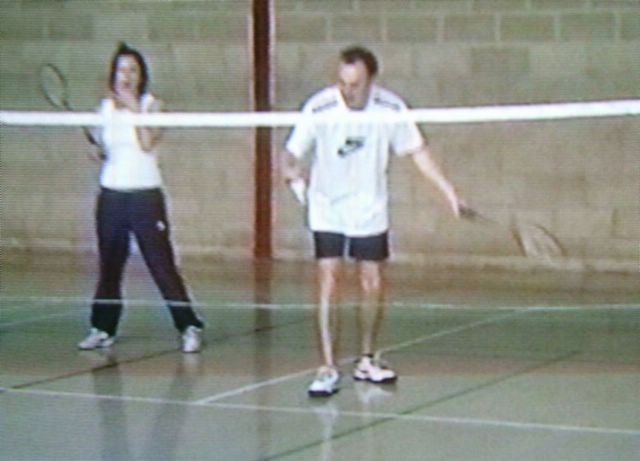
Gareth and Jo face the sun, but win anyway.
The first game had all the ingredients of a classic encounter – rapid rallies, stunning smashes, deftly deceptive drop shots and me hitting my wife in the face with the shuttlecock. Luckily for her (and me) I was hitting a backhand and I was only trying to hit it back to Jo after a point had finished. I broke my own apologising rule. It was the beginning of the end. Gareth and Jo took the game, 15-11.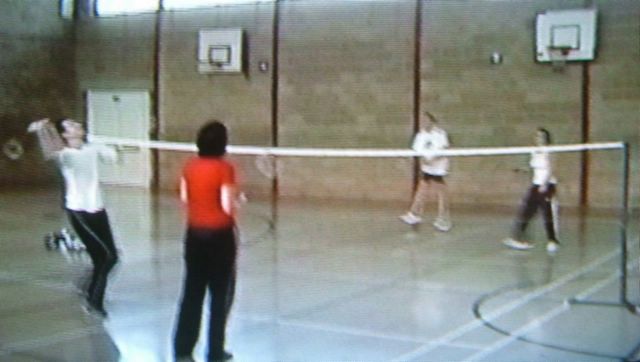
Despite her superior talent, Katie (modest as ever) lets me try a smash.
In the second game, as Katie got into her stride and took a controlling hold of things, we fared much better. There were some exciting rallies, which Emms and Robertson themselves would have been proud of, as the game rushed to a nail biting conclusion. Hutton and Forber made a last minute comeback, but in the end, we held on to win 15-13 and take the match into a final set.
We carried our momentum on as we rushed to an early lead in the final game. Again, I slipped into smugness. We were several points up and had the light at our backs. Jo’s serve had turned into smashing practice, and Gareth seemed to be lacking my killer instinct (i.e. wasn’t being as much of an idiot as I was). My smugness rapidly began to evaporate as the opposition mounted a comeback.
At 12-12 in the final game a long period ensued during which the serve changed hands at least a dozen times without any actual points getting racked up. The focus shifted from winning to not losing. It was tense. Well no, I was tense. The others seemed to be enjoying themselves.
Gareth resorts to his favourite drop shot as Katie and Jo admire his form.
The end, when it finally came, was embarrassing – not so much because I put an easy smash into the net to give Gareth and Jo the match, but more because I then thrashed the net with my racket, exhibiting perhaps a tad more vehemence than was called for. More work required on the “it’s not the winning, it’s the taking part” philosophy I think.
Big thanks to my partner (in life and mixed doubles) for playing so well and putting up with my tantrums when I don’t win (in both arenas). Thanks also to Gareth and Jo for teaching us a lesson, and especially to Timo for filming the whole thing so adeptly.
Having now finished the badminton and the table tennis, there is really only the tennis left that I can play without some specialist help. While I set about contacting sports associations and governing bodies seeking that help and advice about having a go at their sports, I intend to do something I believe athletes refer to as “training”. It’s a new concept for me – running when there isn’t a race or a threat seems very odd – but we’ll see how it goes.
Result of Badminton – Mixed Doubles
Gareth Forber (GBR) & Jo Hutton (GBR)
beat
John McClure (GBR) and Katie McClure (GBR)
15-11, 13-15, 15-13
Badminton - Mixed Doubles Preview
Britain, in the shape of Gail Emms and Nathan Robertson, won a silver medal in the mixed doubles in Athens. It was a thrilling final, watched by a very noisy British contingent (of which, our very own John Adams was one – he’s the one on the far end of the group (six from the left) – the guy in the cowboy hat is Soz, also known as the ubiquitous Ultimate Olympian comment-poster, Swiss Toni). Culturally, it was a giant leap forward for Britain as a whole.
Although it may not feel like it when you’re driving around this green and pleasant land, we are a nation of polite and deferential gentlefolk who wouldn’t say boo to a goose, so to come so close to winning a gold medal in a sport that requires one to be frankly rude in not apologising to one’s partner is quite an achievement. I have mentioned before the importance of not apologising when playing doubles – this was almost (but not quite) possible to do when I had Gareth next to me, but I suspect I may find it much harder tomorrow morning when I line up alongside my wife.
History is littered with examples of mighty husband & wife teams – Paul and Debbie McGee, Richard and Judy, the Krankies – so it is in illustrious footsteps we will gingerly tread as we carry the weight of history with us to the Peers Sports Centre at 10:00AM tomorrow. Gareth Forber and Jo Hutton provide the opposition, but they’re not married, so we should be fine.
I’ve played some mixed doubles before, but never with Katie. I can only assume from the state of her racket (retrieved from the attic at her mother’s house during the week) that she is either a ferocious player with incredible and terrifying power, or that she got really bored the last time she played and ended up eating the grip off her racket.
I’ve never seen Jo play either, although I’ve heard on the grapevine that she has a PhD in badminton studies, so I’m expecting great things. If she can offer the sort of feisty, controlled aggression on the badminton court that she displays when talking about her sister’s taste in men, we could be in trouble.
Timo Kindred (Sascha’s twin brother) is coming to stay this weekend and was pencilled in to partner Jo, until he remembered that he has only recently had surgery on his knee. He very sensibly relegated himself to official cameraman, and Gareth has come to the rescue to make up the numbers.
My main priority is not to injure anyone. When I played with a club last winter, a week would seldom pass without someone (although, strangely, never me) accidentally sending a shuttle or racket careering into one of the female players. In general, this doesn’t hurt that much, so it shouldn’t be anything to feel overly guilty about, but when you’re not allowed to apologise…

Table Tennis Review
Smoking is a really disgusting habit. Even smokers will concede that for the most part they don’t enjoy smoking, but they keep doing it, because, every so often, it’s just glorious. It’s that every-so-often that still haunts ex-smokers like me years after they’ve stopped; that moment after a warm day on the golf course when the first mouthful of cold beer hits the back of your throat and you briefly think that life would be perfect if you could only set fire to some dried leaves and inhale the smoke.
Eastenders is also a really disgusting habit, although much less likely to give you cancer. Night after night you keep watching it even though you know in your heart of hearts that it’s rubbish. Partly you watch because familiarity in this case breeds not contempt but a sense of belonging, and partly you watch because it reminds you that no matter how hard your day has been, its very unlikely to have been as miserable as Pauline Fowler’s. But you also watch because the odd time (increasingly odd these days by all accounts) they get it exactly right. From somewhere they produce a decent script and you realise at the end of half an hour that, for most of it, you managed to suspend your disbelief and you actually cared what was going to happen next.
Table tennis isn’t quite as habit forming as smoking or Eastenders, but it has its own little way of sucking you in. Like many sports, the participants spend most of their time failing and only a very small proportion of it pulling off the kind of shots that float like dreams through their imaginations. For every ludicrously difficult smash from ten feet behind the table that somehow gets just enough topspin to stop it missing the table, but not enough to make it dive into the net, there have been any number of failed attempts and containing shots.
The game’s timing tends to be impeccable. It’s when you’re at your lowest ebb and beginning to get frustrated with how incapable you both are of stringing together a decent rally that one arrives and makes you both smile and laugh with each other (no matter who won the point) like a couple of little children watching and believing a magic show. The ball does things you hadn’t expected it capable of, and your body reacts faster than you’d known it could.
It’s a game that requires both patience and talent in greater measure than I posses to be truly exciting. John Adams has a penchant these days for referring to things he likes as being such-and-such “of the gods” – during all our table tennis exploits, we produced just one rally that made him look into the video camera and proclaim it to be “table tennis of the gods!” And they must have had a hand in it, because I’m fairly sure that neither of us is half as good as we’d need to be to produce again the kind of form we found in that one lonely moment.
I will play again I’m sure – I own a bat and it’s not exactly an expensive habit – and I will watch with refreshed appreciation the efforts of the pros on the TV. It’s a good game, and I’ve enjoyed this leg of the challenge a lot, but I won’t be falling asleep tonight longing to be the next Jan Ove Waldner.
If At First You Don't Succeed...
Last week, we played a table tennis match (best of five) and it didn’t count. This week, John Adams and I rattled through another match (best of seven) in about 15 minutes as our doubles opponents looked on, busting at the seams to get in on the action. Last week, John beat me in a five game thriller, but the result failed to stand on a technicality. This week, I beat him in a six game sprint, and the result will stand regardless of the malignant chatter from the audience about the legality of my service action and the quality of the ball being used.
With the singles out of the way, the path was clear for the main event of the evening - the men’s doubles. This epic nearly didn’t happen. Through the course of the day I struggled to find a fourth player. In the Olympic spirit, I strove well, but failed to conquer. In the end, we were spared another wasted trip to the table by a virtual stranger – or a virtual friend to be more exact.
Huw Morris saved the day. Until he strode up to me and introduced himself last night, I had known him only through his postings to Sportsfilter.com as the mildly disgruntled West Bromich Albion fan (is there any other kind?) using the screen name Salmacis. Having seen this website, he realised he lived just round the corner from the venue and volunteered as official photographer for the evening. Fortunately, he got my last minute e-mail before he left the house and brought his trainers as well as his camera.
After some confusion over who was left-handed and who wasn’t, it was decided by mutual consent that John and I would face Rob and Huw.
If playing doubles in badminton requires a degree of mutual understanding and consideration, then playing doubles in table tennis requires a degree in mathematics just to work out who should be standing where and who’s next to serve. Unlike badminton or tennis, where one half of the partnership could theoretically hit nothing but his own serves for the entire match, the workload is more evenly distributed in table tennis. If you hit two of your side’s shots in a row, the point is lost.
Getting out of the way is a hard skill to master – especially when you’ve just spent a quarter of an hour playing singles. On numerous occasions through the course of the match, I prevented John playing some exquisite shots simply by not realising until it was too late that I was standing between him and the ball. John on the other hand (polite, deferential Englishman that he is) didn’t once get in my way.
Having discovered the necessity to possess this difficult skill, I am amazed that the Asian nations are so good at table tennis doubles. I can only conclude that those who are good at staying out of the way also stay at home to practice their table tennis, while those who aren’t, come to Oxford to wander around looking at old buildings in front of me when I’m on my lunch break.
For a man who didn’t know he was playing until he arrived at the table, Huw played very nicely. He figured out my serve quickly enough that I had to try and change it halfway through the game, with messy consequences. Rob’s form was as I’d expected it would be. A word of warning to anyone playing anyone at anything – if the phrase “I used to play all the time, but I haven’t for over a decade” is used, beware.
Children play sport with a sense of discovery and careless abandon that can be very hard to beat. Adults playing a game (that they used to enjoy) for the first time in a long time exhibit a similar sense of rediscovery and excitement in their play as they journey out to their limits. In time, once they reach their limits and realise that they have contracted somewhat over time, they can become tentative and cagey – they stop playing and start working on their game. But on the way out, it’s all flourish and exhibition.
So it was with Rob. You could see his experience in the way he played, even if it was thinly concealed behind years of sitting at a desk and a particularly hopeless hired paddle. More than the rest of us, he looked like he knew what he was doing. He was trying to hit good shots, while the rest of us were just trying not to miss.
In the end though, all his talent couldn’t outshine the surface of the rubber on his bat, and John and I managed to eek out a victory. With the end of the game came the end of the table tennis leg of the journey; many thanks to John, Rob and (especially) Huw for playing with and against me. I’ll be playing badminton mixed doubles on Saturday morning, and then it’s on to tennis of the table-less variety next week. Four down, one hundred and twenty-four to go.
Rob and Huw celebrate avoiding the whitewash having just closed the gap from 3-0 to just one game.
Result of Table Tennis – Men’s Singles:
John McClure (GBR) beat John Adams (GBR)
11-5, 13-11, 11-13, 8-11, 11-9, 13-11
Result of Table Tennis – Men’s Doubles:
John McClure & John Adams (GBR) beat Robert Simmons & Huw Morris (GBR)
11-5, 11-7, 11-9, 9-11, 9-11, 11-8
Table Tennis - Men's Doubles Preview
Tonight we return to the Peers Sports Centre to play the table tennis doubles, and to replay the singles match John and I didn’t quite manage to pull off last week. The line-up of participants has not yet been finalised, but one player who will certainly be making his debut in the Olympic challenge is Robert Simmons. He’s a director of the company I work for, and pretty much everything I produce for work passes under his nose before it goes out the door. I suppose I’d have to call him my boss.
I’m not reluctant to call him that because it isn’t the case (he is my boss), or because he adopts the ridiculous “Call me Rob!” position of the wannabe down-with-the-kids teacher everyone has had to suffer at least one of in their school years. We do call him Rob, but only because that’s his name, and not because he asked to borrow the latest Nirvana album as he had heard it really “spoke to people of our generation.”
I am reluctant to call him my boss here because I hate to cede anything to anyone in a sporting context, and I don’t want him to read this before we play and get the idea that he’s going to be able to boss me around on the table tennis table.
Before I played badminton with Gareth against John and Will last week (to aid my fitness rather than to tick anything off the Olympic list), there was some discussion about whether or not we should retain the same partnerships as we had established the week before. During that discussion, as Will pondered our relative strengths and weaknesses aloud, I told him that he should bear in mind that whatever was going on, I’d always want to beat him more than he’d want to beat me.
I didn’t say that because I dislike Will; on the contrary, I find it hard to imagine anyone taking exception to someone so affable. I said it because I’m too competitive about certain things. Like everything.
I grew up playing golf. I don’t know how many matches I have played in my life, nor can I remember their results, but I’d guess that I’ve probably won about as often as I’ve lost. I have beaten people whose talent was (and remains) far beyond my own, and people I should have been able to dispatch left-handed have beaten me. But I can count on the remaining functioning fingers of my right hand the number of times I’ve been beaten by someone because they wanted to beat me more than I wanted to beat them.
My friends joke about it quite often when we line up to play a bit of table football or go to the bowling alley. I play along, laugh at myself and pretend that really I’m just playing up to the characteristic they have attributed to me. But, if the truth be known, on the inside I’m as gutted as I was when Michael Thomas scored for Arsenal to deprive Liverpool of the league title in 1988/89 when their little plastic man on a stick kicks the little rubber ball past my little plastic man on a stick to win the game.
I don’t care about table football – it’s an irritating game that favours players with talents I don’t desire to acquire – but I really don’t like getting beaten. At anything.
In my calm moments, away from any arena that could be construed as competitive, I am well aware of all that this character trait says about me as a person. I am mildly concerned that if and when we have children, I will turn into the oft-lamented ‘competitive dad’ – a stereotype I despise almost as much as the aforementioned down-with-the-kids teacher. I know that very little in this world is truly worth getting competitive about and that no one will die because I couldn’t knock down more pins than you. But, when the game begins, that won’t matter anymore and I’ll still want to beat you more than you’ll want to beat me – even if you are my boss.
My mother, in her fervent desire to have her children share her love of all things French, would often wander around the house reaming off a passage of that beautiful language that she had been taught at school:
”Le plus important aux jeux Olympiques n’est pas d’y vaincre mais d’y prendre part, car l’essentiel dans la vie n’est pas tant de conquérir mais de bien lutter.” *
Which, roughly translated, means:
“The most important thing in the Olympic games is not to win but to take part, because the main thing in life is not so much to conquer but to strive well.”
It would seem I have a lot to learn.
* This quote was obtained from the woman herself, with the spelling subsequently confirmed by SMS, so it should be pretty much on the money. That said, she does often refer to herself in that medium as my “nun” and has been signing off from text messages “wowo” instead of “xoxo” for a year and a half now.
False Start

I'm sure I'd be better at this game if they raised the table by about 18 inches.
Table Tennis – Men’s Singles – Peers Sports Centre, 29th September 2004, 8:30PM
The table is much smaller than I remembered, especially when it is set up (as it was) in the middle of a badminton court. It’s not nearly big enough to play tennis on. We warmed up for five minutes. I wonder if maybe the top players prefer to warm up with someone other than their opponent. I found myself beginning to spot patterns in John’s play after only a few rallies. Jan-Ove Waldner described the game in a recent interview as being like chess, but faster. I could see what he meant.
In the end, fast doesn’t even begin to describe it. We started playing at 8:36PM. By 8:50PM, John was dancing his victory dance for the camera having won a five set thriller. Less than fifteen minutes. I wonder how that compares to the average match time for the experts. If anything, they should be a bit quicker as I’m sure they don’t have to go running across two adjacent badminton courts to retrieve the ball, apologising to the badminton players all the while, every time they miss the table completely.
Even under the old scoring format, table tennis was a game of momentum; a few points lost or won in a row could form a vicious or virtuous circle leading to defeat or victory. Now, with each game being played to 11 (rather than 21), there is even less time to mount a recovery if momentum starts to swing away from you.
In theory, this shouldn’t really be the case – not at our level of play anyway. Serving in our game is no real advantage – even if we were good enough to disguise what kind of spin we were putting on the ball, there would be no need to do so as neither of us are good enough to have read the undisguised spin in the first place. As such, each and every point is pretty much up for grabs. Being 10-0 to the good or 0-10 behind shouldn’t make a bit of difference to the point or how you play it, but it does.
The mind plays a massive role in what’s going on. When you’re on a roll and winning points hand over fist, you almost chant out the score like a mantra as it ticks along in your favour. When your opponent is on a roll, you want to do all you can to disrupt the rhythm of what he’s doing. When you gain the cushion of a few points you feel free to play more committed shots, but when you are trailing by a few points, you get tentative. Tentative doesn’t work in table tennis.
This is how stupid you look when you get tentative.
However, as it turns out, our five set thriller (which John won 5-11, 11-6, 11-9, 11-13, 13-11) counts as nothing more than a warm up. At the insistence of my boss (thanks Rob) I checked my facts this morning to discover that the BBC’s guide for beginners got it wrong. Olympic table tennis matches are the best of seven sets, not five. I blame whoever wrote the guide on the BBC website, but I also blame my opponent. Less than an hour before we played last night, he was showing me photographs of himself sitting in Athens a month ago watching the Olympic table tennis semi-finals. You’d think he might have noticed that the matches were decided over seven sets.
Of course, I’m joking and the blame lies squarely at my own feet – as the organiser of this ridiculous escapade, the buck stops with me. I’m just glad I made this mistake about an event that will only take 20 minutes to replay and not one that took all day to complete and months of training beforehand. Imagine that, the day after running the marathon, “What do you mean they’ve changed it to 28 miles?”
Result of Table Tennis – Men’s Singles
Null and void. To be replayed next week (probably on the same night as the doubles).
Injury Time
Last night, I played badminton again (doubles, with the same personnel as last week), not to fulfil anything from the Olympic list, just for fun and to increase my overall level of fitness. At one point I lunged to pick up a drop shot and my left kneecap hit the floor slightly harder than I would consider ideal. It hurt a bit at the time, but quickly wore off as I played on. This morning, it’s a bit stiff and a bit bruised.
Last week, my right wrist, elbow and bicep ached a bit for a few days after we’d played. This morning, they’re all sore again. The bicep is sore in a good way – sore in a way that suggests that my arm is building muscle mass – but the elbow and the wrist are sore in a niggling “I’ll snap if you push me too hard” way that is slightly unnerving.
I had to see my doctor a couple of weeks ago about something else entirely, but I told him of my Olympic plans while I was there. He visibly winced. I was surprised by his reaction, which I interpreted at first as an indication that he didn’t think I was up to it physically. I'm no Lance Armstrong, granted, but I'm not exactly hugely out of shape.
It turned out that his concern was based more on my propensity to get injured than on my propensity to eat too much junk and not exercise. He cautioned me, quite gravely, that I ought to warm up very thoroughly before every event. He reminded me that even the best athletes in each of the sports get injured regularly and that, as a novice in most of them, I’d be even more at risk.
It struck me then that my timeframe for getting this done is probably tighter than I tend to imagine. I think of myself as being on schedule at the moment. This is day 32. After tonight, I will have completed 3 events – just inside my required rate of one every 11¼ days. But that rate makes no allowance for time I may have to spend recovering from any injuries I suffer – and, given my track record, it’s probably safe to assume that I’ll do something to myself at least once a year between now and 2008.
So I’ve revised my schedule a bit. My new goal is to complete one event per week. This is week 5 of 206. Once I’ve thrashed John at table tennis tonight, I will have 201 weeks left in which to complete 125 events. If I manage one a week, that would give me 76 weeks (or just over a year and a half) of injury time – almost as long as Manchester United get to score an equaliser at the end of a home game.
Table Tennis - Men's Singles Preview
Week 5 (of 206) and I’m switching sports to table tennis in the third leg of what I’m now thinking of as my leisure centre section. Tomorrow night I will face the mighty John Adams in the palatial surroundings of the Peers Sports Centre. As with badminton, I have played a bit of table tennis over the last couple of winters, although I have yet to try out the new scoring/serving system.
Under the old rules, each set was played on a first to 21 points basis, with the serve changing ends after every five points. The new rules feature a shorter set format (first to 11) and the serve now changes ends after every two points. Matches are decided over five sets. If you want more details of the technicalities, check out the BBC’s beginner’s guide to table tennis.
Table tennis was never a demonstration sport in the Olympics. It made its debut as a full medal sport in Seoul in 1988. As I was with badminton, I’m surprised at how relatively recently it was included in the Olympic programme. The current men’s singles Olympic champion is Seung Min Ryu of Korea. He became only the third non-Chinese player to win a medal in the men’s (singles or doubles) events in the game’s Olympic history.
One of the others, Jan-Ove Waldner of Sweden, the men’s singles champion in 1992, beaten finalist in 2000 and a semi-finalist in Athens, is a legend of the game. He can wander the streets in Sweden without causing much of a commotion, but he can’t leave his hotel without getting mobbed when he goes to play in China. He is expected to retire after the world championships in Shanghai next year.
Table tennis is one of those games for which a lot of people I know have volunteered their services as an opponent. It seems to inspire a similar wistful look in everyone; a look that suggests memories of playing on holiday, and maybe even winning the campsite competition. Lots of people fancy themselves as being “handy enough” at table tennis, but the truth is that a professional could very quickly make even a decent part-timer look like a total fool.
The general perception is that a high level of fitness isn’t required to play this game. While that may be true, the men and women who play it well are among the fittest athletes on the planet. Neither John nor I quite sneak into that elite class at the moment, but we are fairly evenly matched so we should have a good game.
In other Olympic news – I’d like to offer enormous congratulations to Sascha Kindred, who has been adding to his medal haul in the pool in the Paralympics. He won gold in both the 200m individual medley SM6 and the 100m breaststroke SB7 (setting a new Paralympic record in the latter). He is the world record holder in both events and was defending the titles he won in Sydney four years ago. He also put in a stunning final leg to help Great Britain grab a bronze in the 4 x 50m freestyle (20 points) relay.
I’ve never met him, but his twin brother (Timo) is a good friend and a keen sportsman who will no doubt be featuring in many of the events I have to complete over the next four years.
Double Trouble

Gareth looks on as I take John and Will to task, virtually single handedly.
Badminton – Men’s Doubles – Blackbird Leys Leisure Centre, 23rd September 2004, 7:00PM
I’ve always thought that I prefer individual sports to team events. I was born and raised as a golfer – a sport where being on your own tends to be the rule rather than the biennial exception. I played team sports at school (hockey, rugby, cricket) and I enjoyed them, but I could never understand the people who trained really hard to try and get good at them. What was the point? You could bring yourself to a state of near-perfection to then have all your efforts rendered meaningless when the weakest player dropped the ball in the last minute to cost you the match.
Ask people to name the greatest sports people of all time and they give you boxers, athletes, tennis players, cyclists, swimmers – inevitably Pelé and Best get a mention, but only because they were known as exceptional individuals, rather than good team players. The message I always garnered from that was that to be great, you had to be on your own.
Doubles represents a special kind of team challenge. Blame for failure cannot be easily swallowed up by an entire team – if it wasn’t your partner’s fault, it was yours. There is an unwritten law in doubles of any description that most people adhere to: don’t apologise. The assumption is that you’re trying as hard as you can, and that you’re sorry for any mistakes you make, so no need to spend the whole match saying so.
Last night, Gareth and I took on John and Will in the second event of my Olympic challenge, the badminton men’s doubles. For the first time in many years, I enjoyed playing as part of team. Perhaps it was because I know Gareth well enough to know that he wanted to beat our opposition probably about as much as I did (not through any ill feeling, just because we both hate to lose).
BB King once said in an interview that a big part of living a happy life was not only to help other people, but also to let other people help you. Doubles is a bit like that sometimes – it feels good to play well, but it can also feel good when your partner steps in and supports you when you make a monkey of it all. It also feels good that in the end the result belongs to both of you, no matter who played well and who didn’t.
Doubles in badminton is also fun because you don’t end up feeling like you might die by the end of each game like you do in singles, even though the sports hall was somewhat hotter than would be considered ideal last night.
In the end, perhaps sport is more about sharing than it is about being alone. Perhaps the magic lies in two or more people suddenly working together as though controlled by a single mind. I wouldn’t say that Gareth and I are quite at that level just yet, but we had our moments, and we did manage to sneak a win.
Result of Badminton – Men’s Doubles
Gareth Forber (GBR) & John McClure (GBR)
Beat
Will Clapton (GBR) & John Adams (GBR)
15-9, 12-15, 15-2
Alternative Olympic Disciplines
It occurs that there are a few unofficial Olympic disciplines I perhaps ought to try in the next four years if I am to truly enter into the spirit of experiencing the full Olympic spectrum.
1. Getting the Olympic rings tattooed on my upper arm
These days, it seems, you aren’t fully part of your country’s Olympic team until you have had yourself branded in this fashion. I first noticed it going on in Sydney in 2000, but I’ve since seen the odd multiple Olympian bearing the marks of all the games in which they have taken part.
2. Being interviewed by an inarticulate former athlete about how I’m feeling
This interview must take place at least a week before I compete in the event to which it relates and must contain endless platitudes and baseless speculation about my chances of getting a gold medal.
3. Providing a sample for a drugs test
From what I’ve read, the process itself is a lot more complicated than the rules of some of the sports. Also, I have nothing but admiration for anyone who can “perform” in front of such a closely watching audience.
4. Providing a ridiculous excuse for missing a drugs test
History is full of many excuses from which to choose (although it offers few that actually worked). The real challenge would be to come up with something truly original. The dog ate my test tube… and my sample ran in the rain on the way to the testing facility… after I fell off my motor scooter… that was being driven by the dog.
5. Performing a lap of honour
No longer a woolly tradition designed to acknowledge the support of the crowd, the lap of honour is in danger of becoming an event in its own right. Points will be awarded for the number of flags carried, babies kissed and photographs posed for, with the total being multiplied by the overall time achieved (the longer the better, obviously). Special bonus points can be gleaned for congratulating other athletes who are receiving medals on the podium as you pass.
6. Lodging a protest at the end of the event and gaining a better medal as a result
In Athens, the lawyers had as much to do with the outcome of some events as the athletes. It must be bizarre to receive one’s gold medal in the post along with a stamped, addressed envelope and a note beseeching you to forward the silver to the current holder of the bronze. It’s like one of those chain letters that never works.
7. Shedding a tear at a medal ceremony
I suspect few people remember the final race of the coxed pair in 1992 when Gary Herbert coxed the Searle brothers to victory in Barcelona, but more will remember his reaction at the medal ceremony. Bless him.

Badminton - Men's Doubles Preview
A week since my first outing, tomorrow night sees my second assault on the mountain of Olympic events to be completed before Beijing 2008. I’m playing badminton again – doubles this time – at the same venue; the Blackbird Leys Leisure Centre.
Last week, I let Gareth beat me in the singles. This week, we will join forces to take on John Adams and Will Clapton, two colleagues from work. Gareth is left-handed. In theory, that should make it harder to play doubles with him as our forehands attack the same area of the court, but in practice, we played quite well the odd time we were paired together last winter.
John plays badminton like he plays most sports I’ve seen him tackle – with an unbounded enthusiasm and quiet determination that tends to negate any lack of technical ability. He’s the sort of player (of any game) that you’d back yourself to beat and then get stung by. He’s like the Terminator; he absolutely will not stop until you are dead.
Will is an unknown sporting quantity. When he joined the company a few months ago, I snuck a look at his CV, wherein it is proudly stated that Mr Clapton once played junior county badminton. Since accepting the invite to play tomorrow, he has barely missed a chance to point out that he hasn’t played for some time and that he’s not as good as he used to be. Time will tell.
I’m hoping that (in theory) only having to cover half the court in doubles means that I won’t feel quite so sore this Friday and Saturday as I did last week – although, if the truth be known, I can bypass my greatest source of pain from the last game simply by wearing a different shirt – one without a nipple-rubbing emblem on the chest.
Let the Games Begin!

Poised... ready to strike.
Badminton - Men's Singles - Blackbird Leys Leisure Centre, 16th September 2004, 8:00PM
Watching the badminton at the last Olympics, I was surprised to learn that the players get five minutes to rest between games. That seemed like far too long to me; surely one would be in danger of tightening up a bit? Besides, it’s not that hard going, is it?
Last night, having just snatched victory from the jaws of defeat in the first game (15-13), I was in dire need of more than just a five-minute sit-down. A quick blood transfusion would have gone down a treat for example. I didn’t measure it terribly scientifically, but, at a rough estimate, my heart was beating twice as fast as it usually does when I’m sitting watching badminton on TV. It was also beating somewhat more vigorously than usual too; so much so in fact that I could hear it.
The sweat was pouring out of me at a frankly disgusting rate and from places I didn’t even know I had pores. In my wisdom, I’d opted for a long-sleeved shirt. If I had brought a pair of scissors, I would have cut the sleeves off without a second thought.
I was so tired because I move so fast.
My opponent, Gareth, twitched about and asked if I was ready to begin the second game. I could barely catch my breath for long enough to tell him that I was entitled to five minutes between games. “That’s far too long, you’ll stiffen up.” He could clearly sense my distress and was eager to take advantage of it (he’s good that way).
I set up the video camera under the middle of the net to record the odd moment of glory (or the odd blooper) for posterity. During the early stages of the first game I was very chirpy and played the fool for the camera now and then – by the midway point of game two, I had become somewhat subdued. Sweat kept dripping into my eyes and stinging them, to the point where I could hardly see the camera anymore, let alone play to it.
I realised quite soon that my only chance of winning the match was to win the second game, as I wasn’t going to have much left for a third. I also realised that, from 6-13 down, that was going to be tricky. I gave up. Gareth won 15-6. One game each.
We rested for even less time between the second and final game (Gareth scented blood). What time we did spend changing ends was filled with jokes about how I was going to fare when it came to the rowing if I was in this bad a state after two games of badminton. Needless to say, I found that hilarious.
The footwork has gone as I resort to just standing in the middle of the court and reaching.
The key moment of the match came in the final game. At 3-8 down and struggling mightily, I got the serve back. My competitive juices flowed once more and I steeled myself to go on the attack and reclaim the match. Then a little voice popped into my head with a word on the bigger scheme of things. “This is the first event of 128. You don’t need to win for it to count, you just need to not die.”
And that was the end of me. I tried to dismiss the notion that winning wasn’t important for as long as I could, but in the end, the desire to not have a heart-attack was stronger than the desire to beat a friend in a game of badminton. I capitulated like Jimmy White in a Crucible final and lost 15-8 in the final game. Then I more or less collapsed on the floor.
I read in an article somewhere yesterday that a badminton player can cover around 6km during the course of a match. The article mentioned surprisingly little about ending the match feeling as though you’d been forced to go twelve rounds with Lennox Lewis... in a sauna... whilst wearing an overcoat.
Badminton singles is a tough game, and I’m in worse physical shape than I thought I was. Somehow I’d expected that all this sitting around watching and thinking about sport would have gotten me reasonably fit by now. On the upside, I'm nowhere near as sore and stiff today as I thought I would be. At least I survived. Only another 127 events to go.
Result of Badminton - Men’s Singles
Gareth Forber (GBR) beat John McClure (GBR) 13-15, 15-6, 15-8
Badminton - Men's Singles Preview
Let the games begin! Tonight, at eight o’clock, the quest begins in earnest with the badminton men’s singles due to take part at the Blackbird Leys Leisure Centre – a humbler beginning is hard to imagine.
Yesterday, I bought some brand new shuttlecocks – that was an education in itself. I had thought the decision as to what type to buy was pretty much limited to nylon or goose-feather, with the former aimed at the recreational player and the latter at the aspiring superstar. Of course I had chosen the goose-feather ones before even venturing out to the shop.
However, when I got there, I was faced with a choice of five different “grades” of goose-feather. In the end, I felt sorry for the poor old geese deemed rubbish enough to provide only the lowest grade of shuttlecock feather and plumped for the cheapest ones. I had no idea it was such a complex issue.
While I was in the shop, I picked up a new grip for my racket too. It doesn’t really need one, but somehow the packaging convinced me that my game would be improved almost beyond recognition by an additional 2mm of faux-leather between the existing grip and my hand. We shall see.
Badminton was a demonstration sport in 1972, an exhibition sport in 1988, and was granted full Olympic status in 1992 in Barcelona (is it just me, or is it impossible to say that word without hearing Freddie Mercury in your head?). The rules were first laid out in 1877 by the Bath Badminton Club, and the first All England Championships were held in 1899. The International Badminton Federation was founded in 1934.
Historically at the Olympics, the Indonesians, Koreans and Chinese have dominated the medal tables. Great Britain has only ever won two medals – both in the mixed doubles - Simon Archer and Jo Goode took bronze in Sydney in 2000, and (of course) Nathan Robertson and Gail Emms took silver in Athens in 2004.
The current men’s singles champion is Taufik Hidayat of Indonesia. He beat Shon Seung of Korea 15-8, 15-7 in the final in Athens. The top placed Briton was Richard Vaughn, who made it to the last 16.
My opponent this evening is my good friend, Gareth Forber. We played a fair bit of badminton against each other last winter, and we’re quite evenly matched, so I’m hoping tonight will make for a suitably exciting start to this ridiculous undertaking. And I’m hoping I win. Because I’m a bit like that (apparently).
In other news, I got my first official pledge of sponsorship. It had a strangely unsettling effect on me to have my sponsor form returned by e-mail with a pledge on it – I think it was the point at which I realised that now I have to actually follow through and do this. For the first time, excitement stepped aside for a moment to let trepidation sit down. Still, the running total has begun and stands today at £50. Thank you, Mark!
Where to begin?
The problem with such a large undertaking is that there seems to be no end to the number of different ways in which I could approach it. So spoilt am I for choice that there is a chance I could sit here forever trying to decide how best to begin and never actually do anything. Deadlines are what I need; otherwise the size of the task could get seriously unmanageable. I have no doubt that C Northcote Parkinson's famous assertion will hold true and that the work to be done will expand to fill the time allotted to it, but I need to get a move on all the same. My first deadline is the end of this piece - by then, I will have decided which event to tackle first.
I probably flatter myself to think that there are several events on the list for which I am already adequately skilled and adequately physically fit – perhaps a more accurate way to look at the situation is that there are several events on the list at which no amount of extra training, practice or physical conditioning will make me any better than I am now. I may not be fit enough or skilled enough to play international football (despite only being Northern Irish), but I can kick a ball and run around for 90 minutes.
Some events cry out immediately and obviously for a certain degree of physical conditioning – I can run along a road, but that doesn’t mean I could go out and do it for a little over 26 miles tomorrow morning. In all honesty, the 5,000 metres might present a fitness problem at the moment. Alright, so would the 1,500. And the 800 might be a bit tighter than I’d like to admit.
Other events require skills I do not yet have – the favourite question arises again; how does one learn to pole vault without breaking one’s neck in the process? For these events, I will need to find help in terms of instruction and (on occasion) in terms of finding and gaining access to the necessary equipment.
There are still other events that require both new skills and a much higher level of fitness than the one I currently lie about enjoying. I’m writing this from an apartment in the Canary Islands where I am on holiday at the moment. On our first day here, I made a rather alarming discovery when I leapt into the swimming pool. I am nowhere near as good a swimmer as I tend to give myself credit for.
I have become (if I was ever anything else) a recreational swimmer of the worst kind – I propel myself through the water using a strange combination of all four strokes, and only ever as far as is required to reach whatever inflatable item I have just failed to catch. It’s a sort of five metre individual medley combined with a brief moment of water polo before I forget to kick my legs and end up getting water up my nose. In short, when it comes to the swimming events, I am going to need some lessons as well as some fitness training.
Some events I perceive as having other accessibility barriers in addition to a lack of talent or physical prowess on my part, barriers that I expect may get lower the further into this quest I find myself. For instance, I suspect that it may be easier to convince someone to lend me a sufficiently talented horse (and teach me how to ride it) if this whole venture has already gained some momentum or the attention of the media.
Likewise, I anticipate a degree of trouble getting into sailing from a standing start. Both of these sports like to argue that their respective barriers to entry are not nearly as insurmountable as most people consider them to be – I hope to give them the chance to prove that.
There comes a time for talking and writing to stop and action to begin. That time is now. Well no, that time is next week really, but the decision about where to start has been made. I will make my first assault on the badminton events, of which there are three – singles, doubles and mixed doubles. I played badminton through most of last winter and in decent enough company that I now have at least a working knowledge of the rules. And I know how to get to the leisure centre.
One other important piece of news (in fact, really the most important piece of news) - having approached them to see if they minded me fundraising in this manner on their behalf, I’m delighted to report that the Sobell House Hospice Charity have given me the thumbs up. In time, I’ll no doubt write in greater detail about why I want to raise money for them, but in the meantime, if you want to learn more about what they do, you can click on their name above to see their website.
The List
Any athlete worth his salt has clearly defined objectives. We see this time and again as the winner announces that he has done what he “came to do” and the losers make feeble noises about having vaguely “done their best.”
The list below provides a clear definition of my objectives. I want to compete in all of the events contained in it. If you want to see what the IOC has to say on the subject, check out its list of sports on the Olympic programme. A few things that appear on the IOC’s list are excluded from mine.
I have divided the team sports into three categories.
The first category contains team events that have no equivalent individual event. The second contains team events that do have an equivalent individual event, but for which there is a significant difference between the two. The third category contains team events in which the team score or result is achieved simply by adding together the individual scores or results from the individual team members.
Confused yet? I will elaborate.
Category one contains events for which being part of a team is strictly necessary in order to participate in the sport – for instance, there is no such thing as individual football (or solo soccer, as the Americans would no doubt chose to call it); to play with a basketball is not the same as to play basketball, and to throw a ball across a field is not to have experienced a game of baseball.
Category two contains disciplines where the equivalent individual event is very similar to the team version, but there is enough of a difference between the two to merit the inclusion of both on my list – in the 400m, the athlete runs one lap of the track. In the 4 x 400m relay, four athletes run one lap of the track each in turn, but in between, there is the added skill involved of passing and receiving a baton.
Category three contains those team events where the team version is physically the same as the individual version in almost every respect – the only difference being that, in the team version, your score or result is contributing to a team total instead of standing alone. Essentially, these team events are duplications of their respective individual events, and as such they are coming off my list. The casualties are:
Archery (team event)
Equestrian (all three team events)
Fencing (all three team events)
Gymnastics (team event)
If the men’s rowing eight consisted of eight men sitting at individual rowing machines and then combining their times to produce a team score, then all the team rowing events would be in that list too. Conversely, if the team event in the equestrian show jumping consisted of William Fox-Pitt, Pippa Funnel and Leslie Law all mounting the same horse at the same time before trying to coerce the poor creature to jump over a scale model of the Great Wall of China, then the equestrian team events would come off the list (and probably go straight onto another list compiled by some animal rights activists).
I started with 136 events. Removing these team disciplines reduces the list to a mere 128 events. Less than a week into this four-year adventure and I’ve already dealt with 8 events. At this rate, I’ll be finished by Christmas.
I had trouble deciding where the line between team and individual lay in cycling - Lance Armstrong’s a hell of a guy, but he wouldn’t have won all the “individual” honours he has without the help of his US Postal Service team. For now, I have left all the cycling events in the list, but perhaps, when I come to do them, some kind-hearted cycling expert might take pity on me and let me off one or two of them to avoid repetition.
Some individual events also have team versions that require collaboration with a partner, but I am satisfied that there is enough of a difference between the skill involved in playing, for example, singles tennis and doubles tennis to merit the inclusion of both.
Other events require a partner but have no individual equivalent – the individual single oar rowing or the horseless dressage, for example, simply wouldn’t work.
Certain events divide their competitors according to weight. For these disciplines, I will only be participating in the category for which I am eligible at the time, rather than starving or binge eating as appropriate in a futile attempt to make the weight in every available category.
Some of the events I have done before; some I’ve never even seen on TV. Some I could do on the beach in my underwear; some require so much specialist equipment that it can be hard to know whether the winner was the best rider or just had the best bike. Some I’m looking forward to; some I’m absolutely dreading. Here they are:
Diving
10m Platform
3m Springboard
Synchronised 10m Platform
Synchronised 3m Springboard
Swimming
50m Freestyle
100m Backstroke
100m Breaststroke
100m Butterfly
100m Freestyle
200m Backstroke
200m Breaststroke
200m Butterfly
200m Freestyle
200m Individual Medley
400m Freestyle
400m Individual Medley
1500m Freestyle
4 X 100m Freestyle
4 X 100m Medley
4 X 200m Freestyle
Archery
70m individual
Athletics
100m
200m
400m
800m
1,500m
5,000m
10,000m
110m hurdles
400m hurdles
3,000m steeplechase
20 km walk
50 km walk
marathon
4 X 100m
4 X 400m
decathlon
discus
hammer
javelin
shot put
high jump
pole vault
long jump
triple jump
Badminton
singles
doubles
mixed doubles
Canoe/Kayak
Flatwater C-1 500m
Flatwater C-1 1000m
Flatwater C-2 500m
Flatwater C-2 1000m
Flatwater K-1 500m
Flatwater K-1 1000m
Flatwater K-2 500m
Flatwater K-2 1000m
Flatwater K-4 1000m
Slalom C-1
Slalom C-2
Slalom K-1
Combat Sports
Boxing (75-81kg)
Judo (73-81kg)
Taekwondo (68-80kg)
Freestyle wrestling (74-84kg)
Greco-Roman wrestling (74-84kg)
Cycling (Road)
Individual Road Race
Individual Time Trial
Cycling (Velodrome)
1km time trial
individual pursuit
team pursuit
keirin
madison
sprint
olympic sprint
points race
Cycling (mountain bike)
Cross-country
Equestrian
Dressage
Show Jumping
Eventing
Fencing
épée
foil
sabre
Gymnastics
floor
horizontal bar
parallel bars
pommel horse
rings
vault
individual all-round
tramploine
Modern Pentathlon
Triathlon
Rowing
single sculls
pair
double sculls
four
quadruple sculls
eight with coxswain
Sailing
board (mistral)
double-handed dinghy (470)
high-performance dinghy (49er)
multihull open (Tornado)
single-handed dinghy (Finn)
single-handed dinghy open (Laser)
star
Shooting
10m air pistol
10m air rifle
25m rapid fire pistol
50m pistol
50m rifle prone
50m rifle three positions
10m running target
trap
double trap
skeet
Table Tennis
singles
doubles
Tennis
singles
doubles
Volleyball
Beach
Indoor
Weightlifting
77-85kg
Team Events
Water polo
Baseball
Basketball
Football
Handball
Hockey