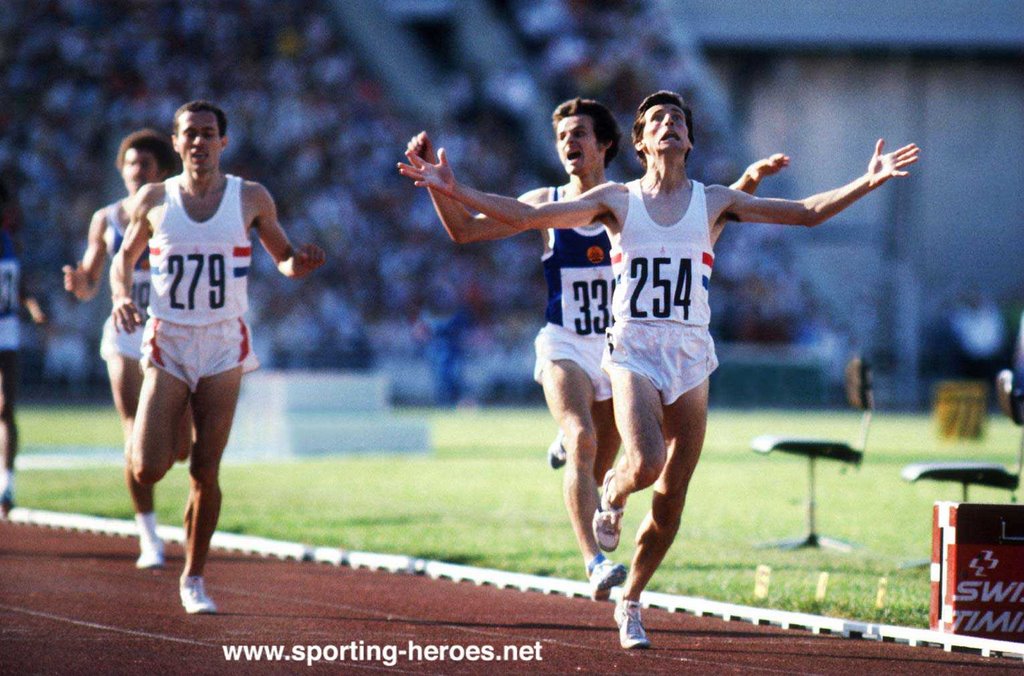
Seb Coe and Steve Ovett - a couple of 800m experts.
A mere six months after our first attempt at running the 800 metres (preview) turned into a very entertaining evening in the pub instead, Kev and I returned to the Iffley Road track last night to have another go at it.
This time, you’ll be delighted to learn, we managed to run the requisite two laps before retiring to the Marsh Harrier for a Guinness.
Kev is a bit of a runner. His three-marathon-challenge has turned into a four-marathon-challenge (three down, one to go), but as ever he offered to help me complete an event and came along to act as timekeeper, morale booster and opposition.
We did a couple of laps at a gentle pace by way of a warm-up and then, having pointed the video camera at the home straight and set it running, we pointed ourselves at the first bend and did likewise.
Unfortunately, video footage of two men running around a track at something less than a blistering pace – especially when you only get to see them for about a third of each lap – isn’t exactly riveting. Thanks to the Benny Hill feature on my iBook, I have managed to speed it up a little to save you the effort of watching it in real time.
At the end of the clip, Kev holds his phone to the camera. This is because he was using it to time us and not because Lord Coe had just text to say we were bobbins.
We set off together and remained so for about 200 metres, at which point Kev started drifting ahead. During our warm-up, my legs had felt full of spring and ready for action; almost as soon as we started running for real, they felt full of lead and ready for a bit of a sit-down.
We entered the home straight for the first time and Kev had already built up a reasonable lead. He was carrying his phone and using the stopwatch feature on it to time us. I guessed he was trying to drag me along at the pace I needed to be keeping in order to break the magical double-the-world-record barrier. As it turns out, he was just showing off.
He continued to show off into the second lap and I started fading fast. Halfway down the back straight, I felt something I haven’t felt since the early stages of the swim in the triathlon in 2005 – an almost overpowering urge to just stop and give up.
Proper athletes are astounding running machines with brains that focus sharply. As they come down the back straight in the final lap of the 800 metres, they are thinking about just one thing – when to kick for home – and everything else just sinks into the background.
The way I run is also astounding, but in the same way that a octopus falling out of a tree is astounding, and my brain has a tendency to wander wildly out of its lane at crucial moments. As I came down the back straight in the final lap, I was thinking about a million different things and none of them were even remotely helping me to keep putting one foot in front of the other.
I came off the final bend and into the home straight to see that Kev was nearly finished. I presumed I was a long way off the target time, but suddenly, inspired presumably by the realisation that it was all nearly over, I found a burst of energy in my legs and was able to run a little harder over the final 50 metres.
I finished and Kev was all cockney grinning as he imparted the news that I’d smashed the target time and run a mighty 03:02.01.
I quit smoking at New Year. Three months on and I’m feeling very good about that, and feeling very healthy because of it. For an hour after the race last night I coughed and spluttered and felt generally tight in my chest as though I had started again. It’s good to tick another event off (a mere 101 remain), and always nice to beat the target time, but the biggest lesson from last night is that I’m pretty hopelessly unfit again (if I was ever anything else).
Result of Athletics – 800 metres:
1st Kevin Game (GBR) 02:46.00 61% Olympian
2nd John McClure (GBR) 03:02.01 56% Olympian
Athletics - 800m
Baskets and Volleys
Basketball was invented in 1891 when Doctor James Naismith - a Canadian PE teacher at a school in Springfield, Massachusetts – famously nailed a peach basket ten feet up a wall and told his students to have a go at lobbing a football into it. In a moment of inspiration, he called the game Basket Ball. His new game was initially popularised and developed across the USA and Canada by the YMCA.
A little more than three years later, William G. Morgan - the PE director in a YMCA just ten miles down the road in Holyoke, Massachusetts - decided to invent an indoor sport for the older members that was less rough than basketball but that still required a bit of effort. Less prosaic in his naming technique than Naismith had been, Morgan originally referred to his new game as Mintonette, but the American public at large couldn’t cope with his fancy French-sounding name and quickly took to calling it what it looked like: volleyball.
Basketball was an Olympic demonstration sport as early as 1904, but was only fully adopted in 1936. Since then, the USA has won all but three of the Olympic titles; the first time they lost a match was to the USSR in the controversial final of 1972. In Athens in 2004, despite fielding a team with combined earnings that could have funded a reasonably ambitious space programme, the USA had to settle for the bronze medal behind Argentina and Italy.
Volleyball was a demonstration sport in Paris in 1924, but had to wait even longer than basketball before it made it into the full programme, which it finally did in 1964. Despite being invented in the USA, the Olympic competition has been dominated by the European (particularly Eastern European) teams. It’s a serious business in Europe it would seem; in Greece last week, the crowd got so excited at a volleyball game that a riot kicked off resulting in the death of one man and the suspension of all team sports in Greece for two weeks.
Thankfully, nothing so dramatic happened on Friday night. Once again, an Oxford University sports club came up trumps and the volleyball club sent along half a dozen top class players who were willing to give up their Friday night to show a bunch of complete novices how to play their sport. They did so with patience, understanding and kindness. Perhaps as a result – or perhaps because it’s just a damn fine game – everyone seemed to really enjoy the first event of the evening.
After Brian and Ludo took the lead in showing us some basic technique and outlined the rules, we split into two teams of mixed gender, race, height and ability to have a match. Ludo started trying to formulate some sort of game plan for our team, but in the end resorted to my favourite sporting technique – “Never mind… we’ll improvise” – and we were under way.
We fought three close sets, each of which was littered with entertaining and impressive play, but in the end my team finished a tantalising second. I got the distinct sense that the top guys weren’t giving us the heat, but I also got the sense that it was probably just as well.
A couple of the guys were genuinely enormous individuals. On the odd occasion when they did find themselves opposite each other at the net, it was like watching gazelles robbing a pogo stick factory. It wasn’t so much the height they achieved – impressive as that was – as the length of time they seemed to be able to stay airborne; a talent some of them hung around to transfer to the basketball court later on.
Kev (right) would be the first to admit that he's not the tallest, but Tim (left) is 6'5". I dread to think what that makes Anders (centre).
Having played basketball, I could see why William G. Morgan felt the need to invent volleyball as an alternative for the “older members”. Having only a handful of people who really knew what they were doing perhaps hindered us, but it seems a game in which a lot of frenetic action leads to very little.
I have watched some basketball on TV and thought at the time that it looked a bit dull - they all just run to one end and score, then all run to the other end and score. Our game was exhausting, but it wasn’t dull, even if by and large all we did was just run to one end and not score and then run to the other end and not score. The only dull bits from my point of view were the bits when I stood around the centre circle trying not to wheeze too much.
There wasn’t much ebb and flow to our score line – perhaps the teams turned out to be a little lopsided – but my team, hindered by my lack of pace, fitness and talent, quickly found itself adrift and ended up losing by a margin that was in the end virtually forgotten. All I can really remember is that we were 42-28 behind going into the final quarter, and it quickly became apparent that there wasn’t much need to keep track of the score anymore - there was only one team going to win and we weren’t it.
Ben, the guy behind me, spent the hour that followed this warm up showing me that height in basketball isn't all it's cracked up to be. Without him on our team, we would have lost by a lot more than we eventually did.
The disparity in the scores did allow for some top class showboating. The prize for comedy moment of the game has to go to Will whose attempted through-the-legs-lay-up went hideously wrong and resulted in him making a last ditch pass to a completely unmarked breeze block in the back wall. One technique I did pick up from Will was the look-one-way-pass-the-other-way dummy. It would have worked wonders when I tried it, had I had the least bit of coordination, or any real idea of where my teammates were.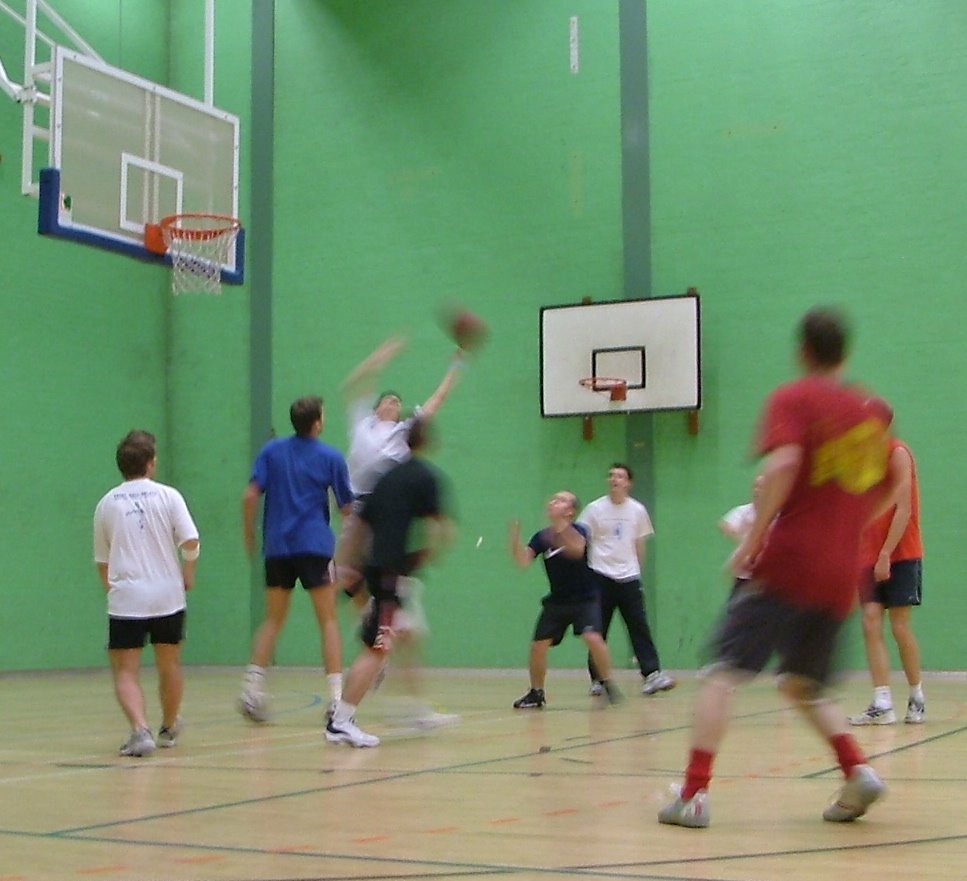
By the end of the game, despite spending most of the last quarter marking and being marked by an equally exhausted Rich Hughes on the halfway line, I was utterly spent. The basketball had been fun, but for those of us for whom the evening was presenting two relatively new sports, volleyball was the winner by a country mile. The pub was fun too, but then we all knew that anyway.
There are two questions I get asked a lot in the course of doing this challenge. One is “what’s your favourite event so far?” and the other is “are there any you have done that you want to do again once you’re finished?” After Friday night, volleyball is at the top of both lists.
Huge thanks to everyone from the volleyball club who came along to help out and then stayed to make up the numbers in the basketball. Thanks also to the legion of volunteers who came from far and wide (well, as far as Nottingham, and as wide as Simon) and helped make it a really fun night.
Volleyball
The Ultimate Olympian’s Dirty Half Dozen lost narrowly to Simon Bentley’s Screaming Spikes (25-21, 22-25, 15-11). Non-professional Man of the Match: based on sheer enthusiasm (two of his most impressive plays came while he was sitting on the substitute’s bench) the award has to go to Simon Bentley.
Basketball
The Ultimate Olympian’s Fearless Five had their asses handed to them by Will Clapton’s Dunking Donuts (65-35*). Non-professional Man of he Match: even though he only stayed for the first half, Michael “Air” Weatherhead, who is now officially annoyingly good at swimming, volleyball and basketball.
*score estimated later in the pub - may not be entirely accurate
Baskolleyball

Before I bore you to death with all the Olympic sport I haven’t done this week, get your diary out and make a note. At 7PM on Friday 30th March 2007 at the Oxford University Sports Centre (OUSC), there will be an Ultimate Olympian double bill.
The first event will be a game of volleyball, and the second a game of basketball. Details of who will be participating are sketchy at the moment, but if you want to be considered, regardless of your age, gender or ability, send an e-mail and I’ll put you on the list of hopefuls.
I’ve been in the gym and the pool a lot over the last week, but I haven’t ticked off any events yet. As ever, real life (as I believe it’s called) keeps getting in the way, but, thanks to Jessie at the OUSC, I have at least set a date for the Baskolleyball evening.
Making Waves - or not...

Saturday morning was supposed to be back to rowing porridge. I took it (relatively) easy the night before, got to sleep (relatively) early and leapt from my bed in the morning full of energy and ready to go. Sort of.
Even the pounding rain and gentle wafting of the gale-force wind didn’t put me off and I bravely battled across town for an hour to get to the boatyard on time. Once there, I was rather tersely informed that there wouldn’t be any rowing that day “obviously” because there was “too much water”.
I was disappointed (although the river did look particularly dirty and angry so I wasn’t entirely distraught), but I was awake and dressed for action, so I went to the gym instead and then for a swim. It would seem that Saturday morning is a very good time to do both of those things – both the gym and the pool were almost empty.
I went swimming again last night. This not smoking lark is great for the energy levels, but not so hot for the writing skills. I can hardly finish a thought.
The main purpose of this post wasn’t to update you on how little has changed since last I wrote, but to link to this amusing piece from NewsBiscuit. Go there and be entertained – there’s nothing of that sort to be had around these parts today.
Comeback Kid
Some of the more astute among you may have noticed that I have been absent from these pages for a while. As ever, I have excuses aplenty – I’ve been busy at work, I’ve been busy in the pub, it’s cold outside – and as usual, they are all rubbish so I’ll spare you. The long and the short of it is that I’m back.
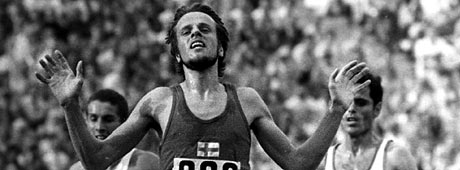
Looking for some inspiration, I discovered a sporting comeback that may be hard to top. At the start of the 1972 Munich Olympics, Lasse Virén, a 23-year-old Finnish policeman from the small village of Myrskyla, was not widely known. The heats of the 10,000 metres constituted his Olympic debut.
He qualified, but when he stumbled and fell just before the halfway mark in the final his chance of victory seemed to have gone.
The Tunisian Mohamed Gammoudi (who had won the 5,000 metres at the 1968 Olympics) tripped over Virén and gave up two laps later. But the Finnish runner calmly got to his feet and chased his way back into contention, overtaking Britain's David Bedford, the long-time leader, to not only win the gold medal, but set a world record of 27min 38.4sec.
Ten days later, he also won the 5,000m (in an Olympic record time) - a double that he repeated in Montreal in 1976.
You can watch the whole race in three parts [1, 2, 3] courtesy of YouTube, but if all you want to see is how badly he fell over, skip to three and a half minutes into Part 2.
I can't promise a comeback on quite such a spectacular scale, but I can promise a quickening of the pace around here. I'm going to need something to keep me occupied now that I've stopped smoking again.
Another False Start

I feel duty bound to point out that I didn't drink all of that.
Having been told by the nice lady on the phone the previous evening that the track would be free from 6PM until 7:30PM, I arranged to meet Kev (who now has a blog all of his very own) and Gareth (who I think of as “enthusiastic”, but Kev very rudely refers to as “loud”) there shortly after six.
Much to our dismay, we were unable to run in the end as the track was covered in some sort of unmoveable, slightly smelly, and largely unsightly organic matter. I think it’s called “students”, but I can’t be sure.
Unfortunately, we had to go straight to the pub.
Needless to say, after a few beers, it seemed like a good idea to head back to the track and see if we could squeeze in a quick race before they closed. Sadly, we were a little too late and not quite drunk enough to avail ourselves of the hole in the fence. There was nothing else for it but to head back to the pub and consider doing the whole thing again next week.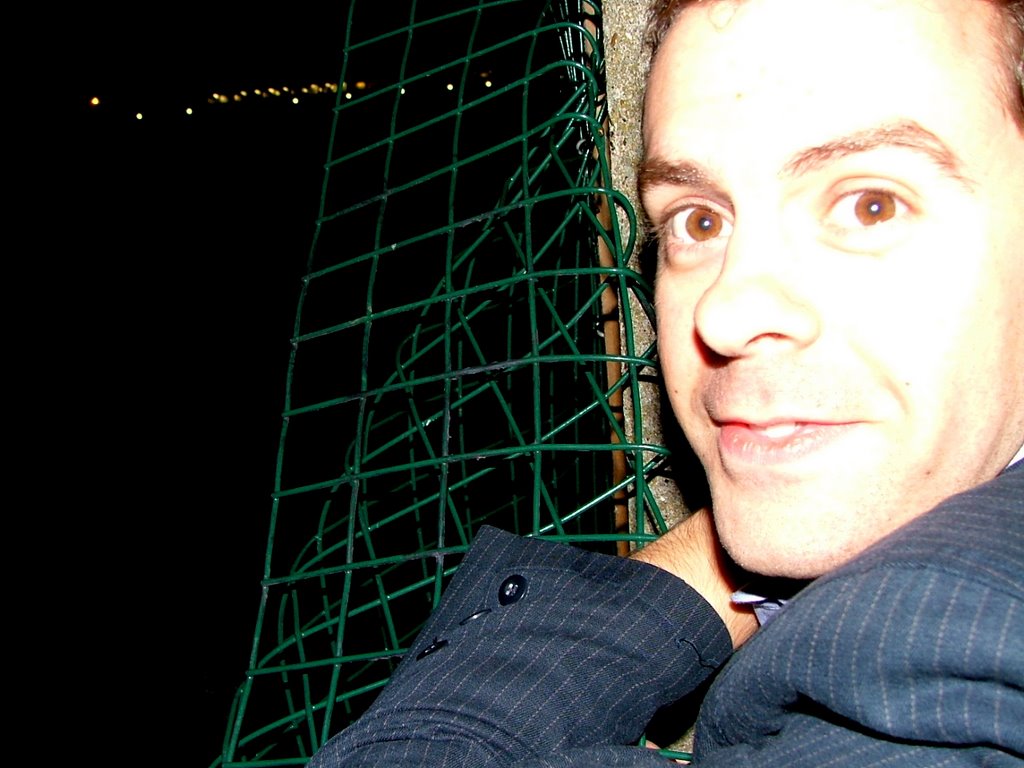
Like some latter day Steve McQueen, Kev reckoned there was a bit of a blind spot.
The plan that was hatched may have been slightly alcohol-fuelled, given that it involved going back next week at exactly the same time. In the cold light of day, it occurred to me that we might encounter the same problems then that we dealt with so pathetically last night.
Athletics - 800m Preview

"That was lovely... fancy a Chinese?"
It would seem that the pace of the action around here isn’t quick enough for some people, so in an effort to keep things ticking over, tonight will see a bit of true Ultimate Olympian action – that is to say, some shambolic, poorly thought out, hurriedly executed sport followed by a trip to the pub with Kev from Sobell House.
On the spur of the moment, a gauntlet was thrown down, and tonight Kev and I go head to head over 800 metres at the Iffley Road track, the scene of Sir Roger Bannister’s most celebrated mile. The event was chosen because it’s short enough to not hurt too much (despite a complete lack of training), it’s short enough to not take too long (despite the new licencing laws, the pubs don’t stay open forever you know), and we don’t need any special equipment (like starting blocks).
Probably the most famous 800m race in the Olympics was the final in 1980, when Steve Ovett beat Seb Coe (pictured above pretending to like each other and wearing some particularly fetching gear). Coe had been the favourite to win the 800m and was gutted to only take silver – “There is only one medal that counts. I have to make sure it does not happen again.” – but a few days later, he faced Ovett again in the 1,500m (Ovett’s speciality) and destroyed him.
Tonight, I expect Kev - the Multiple Marathon Man – will be destroying me. I have two goals. The first is, as ever, to run the race in less than double the world record time. The current record is 1:41.11, set by Wilson Kipketer in 1997, so I’ll need to complete two laps of the track in less than 3:22.22. I think that’s possible. The second goal is to avoid getting lapped. I might struggle with that one.
"You're gonna need a bigger boat..."
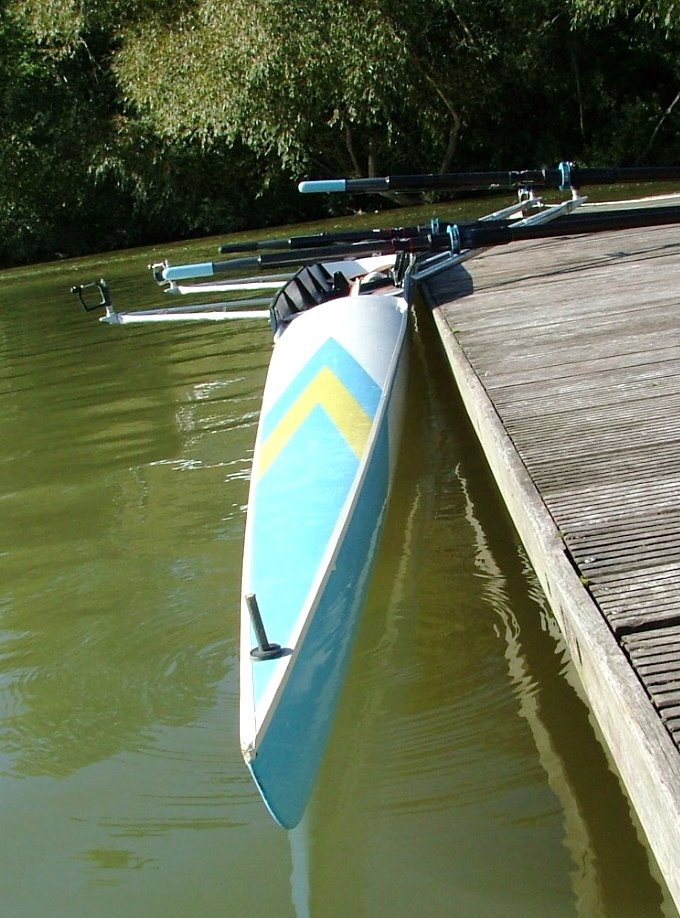
A few weeks ago, when I first met Tom and Nick from the Hinksey Sculling School, they warned me that sculling is addictive. They warned me that it was a hard thing to just try once and then cast aside. I’d be drawn to it, they said. I ought to be careful, they said. From the outside looking in, I admired their love of their sport, but I didn’t believe a word of it.
To me rowing (and sculling) was all about power. The bigger man wins. Yes, there is technique involved, but if you’ve trained harder and lifted more weights, you can make up for deficiencies in technique in a way that a technically gifted lightweight could never counteract.
On Saturday, for the first time, I got into a proper boat and headed out on the river. It didn’t take long before I realised how wrong my preconception about power was, and how right Tom and Nick were about the addictiveness of the sport.
The boat (pictured above) was a double scull. As I climbed down into it I felt the same disconcerting wobble of boat-on-water that I had previously felt climbing into a racing kayak in Nottingham last April.
Nick sat behind me in the front of the boat (if you can figure that out) and we pushed off. He explained how to keep the boat stable - hands in front, like Marcel Marceau climbing a ladder that isn’t there, left hand slightly above right - and demonstrated how the slightest lifting of either hand would make the boat tip to the opposite side.
Having established how not to fall in, and run through some light jargon (every sport has its own little language, littered with shibboleths to distinguish those in the know from those in the dark), we set off up the river.
I say we set off – really, Nick set off as I balanced the boat with my newfound blade (not oar) skills. A short dash down the river later, Nick decided he’d had enough of doing the hard bit and started talking me through how to scull.
What I did was very basic. The seat is on runners, but my legs were to remain locked straight throughout our session. At first, I wasn’t even moving from my hips, just using my arms, and the notion of flattening the blades on the way back wasn’t even entertained. Despite all that, there was a definite thrill involved in being the one powering the boat.
I learnt both my lessons (about power and addiction) almost simultaneously. I quickly realised that all the power in the world (and therefore, a lot of the time I’ve spent recently on the rowing machine or lifting weights) is entirely useless if you don’t know how to apply it. And I clearly didn’t have a clue.
Then, as I felt around with my blades, and splashed, and dug too deep, or missed the water altogether, suddenly, from nowhere, a perfect stroke. Both blades entered the water at the same time, dug just deep enough to get the maximum pull, without digging too deep and causing the boat to lean to one side, and then both blades exited the water together and ripped back, half an inch off the surface, ready to do it all again.
And I was hooked.
Most of my sporting understanding is filtered through golf. The same phenomenon exists there. A complete novice can lift a golf club, waft it around a bit, and if he or she is very unlucky, catch one absolutely flush and be addicted for life. The essence of the addiction is frustration. A glimpse of perfection is granted, but only for long enough to make you feel the need to search for it forever.
Rowing is a sport, like golf, where repetition is key. Above a certain level the difference between one person’s best and another person’s best is irrelevant. Instead, it becomes about who can reproduce their best most frequently, and (crucially) reproduce their best when it really matters.
Redgrave may not have been technically the best rower - or indeed the strongest, or the fittest - but he had in spades what others lacked. He had the ability to deliver his best at the critical moment.
It is the fact that you can sit in a boat for the very first time and produce (entirely by accident of course) something close to a Redgrave stroke that makes rowing addictive. I can watch Zidane with a football at his feet and admire the beauty of it, but can never know how it feels to do what he’s doing. I can watch Federer hit shots on a tennis court that make the hairs on the back of my neck stand on end, but I can only admire it, never experience it.
It goes without saying that I could never attain the Olympic heights scaled by Sir Steve, but at least I can taste it, just for a moment. I can’t decide yet if that taster is a wonderful thing or the dangerous early stages of a crippling addiction. This challenge is going to be hard enough to complete without having to spend time in rehab.
Scull, scull, scull your boat...
Having spent last Saturday morning zipping up and down the river in a small skiff watching children as young as nine making sculling look incredibly easy, I’m heading back to the Hinksey Sculling School tomorrow to show them a thing or two about how to handle a long, thin boat.
I’m encouraged by how stable the youngsters looked in their single sculls, or at least I was encouraged until Tom (expert coach) pointed out that their centres of gravity are somewhat closer to the waterline than mine is going to be. One doesn’t so much sit in the boat as on it – or next to it in water up to my neck as will most likely be my innovative approach.
There will be no event completion tomorrow – we’re still at the stage of getting me into a boat to see how much work there is to be done before we can go to a proper racing lake to record some times – but I’m looking forward to it. Mostly.
One thing I’ve learnt so far in the course of trying Olympic events is that the more ardently the experts insist that their discipline is "easy to learn but difficult to master", the more likely I am to get either hurt, wet, or both. In April last year, Shaun Cavern, flatwater kayaking guru extraordinaire, kept telling me that his discipline was simple, right up to the point where I was disappearing into the Trent.
The next day, Ian Raspin, slalom kayaking guru extraordinaire, was saying exactly the same thing, even as he was saving me from drowning.
It’s slightly disappointing therefore that Tom Collins, sculling guru extraordinaire, has punctuated nearly every sentence he has spoken to me since we met with the expression "it’s really very easy." For now, I believe him - the kids last week certainly made it look so – but by lunchtime tomorrow, I might be singing a different tune.
Treadmill Tapdance
All work and no pointless sport make John a dull Olympian. I’m hoping that will all change in the near future - I’ve finished a large project at work that has been hanging over my head all year, and some tentative visits to the gym of late have confirmed that whatever was wrong with my (supposedly ‘good’) knee seems to have gone away again.
In the meantime, to give you a flavour of how I like to dress and behave in the aforementioned gym, here is the video for OK Go’s single Here it Goes (with thanks to all the people who saw it, thought of me for some reason, and e-mailed the link).
Next week, The Kings of Leon Greco-Roman wrestling.
The Deep End

As you can see, I have been working very hard at the Olympic challenge since we went swimming four weeks ago…
Unfortunately, the “working very hard” bit is true, but sadly I’ve not been working on anything as interesting or fun as all of this. I was also away for a few days playing golf in Holland. Two things of Olympic note occurred while I was there.
The first I’m hoping might not be as much of a problem as it felt like at the time. As I walked onto a tee box, my left knee (the “good” one) made a popping sound and suddenly I couldn’t straighten it (stop me if this is starting to sound familiar). I wiggled it about a bit, there was another pop and everything seemed back to normal. I strapped it up for the rest of the trip and favoured the other leg (”There's a lot of it about, probably a virus, keep warm, plenty of rest, and if you're playing football or anything try and favour the other leg.”).
Then, the morning after I got home, I climbed out of bed only to have it pop out of place again (the knee, not the bed). This time it took me half an hour (and rather more wiggling than I really like to start the day with) to get it back into place; by the time I did, the joint had filled with fluid and it hurt like hell.
Three days working from the sofa with my leg elevated, covered in ice and an assortment of frozen vegetables, seemed to do the trick. The swelling went down, the pain it was causing subsided, and the limp became less Douglas Badder and more Huggy Bear. Now, the limp is gone, the knee feels fine, and last night I even ran about 50 yards at a fair lick to catch a bus.
All of which sounds great, but I’m still feeling a bit like I'm walking around on a time bomb that could have me back in the hospital again at any minute. At least I’d know the drill I suppose.
The other thing of note that occurred in Holland was more of a realisation than an injury (for a change). As I mentioned, I was playing golf, a game I’ve played since I was old enough to draw breath. At one stage in my life I even got reasonably good at it.
These days I’m diabolically bad. There is the occasional flash of something encouraging, but really, when you’re stumbling about in the dark, an occasional flash tends to be more disorientating than helpful.
The thing is, I used to care. I used to get really quite upset on the golf course about how bad I had become. I would break clubs and unleash vitriolic streams of very unsavoury language in the aftermath of a really bad shot (of which there were many). I made a decision a couple of years ago after a particularly embarrassing outburst that I was not only ruining the game for myself, but also making the people I was playing with rather uncomfortable. It had to stop.
I’m delighted to say that it has stopped, and while I was away in Holland my golf was so bad (and I was so far out of contention) that I had plenty of time to think about why it has stopped, and why I’m now wandering about the course like the Dalai Lama ("Big hitter, the Lama") instead of Happy Gilmore.
In the space of a month I had played incredibly badly (even for me) in a tournament in Northern Ireland in front of a bunch of people I used to consider my peers, and then there I was walking around a course in Holland with half my old university team, all of whom had left me for dead by the end of the first nine on the first day. I should have been spitting with rage.
Finally I realised what has made the difference, what has stopped me getting cross, and consequently let me enjoy playing again (or at least enjoy it more than I have done for a while). It’s failure. It’s being rubbish at things. Perhaps most importantly, it’s failing and being rubbish on a regular basis. In short, it’s this challenge.
By forcing myself to try things that I think I can’t do (but sometimes surprise myself with – the BBC’s coverage of this year’s London Triathlon was on TV last week and I watched it with a renewed sense of disbelief that I made it round last year), by constantly putting myself out of my comfort zone, and by having to rely on a lot of help from a lot of people, I’ve come to enjoy trying things, even if I don’t succeed.
As I’ve mentioned previously, that’s what the Olympics are supposed to be all about – trying your best (no matter what Sean Connery had to say in The Rock about "losers" who say that) and not worrying too much about the outcome.
It would seem that the deep end is my new comfort zone, which should make this little lot a piece of cake, right, Ben?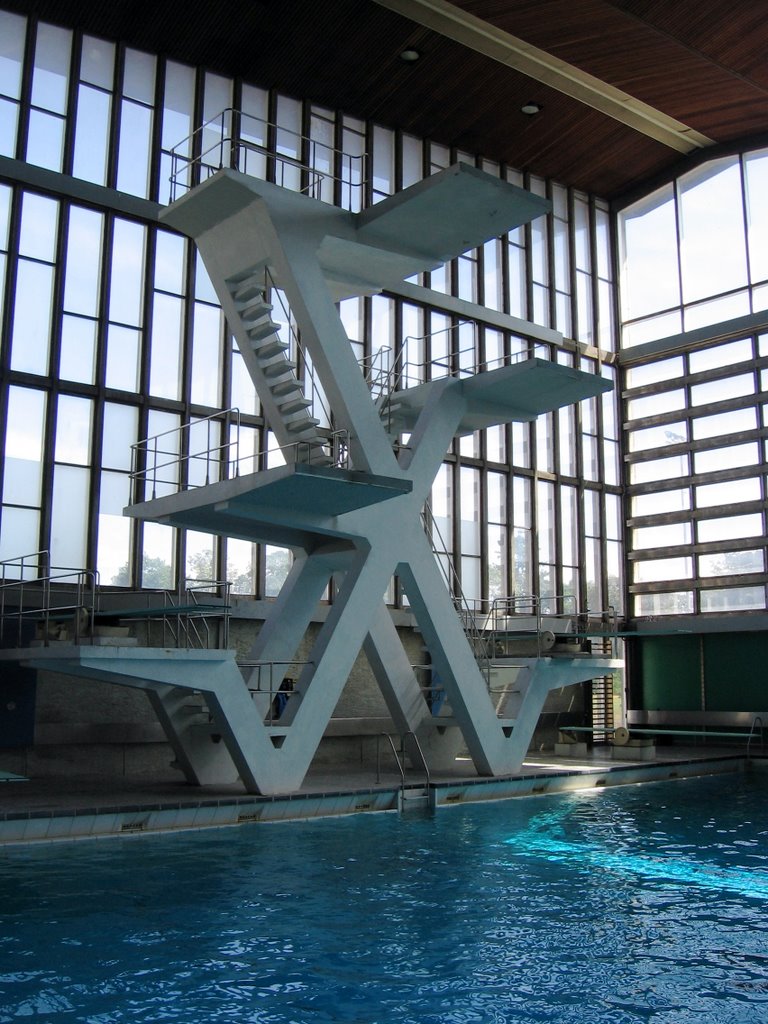
(with belated thanks to my synchronised diving partner for the photos)
P.S. Also thanks to Ben, here's some video footage. Ben, you're either a bad typist or a comic genius - "Ultimate Olumpian"? I might run with that from now on.
Swimming Pictures
Rather than weave these into the previous post, I thought I'd save you all the trouble of going looking for the shots of me and the boys in our swimming trunks. Brace yourselves.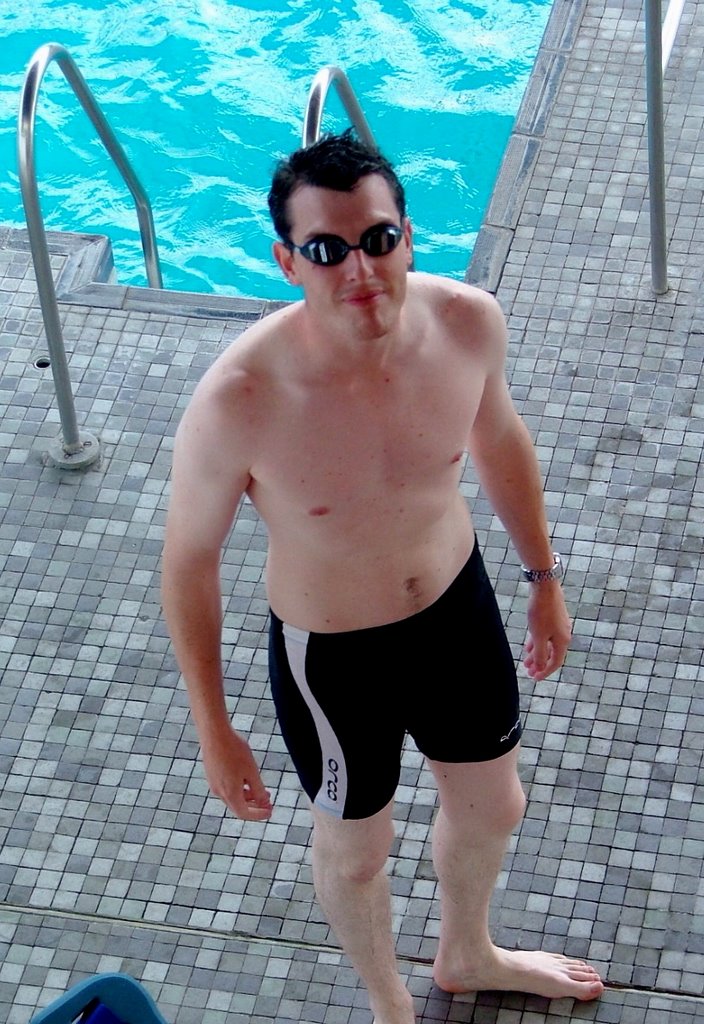
Fighting fit and ready to go - three days later and the only bit of me that's still sore is the bridge of my nose - note to self: don't buy new goggles the day before you go for a 3 hour swim session. With feet that big, I should have been quicker. Still, nice tan, eh?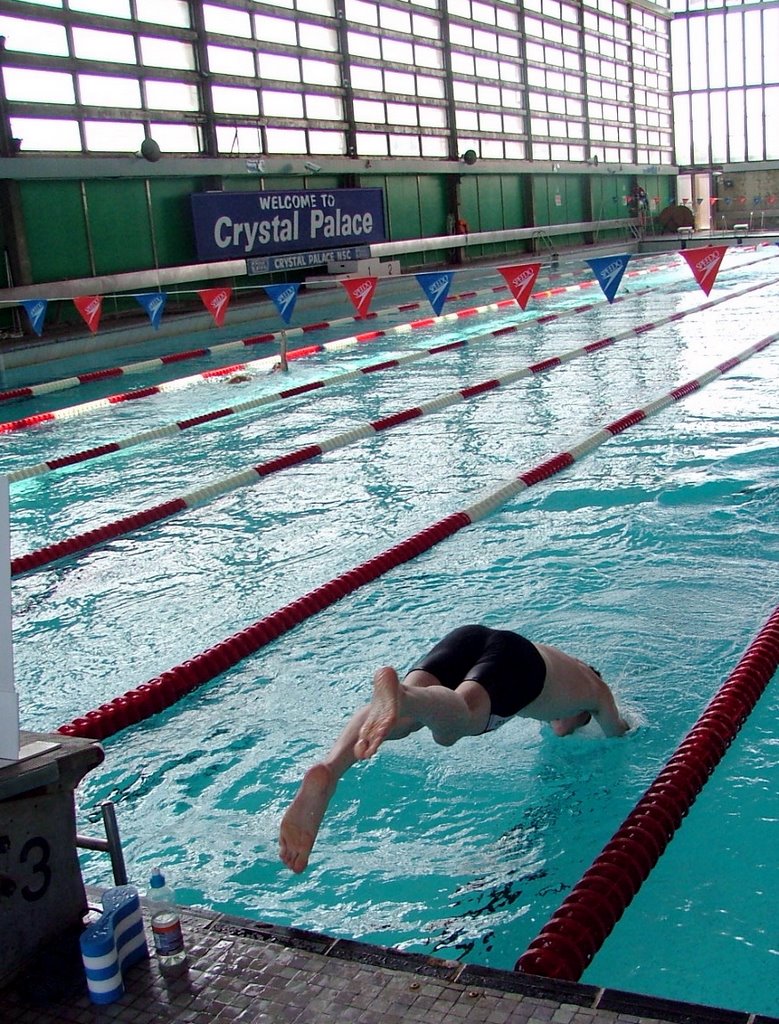
Not unlike Eric Moussambani, my diving wasn't ideal. I think I spent the first twenty metres after this one trying to work out if I was in too much pain to continue with the race. I braved it out in the end. I know they're closer to the camera than the rest of me, but I've never noticed just how ridiculously big my feet are. Sideshow Bob-tastic!
Introducing Mr David Hockney on Fuji Finepix... nice work, Mr H.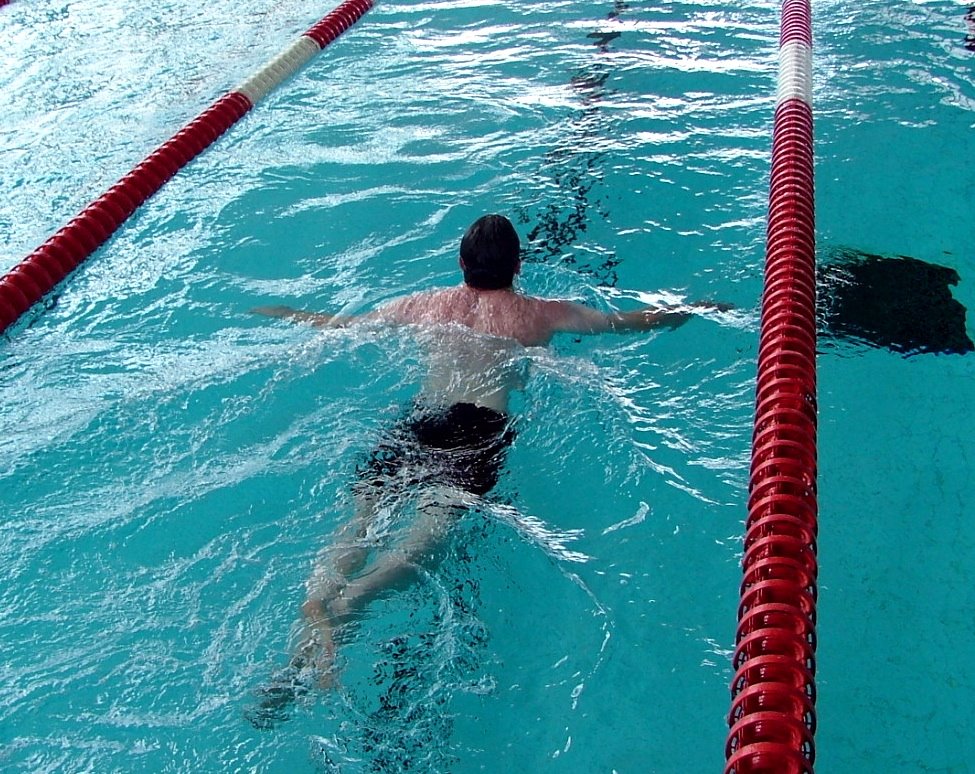
They say the camera never lies, but I assure you I was trying a lot harder than this photo makes it look like I am. The vent on the right of shot is where they let the sharks out when you're not looking.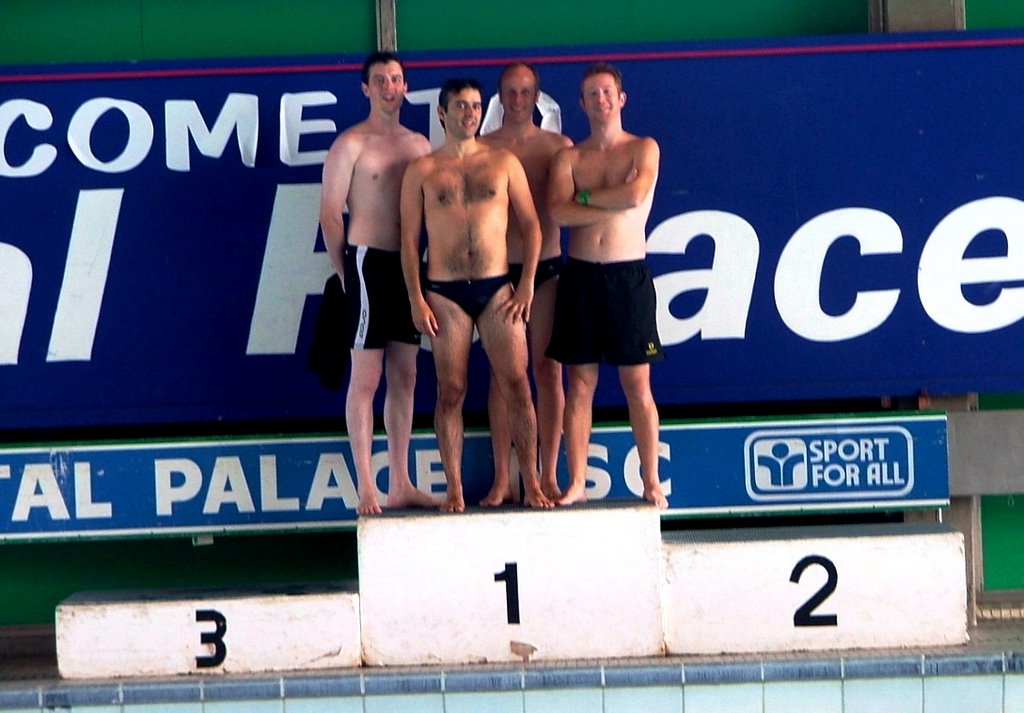
The relay team of the gods - from left to right: Mildly Embarrassing McClure, Doggy Paddle Diogo, Iron Mike Butterfly & Blistering Backstroke Ben. I can assure you that the pool at Crystal Palace is not on a slope - the only man we could find to take our picture had a worn down wooden leg.
There is some video to come, but I'm still working on the technical glitches.
Eight Events in One Day
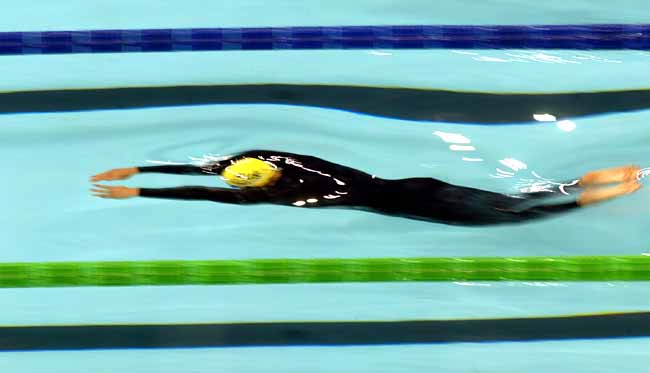 Thorpedo in the Water!
Usually, before I do an event, I write a preview. On this occasion, I was pushed for time; but I was also planning to attempt eight (swimming) events in one day, so thought eight previews might be a little much. I know, however, that a certain other John likes a good preview, and it was his birthday last week, so rather than disappoint him altogether, I thought I’d mash the previews through the review and see how that comes out. Probably as the longest blog entry in history – brace yourselves.
Swimming is one of the Olympic sports in which I have a hero. For my money swimmers don’t get anything like as much recognition as they should – I suppose they’re too anonymous when they’re in the water, or maybe people just don’t understand how incredibly fit and dedicated the best ones are.
My swimming hero hasn’t been my swimming hero for very long, but I can’t conceive of anyone ever being able to replace him at the top of the list (which roughly, from second place, pans out: Thorpe, Moorhouse, Phelps, Goodhew, Eric “The Eel” Moussambani).
He has won eight Olympic medals (4 gold, 2 silver, and 2 bronze), nine World Championship medals (3 of each), and sixteen European Championship medals (8 gold, 3 silver, and 5 bronze); and yet, the chances are, you’ve never heard of him. He holds 14 British records, 8 European records, and 7 world records. He is Sascha Kindred.
His twin brother, Timo, did the triathlon with me last year. Like Timo, Sascha’s an impossibly nice man. Unlike Timo, Sascha has cerebral palsy. They’d both kick your ass in the pool – on Saturday, I went to Crystal Palace to have a go in a 50-metre pool, clock my times, and find out by how much.
My day began at 06:30 – usually, if I see this time of the day, it means I’ve had a great night out and it’s time to get some rest, but today it heralded something that I believe is referred to as ‘Saturday morning’. It was a shock to discover that the world not only exists, but also manages perfectly well without me before lunchtime at the weekends. I gathered my thoughts, and my high-energy foodstuffs, and headed to London on the bus with Michael and Diogo.
We arrived at the Crystal Palace National Sports Centre (which, for all the signposts it doesn’t boast, ought to be renamed the Crystal Maze National Sports Centre) by about 10:30, in time to meet Ben, the fourth member of what would prove to be a remarkable relay squad.
We paid our money and made our way into the depths of the swimming pool complex. The whole place is like a man who has been living alone for too long – it’s a bit frayed at the edges, nothing is quite as clean as it ought to be, and there’s a funny smell that you don’t really want to inhale for long enough to be able to describe.
Despite all that, the sheer scale of a 50-metre swimming pool is impressive when you are used to training – all right, when you occasionally swim – in a 25-metre one. It looks big, but somehow, it also looks manageable (appearances, it later turned out, can be deceptive). Perhaps what made it seem manageable was the constant spectre of the 10 metre diving platform, which seemed anything but manageable, lingering behind us throughout.
We weren’t there to dive though – we’d been told we couldn’t without being part of a club or receiving instruction (which costs an arm and a leg; ironic, given that these are exactly what you might lose if you tried it without help) – but both Ben, who has agreed to be the other half of the synchronised dives, and I could hardly look away from the diving pool throughout the 3 hour swim session.
By the end, I think we had convinced ourselves that the 3 metre springboards present no real problem, but that even the steps up to the 10-metre board look frightening, especially when you consider how tricky they might be to negotiate backwards with your tail firmly planted between your legs – never mind trying to do all that in time with your partner.
But I digress – the mission on Saturday was in the other pool – eight events in one three-hour session.
Event 1 - 200m Freestyle
Ian Thorpe’s World record – 1 minute 44 seconds
My time – 4 minutes 24 seconds
% Olympian – 40%
The first thing to note about freestyle is that, as the name implies, the swimmer can use any style he or she likes, and touch the wall with any part of the body at the turns and the finish. This was one of many useful little titbits I picked up from Dave Wallechinsky’s excellent book last night, and would come in very handy during this first event. Mark Spitz - how much faster might he have been without the 'tache?
This event was Mark Spitz’s third of seven gold medals at the 1972 Munich Olympics. The winner in the 1988 games was the largely unfancied Duncan Armstrong of Australia. He beat the mighty Matt Biondi into third place, breaking the world record in the process, by using a rather ingenious tactic. He was assigned lane 6, with Biondi inside him in lane 5. At his coach’s suggestion, Armstrong swam as close to Biondi’s lane as he could for the first 150 metres - “I just sucked into his trough and bodysurfed the first 100 metres” – before slingshotting his way to the front with 20 metres to go.
My race plan was slightly different, and based rather more loosely around the notion of not drowning. I dived in and felt very good for 20 metres, despite the absence of Matt Biondi in the next lane. I was breathing every two strokes and felt comfortable. Then I felt a little short of breath, so I switched to breathing with every stroke. Then I realised I wasn’t even going to make it to the end of the pool if I didn’t switch to breaststroke. Which was quite embarrassing. In the end, I touched home in a time of 4 minutes 24 seconds. Which was also quite embarrassing. Thorpe could have swum twice as far in the same time, and still have had time to get out and throw a couple of shrimps on a barbie in the time it took me.
Event 2 - 4 x 100m Freestyle
South African World record – 3 minutes 13 seconds
Our time – 6 minutes 51 seconds
% Olympian – 47%
Coming into the 2000 Olympic final, the USA had won this event every time it had been held. Despite being 6 tenths of a second down with 50 metres to go, and having won the 400m individual freestyle less than an hour earlier, a 17 year-old Ian Thorpe swimming the anchor leg for Australia somehow managed to overtake Gary Hall of the US to claim the first ever non-US victory for Australia… in Australia. There’s a rumour a few beers were drunk that night, but I’m not sure I believe it. So good they made it into a stamp.
This event afforded me some help, in the shape of three other swimmers. Despite Michael’s best (and very impressive) efforts, we still didn’t manage to sneak inside the double-the-world-record pace we had tentatively set as a target in each event. It probably didn’t help that I was still doing breaststroke.
Event 3 – 100m Breaststroke
Brendan Hansen’s World record – 00:59.30
Sascha Kindred’s World record – 01:22.98
My time – 1 minute 58 seconds
% Olympian – 50% He never wanted to be a swimmer for a living; he wanted to be... a LUMBERJACK!
Duncan Goodhew fell out of a tree when he was 10 years old, an accident that caused him to lose all his hair, which never grew back. Bullied at school for being bald and dyslexic, Goodhew went to Moscow in 1980 determined to raise two fingers to his juvenile detractors by winning a gold medal as shiny as his head. He won the final by four tenths of a second.
As a twelve year-old, Adrian Moorhouse watched David Wilkie win a gold medal in the 200m breaststroke and was inspired to start training in earnest. In 1984, he swam a disappointing final and finished fourth. While he was still in Los Angeles, he got a telegram from his old Sunday school teacher – “Very bad luck, all proud of you. There will be a next time.” – which he kept and later tucked into the box that contained his gold medal from the 1988 games.
This event is one I finally felt reasonably comfortable with throughout. I saved a bit for the finish and just about managed to scrape inside the target time. I was growing increasingly tired by this point however. It’s all very well not eating before you swim, but it doesn’t do much for the energy levels.
Event 4 – 4 x 100m Medley
US World record – 3 minutes 30 seconds
Our time – 8 minutes14 seconds
% Olympian – 43%
This event wasn’t on the list for this trip, but Michael took me aside and uttered in a hushed and confidential tone that he might be able to do 100 metres of butterfly if I wanted to try for the medley relay. With Ben having shown himself to be an expert backstroker, and Diogo kind enough to let me do the breaststroke leg (is it just me, or is this sport riddled with innuendo?), in true Ultimate Olympian style, we jumped at the chance to have a go at something unplanned.
Ben led off with an expertly executed backstroke leg. I followed up with an average breaststroke leg, but all was really just preamble to Mighty Michael (as he shall henceforth be known) and his butterfly leg. He swept away from the start like some over-excited (and possibly slightly epileptic) dolphin – which sounds bad, but actually that’s just what perfectly executed butterfly looks like. The three of us watched in awe as he turned and just kept on coming. He was tired when he finished, but it was, all sarcasm aside for once, one of the most impressive sporting things I’ve ever seen.
Diogo brought us home with some mighty fine freestyling, someone noted down the time, but I don’t think any of us cared – we’d witnessed something a bit special, no matter how long it took.
Event 5 – 200m Breaststroke
Brendan Hansen’s World record – 2 minutes 9 seconds
Sascha Kindred’s World record – 2 minutes 56 seconds
My time – 4 minutes 29 seconds
% Olympian – 48%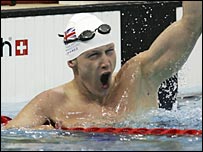 Sascha Kindred - collector of world records.
In 1976, 12 of the 13 men’s swimming events were won by the USA. The only one that wasn’t was won by Scotland’s David Wilkie who set a new world record and became the first British swimmer for 68 years to win an Olympic title (and, in so doing, inspired a young Adrian Moorhouse).
My ambitions were slightly lower. Despite the encouragement of Ben, Diogo and Michael as I came to the finish, I didn’t quite manage to be half an Olympian. There’s video of this one, but you’ll have to wait a day or two while we work out how to rotate it through 90 degrees so you can see it!
Event 6 – 4 x 200m Freestyle
Australia’s world record – 7 minutes 4 seconds
Our time – 16 minutes 55 seconds
% Olympian – 42%
We revised our target for this one to 17 minutes. I think we all thought we were very unlikely to beat that mark when we started, and with the best will in the world, Diogo, Ben and I were a little glum as Michael set off for the final leg with 14 minutes already elapsed. Halfway through his final length, I started getting excited. If he didn’t tie up in the final 25, there was a chance we might do it… all right, there was a chance Mike might do it for us. In the end, he didn’t even make it tense, swimming a final leg of 2 minutes 55 seconds to see us smash the mythical 17-minute mark. The man’s a machine.
Event 7 – 50m Freestyle
Alexander Popov’s world record – 21.64 seconds
Sascha Kindred’s British record – 33.06 seconds
My time – 61 seconds
% Olympian – 35%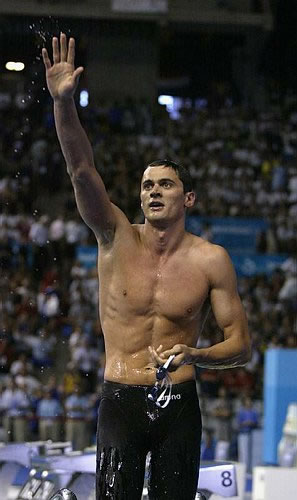 Excuse me, Mr Popov - how many Olympic medals did you win?
Re-introduced in 1988, the 50m freestyle inspired one of Olympic swimming’s great rivalries. For the best part of 15 years, Matt Biondi and Alexander Popov traded titles and world records like men possessed. Very exciting it was too, but my favourite 50m freestyler is Samson Ndayishimiye of Rwanda who, in the games of 2000, was the slowest competitor (recording a time of 38.76 seconds). The highlight of the games for him was swimming in a clean pool that was two and a half times longer than the dirty hotel pool he had trained in.
Having recorded a 57 second split in the first half of my 100m breaststroke, I was confident I could beat the minute mark in this one. If I’d done breaststroke, perhaps I would have done, but for some reason I stuck to crawl, despite tying up like Houdini in the final 10 metres and missed the minute mark by the narrowest of margins. I’d stopped being embarrassed by that stage. I was just tired.
Event 8 – 100m Freestyle
Pieter van den Hoogenband’s world record – 47.8 seconds
Sascha Kindred’s PB – 1 minute 13 seconds
Eric “The Eel” Moussambani’s time in Sydney 2000 – 1 minute 52 seconds
My time – 2 minutes dead (which is what I nearly was by the end) Pieter van den Hoogenband - Holland's aqua-weightlifting sensation.
There was much mocking of Eric the Eel at the start of the session. How we laughed at his unfortunate attempt to qualify for the latter stages of the 2000 games! How we slowly stopped laughing so much as we realised I hadn’t a snowflake’s chance of beating his time.
Eric arrived in Sydney expecting to swim in the 50m event, but his coach decided at the last minute that he should do the 100m instead. Good in theory, but the fact that Eric had never swum that far in one go before in his life might have given him pause. Eric’s heat contained just three swimmers, but when the other two both produced a false start and were disqualified, Eric was left to swim the heat alone against the clock.
Despite a slightly bellyflopped dive into the pool and swimming with his head above the water, he somehow nailed the first 50 metres in under 41 seconds, but he’d used up just about all his energy and the second lap became the stuff of legend. 5 metres from the finish, despite his continued thrashing, Eric stopped moving forward. Exhausted, disorientated, and probably mildly embarrassed, he was essentially treading water. The officials thought about stepping in.
Then the Sydney crowd came to life and adopted themselves a new hero. Their bellowing and encouragement somehow carried him to the finish. His time was more than 40 seconds slower than the next slowest participant’s, and seven seconds slower than Pieter van den Hoogenband’s winning time in the 200m event.
It was funny to watch, and you loved him for it. You loved him even more when you later read that having waved shyly to thank the crowd, Eric went back to the changing rooms and cried.
To his credit, inspired by the subsequent kindness shown to him by the public and many of the elite swimmers, Eric stuck at it and, in the 2001 World Championships, recorded a time in the 50m freestyle of 31.88 seconds. Eric Mousammbani - not the fastest, but comfortably quicker than me.
There’s some video here – with commentary in French especially for the Dubrannas.
Alexander Popov was somewhat better than Eric. After Popov won the 1996 100m freestyle (his second successive gold in that event) an American reporter asked him to name his favourite actor or actress. “This is an American question,” snapped Popov. “I don’t dream about actors and actresses. They should dream about me. I am reality, they are not.” Ironically, he had just become the first repeat winner of the 100m freestyle since Johnny Weissmuller, who you probably know better as the actor who played Tarzan.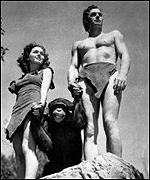 Johnny Weissmuller (with his wife and his coach).
And so we reach the end of this titanic blog entry. Its length is related to its subject, and I’m hoping that by the time you get to this point (if you do) that you’re as tired as I was when I finished those eight events.
Now, if I can just knock off another 5 events quickly, there will be less than a hundred left to complete!
Anyone for tennis?
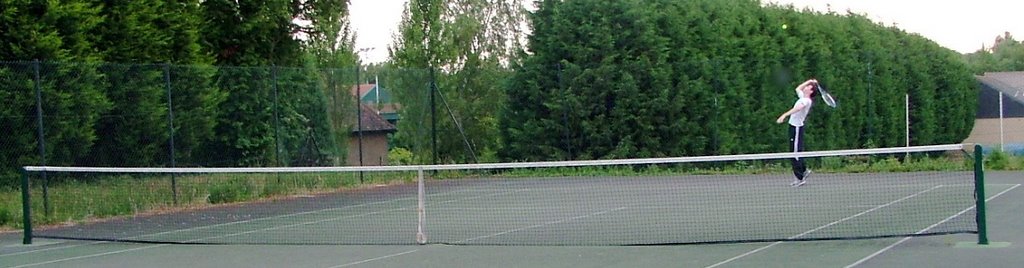
Yesterday saw the playing of two very important tennis matches. One of them involved one of the best tennis players I’ve ever seen, playing against a complete no-hoper from Oxford; the other was between Roger Federer and Tim Henman. The results weren’t entirely dissimilar.
I have a rough rule of thumb that any sport for which a gold medal at the Olympics is not the ultimate achievement in the sport ought not to be in the games. This rule certainly applies to tennis, which was included in the first modern games of 1896, but then dropped after the 1924 games, only to return in Seoul in 1988.
That said, there are a few entertaining stories from the history of the men’s singles tournament.
John Pius Boland (who later became an MP and ardent proponent of Irish independence) was a student at Christ’s College, Oxford in 1896. He went to Athens on holiday and to watch the first modern Olympic games. At dinner in his hotel one night he met a Greek man from Egypt who was playing in the tennis tournament and persuaded Boland to enter too. As chance would have it, they met in the final. Boland considered forfeiting the match, but in the end thought better of it and turned up to beat his new friend 6-2, 6-2 and become the first Olympic tennis champion.
In 1906, by virtue of three walkovers, a Dutchman called Guus Kessler made it all the way to the semi-final round, where he lost 6-0, 6-0.
The 1908 title was lifted by Arthur “Wentworth” Gore who remains the oldest person ever to have won a Wimbledon singles title (aged 41, in 1909) and the oldest person ever to play in a Wimbledon singles final (aged 44 in 1912). In fact, he played in every Wimbledon tournament that was held between 1888 and 1927. Perhaps Tim Henman can take comfort from the thought that Gore won the title 21 years after first playing in the event.
In the Olympics of 1948 and 1952, an Iranian boxer, Emmanuel “Mike” Agassi lost in his first fight both times. In 1996, his youngest son, Andre, won Olympic tennis gold in Atlanta, beating Sergi Bruguera in the final 6-2, 6-3, 6-1.
Gareth manages to serve and give me the fingers at the same time.
I wasn’t quite as bad as Guss Kessler last night, but it was a close run thing. Gareth is easily the best tennis player I know. He’s also a lot more competitive than he pretends to be. I could tell it rather annoyed him (even if it didn’t remotely worry him) when I broke his first service game. At 1-1 in the first set, I was feeling pretty good. It was all rather downhill from there.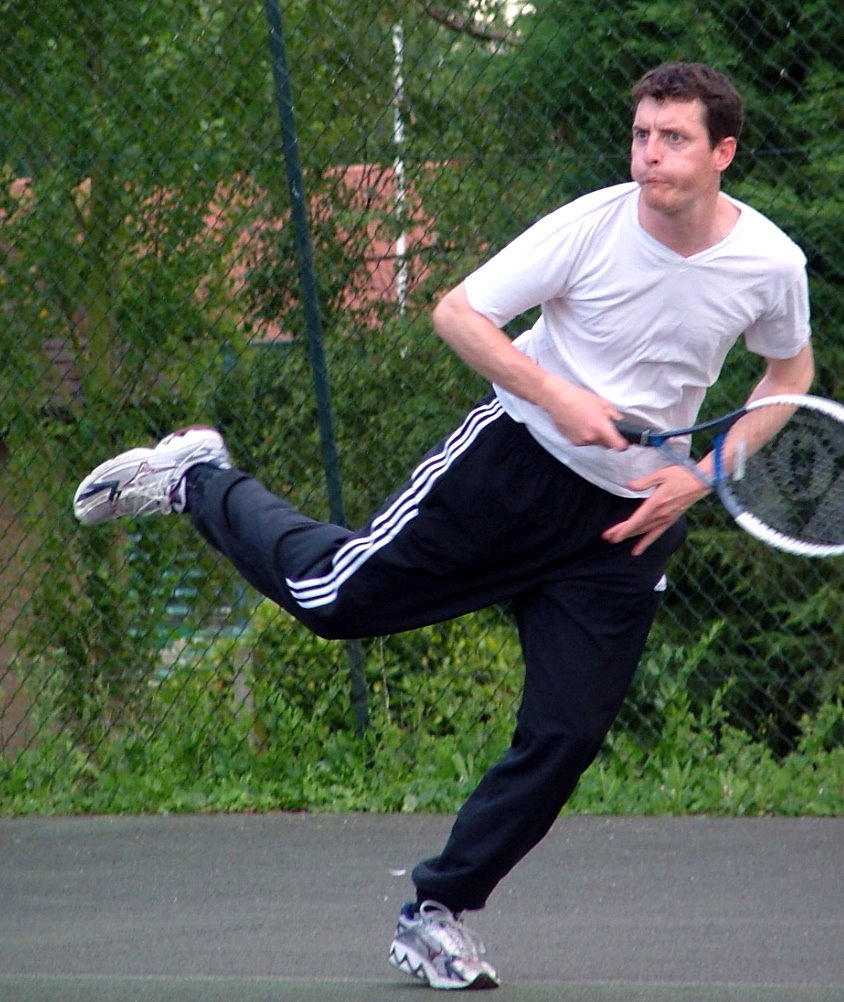
Dizzy Gillespie playing the trumpet.
The photos (thanks, Mike!) later revealed that I blow my cheeks out like Dizzy Gillespie hitting a high note every time I hit the ball. I’ve no idea why I do that – I certainly don’t try to – but even once our esteemed photographer had pointed it out mid-game, I couldn’t stop doing it. Or thinking about the fact that I was doing it.
Me dealing with a tricky backhand, in D flat.
Perhaps it was this mental lapse, or possibly Gareth’s considerable talent advantage, that led to me losing the first set 6-1 and the second 6-0.
My first encounter with tennis was watching Wimbledon with my mother – who, for two weeks every summer, becomes the most ardent tennis fan imaginable. She wept when Ivanisevic won in 2001. But then, so did I. And so did he. I’m choking up now just thinking about it.
My first racket was given to me by my father (I’m not sure how old I was) when he came back from a trip to Belgium armed with a pair of Donnay rackets – a small one for me, and an even smaller one for my sister. Largely, while mum was glued to the television and enraptured by Dan Maskell’s exceptional commentary for those two weeks, Caroline and I were in the garden winning Wimbledon ourselves over and over.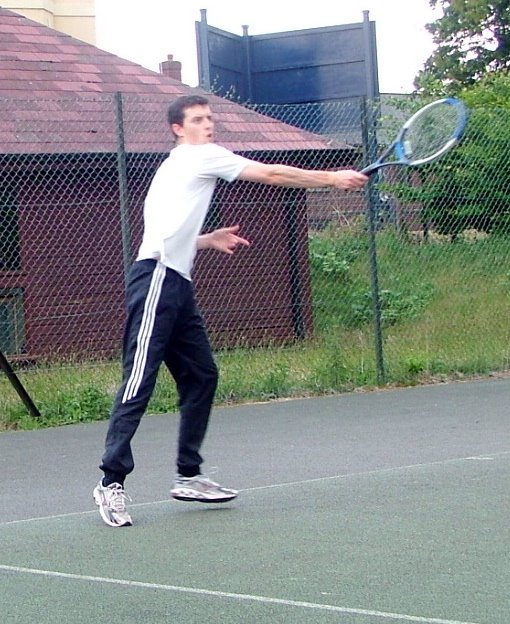
I must have been running out of puff by then.
Having decided that it was a sorry state of affairs that I no longer owned a tennis racket (and that I’d been unable to borrow one from any of my friends), at lunchtime yesterday I went and bought myself one. For £28, I didn’t think I’d be getting much worth writing home (or in one’s blog) about, but it’s an incredible piece of kit.
Fully strung, it weighs just over 300 grams – that’s less than a can of coke – and, even though I didn’t demonstrate it much when we played, it feels capable of great things. As the third set marched on to the same tune as the previous two, my new purchase had its moment of glory.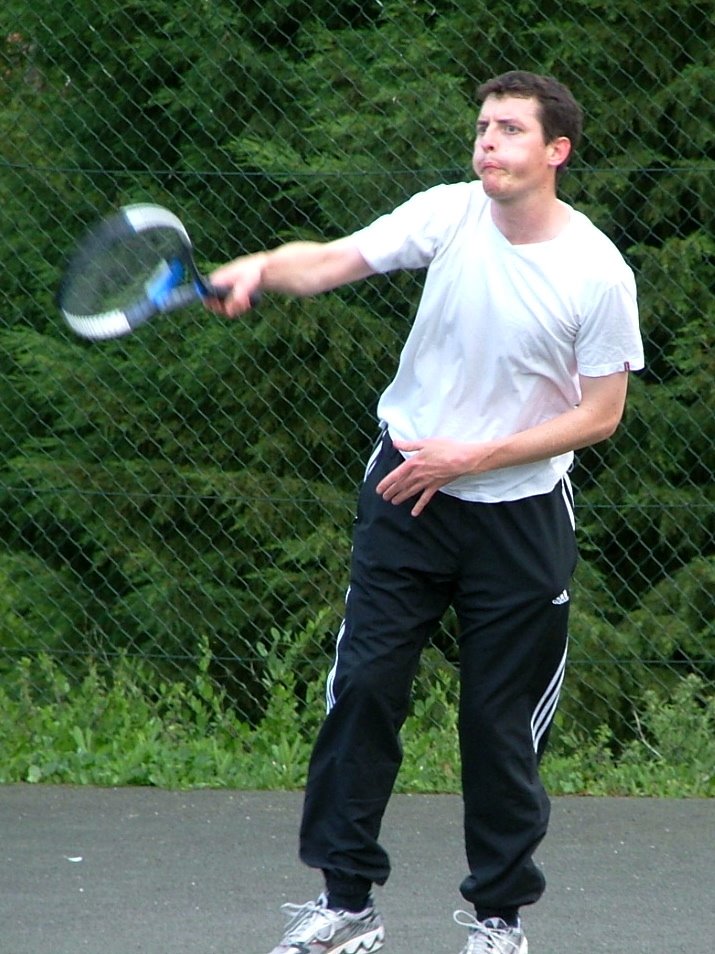
It may have been a moment of glory, but I still looked like Loius Armstrong trapped underwater when it happened.
0-2 down, and serving at 30-15, it produced an ace to Gareth’s (left-handed) forehand. This was exciting on several levels. For one thing, it was one of only a handful of first serves with which I managed to hit the court (let alone the service box); for another, it gave me two game points; but most importantly, it put me ahead in the ace count, 1-0.
I went on to win the game (my second and last of the match), but Gareth had new worries, and the final games became all about him trying to ace me, and me trying my best not to be aced. In what looked likely to be his final service game (at 4-1) he put what was likely to be his final first-serve (at 40-15) into the net. I secretly smirked.
Then he aced me (quite beautifully) with his second serve. The final game of the match consisted of me trying to ace him with every (first and oh-so-inevitable second) serve, so he won that to love without hitting a shot and the match was all over. Just as in the badminton a little less than two years ago, he had beaten me quite soundly.
Tennis may or may not belong in the Olympic games – and it’s a frustrating game for two people of differing abilities to play against each other – but last night was a lot of fun, and I’m delighted to report that my knee withstood not only the tennis, but also the moment of madness that saw Gareth and I have a 400 metre race round Bannister’s track on our way home (he won that too by the way – Gareth, not Bannister - by about 50 metres).
Result of Tennis - Men’s Singles
Gareth Forber (GBR) beat John McClure (GBR) 6-1, 6-0, 6-1
Le Plus Important...
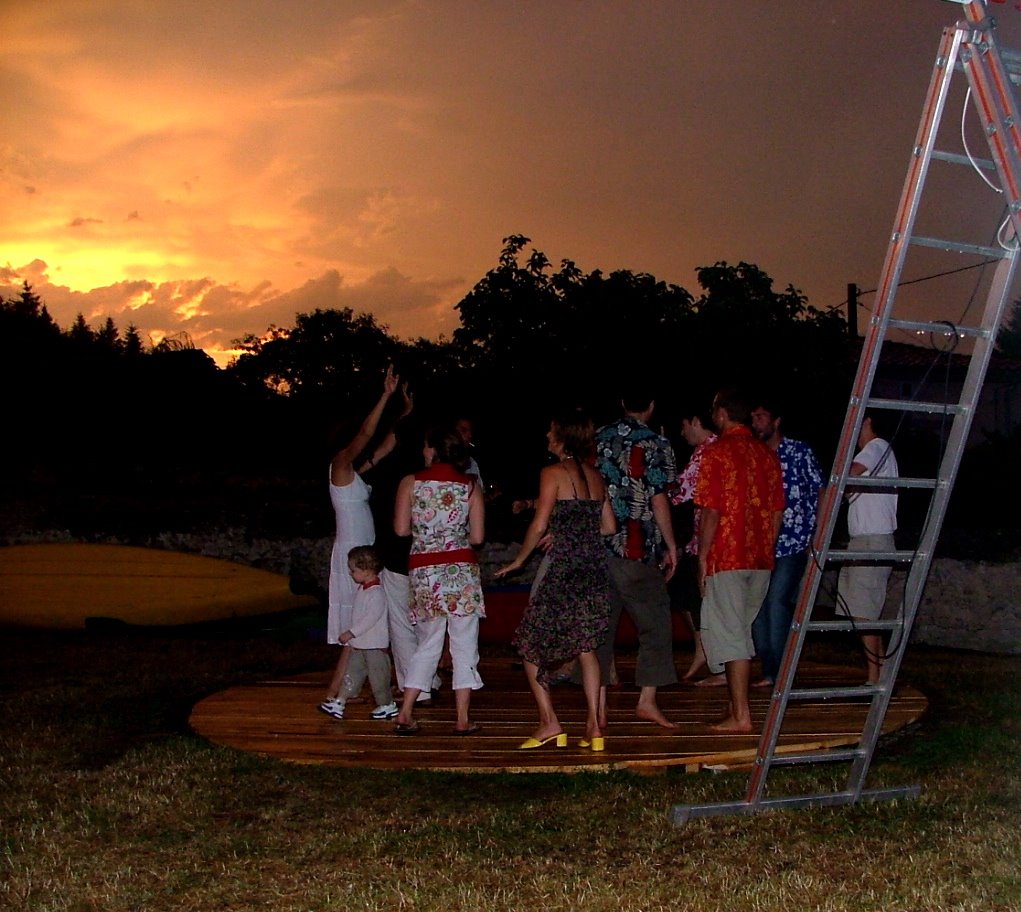
An unlikely setting for an epic sporting encounter...
Having played a leading role in most of my convalescence, it was probably fitting that alcohol should once again have been involved in what I hope was the final stage. At five-thirty on Sunday morning, after a French wedding that will live long in the memory, all the necessary elements for recovery finally aligned.
It takes a clever friend with a very special brand of madness I can’t resist to understand that, after a wedding and when everyone else has gone to bed, the best possible thing to do is play badminton in the garden under floodlights until the sun comes up – that kind of thing seems obvious to me, and infinitely preferable to anything as mundane as sleeping, but surprisingly, we were the only players.
Badminton evolved from an Indian game that had no rules or defined playing area. There was no winner, just one, simple, shared objective – keep the shuttlecock in the air. It adhered perfectly to the Olympic ideal that values taking part above winning.
We played in the spirit in which the game was invented, across what had earlier served as a homemade dance floor. Neither of us scored a point, but I doubt we could have made more effort had it been an Olympic final.
I leapt for high shots, I lunged to retrieve the short and wide ones – I even managed to break a racket (pardon, Nico!) trying to retrieve a shot that flew a little too close to the marquee – and all without a single twinge in either my knee or my competitive spirit.
Later in the day I took a walk, half expecting my knee to be stiff, but if anything it felt better. I tried running a couple of hundred metres. It hurt a little, but then so did the other one; it’s been a while, and I wasn’t wearing running shoes.
I’m writing this as I sit on a train on my way back to the UK. I hope that tomorrow I’ll find an hour after work to go to the gym and move the knee-recovery process on. Who knows? Maybe I might even find the time to do some events before the end of the summer and you can all start reading about something other than the wretched state of my health.
The regular (frequently disappointed) visitor to this site will know that, in addition to being injured, I have been rather lazy recently. As ever, the excuses are legion but dull. I have been in need of some inspiration (I even thought about taking another trip to Ikea), and this weekend it has arrived with a vengeance.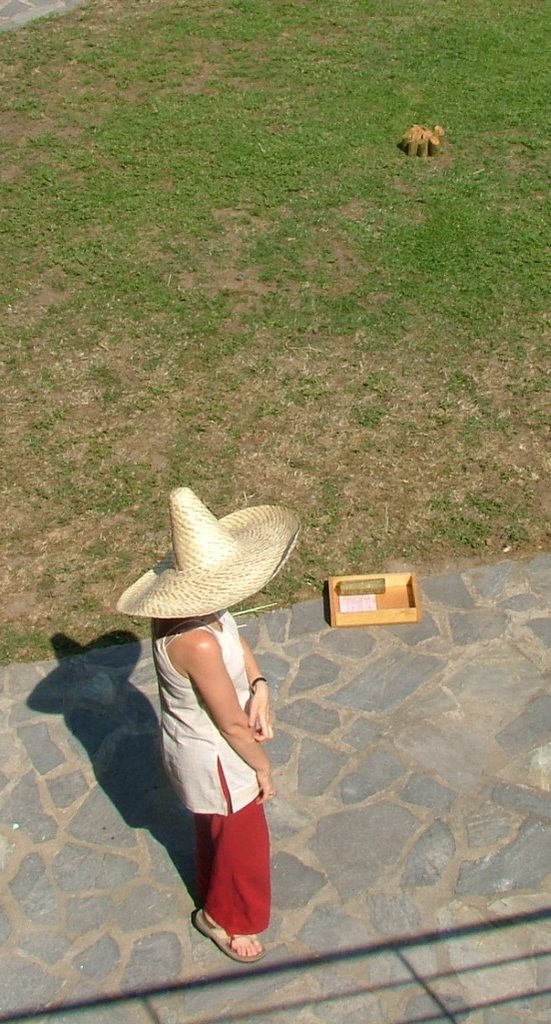 All weekend, I played games as they should be played - trying to win, but too busy enjoying the attempt to worry about whether or not it was successful. Sport provides a vehicle for making new friends and basking in the warm glow of old ones. Put a man in a garden with a small child and you have a man and a child looking at each other awkwardly; add a ball to the equation and suddenly there is laughter and play, and later there will be stories: of triumph and disaster, of near misses and moments of brilliance, of mistakes and achievements – of life.
I played this Finnish game in France with a Mexican bandit. It was that kind of weekend.
***
UPDATE - I didn't make it to the gym last night, but tonight Gareth has very kindly agreed to beat me at tennis. I don't have time to write a preview - if you really need one, tune in to BBC1, BBC2 or BBCi any time for the next fortnight and you'll soon work out what tennis is all about.
Archery - 70 metre Individual
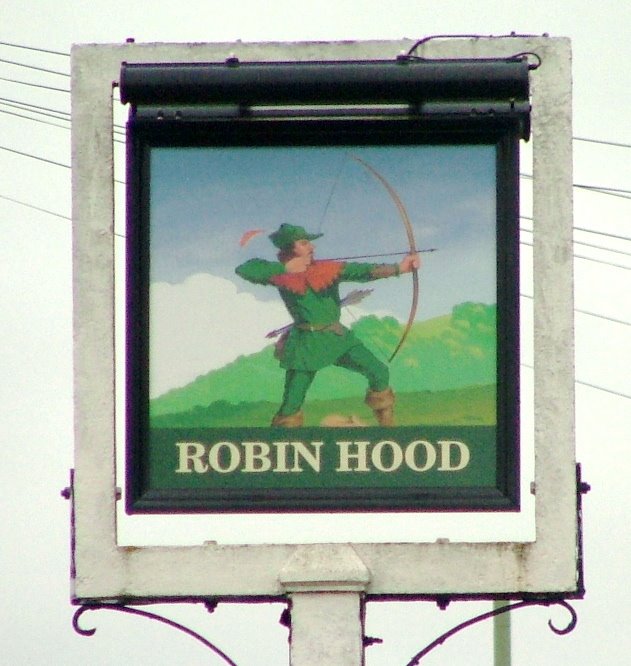 As Will drove us through the wilds of Witney, we passed this pub. The rain was coming down quite hard, but doing nothing to dampen the wind. I suspected the pub might be as close as we would get to anything archery related last night, but thankfully I was wrong.
After some initial confusion when we arrived at Witney Rugby Club about where exactly the archers were hanging out (there was some sort of caravan convention being held on one of the pitches), we eventually found a couple of members of the Windrush Bowmen (a number of whom later turned up and were clearly women).
People in clubs tend to be either incredibly welcoming and eager for you to join in whatever it is they’re doing, or incredibly aloof and eager for you to go away. I’m delighted to report that the Windrush Bowmen (and bow-women) were all very firmly of the former persuasion. Within ten minutes of finding them, I was handed a target frame and told to follow the man with the tape measure while he very exactly measured out the 70 metres we needed.
The rain came and went, but the wind persisted as this same man gave me a very rough idea of what to do. I shot a couple of arrows into a target that was only ten metres away to give me a feel for what I was doing. I assume doing so was also designed to be an exercise in confidence boosting; if it was, it nearly backfired horribly as my second arrow only just hit the target.
Having established that the sights on the bow were essentially meaningless at this stage, as I’d probably miss the long target anyway, my mentor decided I should get on with it and give them all a laugh. I think he was a little surprised when my first three arrows only missed by feet instead of yards. The gentle mocking turned to gentle encouragement as we walked down to retrieve them (from the ground).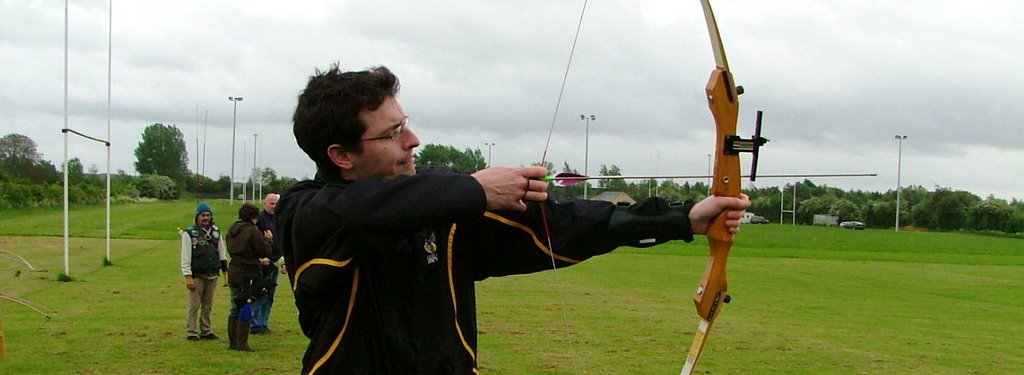

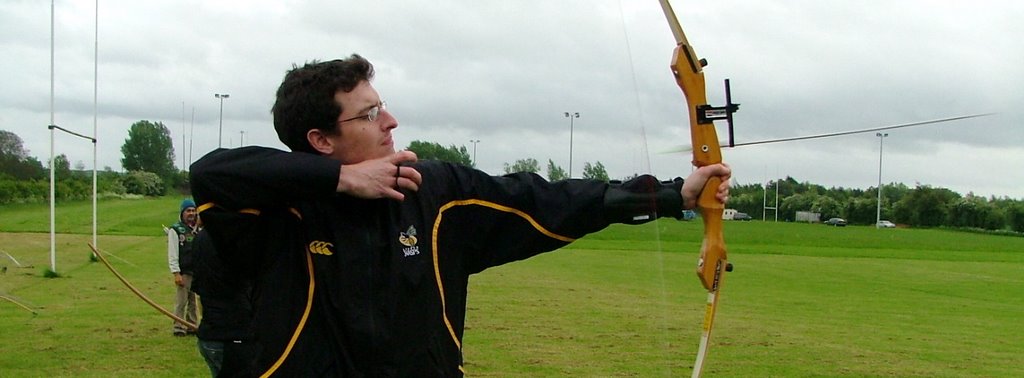
My fourth shot was dead straight (“as an arrow” in fact), but missed slightly high. My fifth shot, however, hit the target and I may have yelped ever so slightly. By this stage, I could no longer really see properly for all the rain on my glasses, so it was the noise the arrow made as it hit that produced the little yelp of triumph. The sixth shot missed high again, but I didn’t really care by then. I walked, rather faster this time, down to retrieve the arrows and to see how many points I’d scored.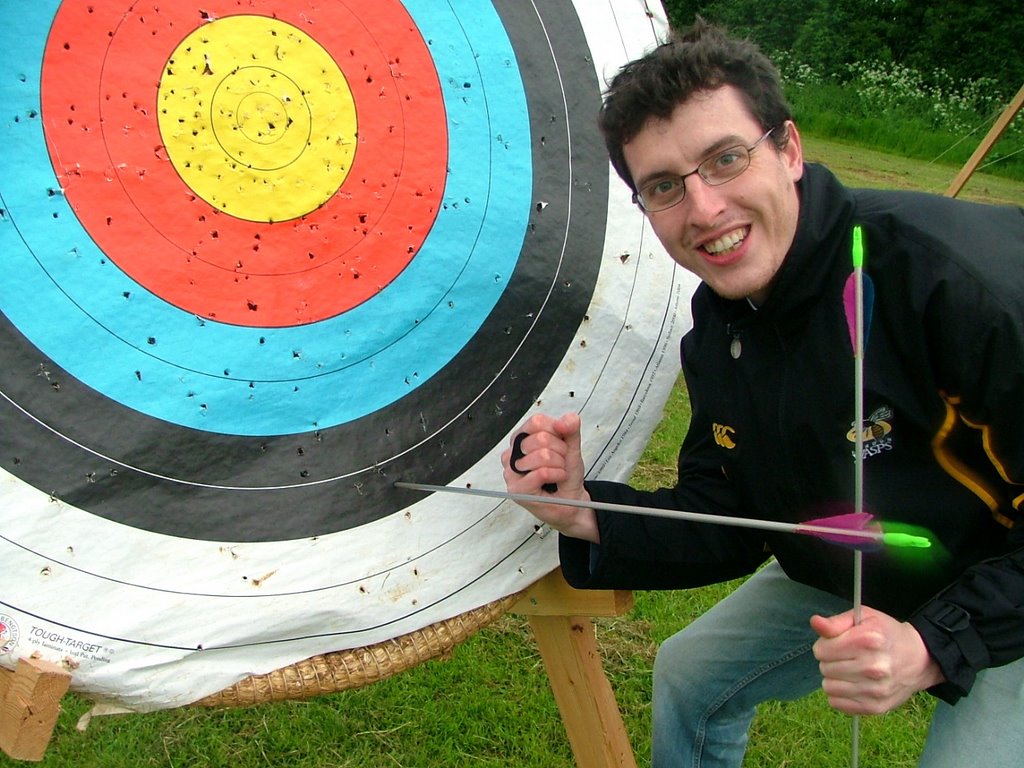
The grapefruit was safe, in fact, you could have nailed a prize-winning marrow to the target and it would have survived unscathed, but I’d hit the outer black, and that’s worth three points. I trotted back to the other end, almost oblivious to the rain, to shoot what I promised the patient Bowmen would be my last three arrows.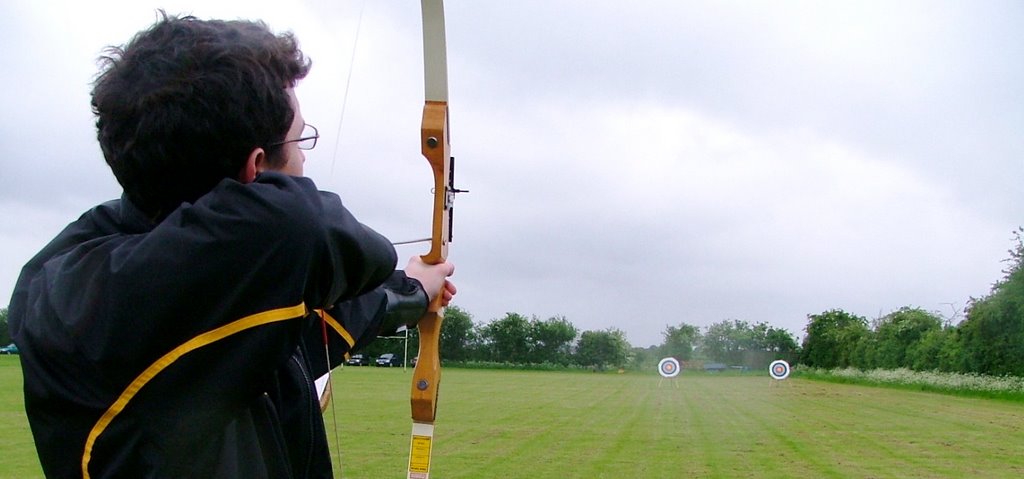

I missed with all three. The wind was getting up, the members of the club were waiting to use the range, and the rain just wouldn’t go away. It was time to call it a day. Somehow, the photos make it look like it was a reasonably pleasant evening weatherwise. It wasn't. For a bit of archery footage, and some indication of how strong the wind was, take a look at the video.
I scored three points with my nine arrows. Assuming that I had gone on scoring at the same rate (which, as assumptions go, is reasonably heroic) for the full 72 arrows of the Olympic qualifying event, I would have scored 24 points. In 2004, at the Panathinaiko Stadium in Athens, the Korean Im Dong Hyun broke the world record with a score of 687 points (out of a possible 720). That’s a hell of a lot of grapefruits.
Of the fifteen events I have tried so far, archery has shot to the top of the list of things I’d like to try again sometime; maybe next time on a dry, windless, sunny evening.
Massive thanks to the Windrush Bowmen for their hospitality, and to Will for braving the elements and taking such good photos and video footage. I’m off to Scotland for a few days to continue the rehabilitation of my knee by playing one of the finest golf courses in the world. When I get back, I hope to set about finding some other events I can do while my knee continues to improve.
Archery Preview
Tomorrow, weather permitting, I will be attempting to have a go at archery. The Olympic archery discipline is contested by shooting at targets 70 metres away. As so often, I’m going to turn to Dave Wallechinsky’s Complete Book of the Olympics to set the scene:
Archery targets are four feet in diameter. The bullseye is 4.8 inches across. This is the equivalent of shooting across three tennis courts laid end to end and hitting a grapefruit.
I think we all know from experience how tough that can be. Only this morning my grapefruit had made it almost to the end of the garden before I managed to get a shot off.
Archery made its first Olympic appearance at the games of 1900, but after the 1920 games it was dropped as an Olympic sport for want of a uniform set of international rules; presumably the French turned up having prepared to shoot grapefruits, while the Canadians were adamant they had been told to practice shooting at bananas. The French-Canadians arrived with a quiver full of arrows, a fruit salad, and their newly appointed national coach, Carmen Miranda.
Fifty-two years later, the archers of the world had settled on a set of rules (and a type of fruit) and the sport made a comeback in 1972 at the Munich Olympics.
Archery is one of the events at which I will cheat ever so slightly. It accounts for two of the 136 events I could have a go at – the individual and the team contest – however, as the team event is merely a replication of the individual event, I’m only going to do the latter.
I’m also going to cheat in the same way I did when it came to shooting clay pigeons (or were they kumquats?); that is to say, I am not going to shoot quite as many times as the athletes at the Olympics do. To win an Olympic gold, an archer would have to first shoot 72 arrows in a qualifying round and then win 6 matches of 18 arrows each.
Assuming there was no need for any playoff arrows to be shot in the event of a tied match, that’s a minimum of 180 arrows, and to my mind, that means just one thing. I'm not going to waste everyone's time by reconfirming how bad I am at archery 180 times.
My hosts tomorrow are the Windrush Bowmen, who shoot at Witney Rugby Club. If you’re in the area, I’d suggest you run away as fast as you can just in case I don’t quite get the hang of it from the start.
This will be my first event since the fencing in November. The lay off has been largely due to bone idleness, but I’ve also been somewhat hampered by my knee injury. I promised an update on that in my last entry, but to be honest there isn’t much new. My knee still hurts if I try to do much with it, but it gets a little better every time I try. I hope and suspect tomorrow’s antics won’t put too much strain on it.

Robin Who?
The first test match of the summer started at Lords today. In a little over six years, that famous old cricket ground will play host to the 2012 Olympic archery events. Slightly sooner than that (a week tomorrow in fact) Witney Rugby Club will have a similar honour when it plays host to me having a go at archery, thanks to Barry Groves, of the Windrush Bowmen, who has offered to show me through the basics.
From our brief conversation on the phone, I’d say he’s not expecting me to be able to hit the target at all from 70 metres. I suspect he might be right. Will (Clapton, not Scarlet) is going to come along to act as a witness and hopefully capture some footage on the night. In the meantime, I will be spending as much time as I can in the pub playing darts to get my eye in.
A proper update, including the latest on the (improving, but not yet recovered) knee will follow soon – but for now, I’m spending so much time at work that the last thing I want to do when I get home at night is turn on another computer.


I Give Up
Last summer, after two and a half years without doing so, I started smoking again. The habit crept back into my life very quietly and quickly. Base camp was established a year ago today with a cigar after dinner in Edinburgh (something no one can do anymore). I thought I could leave it at that, and for several weeks, I did.
Then, in May, the assault on the summit began in earnest when I found myself standing in Statue John’s garden sucking desperately at a Marlboro Light whilst anxiously watching the TV through the window - Liverpool were taking (and saving) penalties in the final of the European Cup. I’d managed that single cigar without becoming a smoker again, so I’d be fine to have just one cigarette, wouldn’t I?
There are four types of people in the world: smokers who smoke, smokers who don’t, non-smokers who don’t smoke, and non-smokers who do.
The smokers-who-smoke will generally make no apology for doing so, own at least one Bill Hick’s DVD, and have an armoury of questionable ‘scientific facts’ up their collective sleeve to hurl back at anyone who dares to suggest they ought to quit.
The smokers-who-don’t-smoke are a wretched bunch. They have seen the error of their ways and given up (often for the umpteenth time), but they still long for the emotional crutch, the element of cool, and the downright physical pleasure a cigarette can provide.
The non-smokers-who-don’t smoke are bemused by the whole situation. Some may have coughed their way through a John Player Special behind the bike sheds many moons ago, but most will never have gone near a cigarette in their lives and will blankly refuse to understand what all the fuss is about.
The non-smokers-who-smoke are the people who seem to be able to take it or leave it. They can (and usually do) smoke when they’re out at the weekend, and then go the whole week without even thinking about a cigarette. Everyone hates them. The non-smokers-who-don’t-smoke think they’re every bit as stupid as everyone else who smokes (or wants to); the smokers-who-don’t-smoke want to be able to do what they do, but can’t; and the smokers-who-smoke hate them because they are forever “borrowing” cigarettes.
Thirteen days later, I still haven’t had one. My sleeping pattern (dreadful at this time of year as a rule anyway) is all over the place, I can’t concentrate on anything for very long without getting distracted, and the other night in the pub I spent the whole evening nervously fingering a box of matches as though someone might at any minute shove a cigarette in my mouth and make me smoke it.
Like it or not, however, I seem to have quit again.
My knee is improving every day, even if it’s not quite happening as fast as I’d been lead to believe that it might. My lungs are shaping up too - I’ve stopped coughing for the first time in six months and the phantom chest pains have disappeared altogether. It’s a radical concept, but maybe if I start taking a bit better care of my body it might stop breaking down on me - and maybe then I could get on with trying some more Olympic events and have something more interesting to tell you on a Friday afternoon!
