
This was great news that brought delight and rapture to a lot of people, many of whom hadn’t realised they cared that much. The day after the announcement the London bombings dampened the celebrations somewhat, but in the weeks and months that followed, there was much chattering (mostly in pubs) around the land. Many wondered about volunteering to help marshal the games, others about how to get tickets – mostly, people just wanted to be there.
On the day of the announcement itself, Mr van de Poll posed the question that was being asked by many other nutters across Great Britain – “what event are we going to compete in?”
This week, an article on the BBC website brought the nation’s attention to Jonathan Phillips, the self-proclaimed 2012 Olympic Competitor. His aims are simply expressed (but I suspect will be harder to realise): “Find a sport, train hard, gain Olympic qualifying standard, convince a country to give me nationality and a place on their Olympic team, raise £1m for charity and be there at London 2012.”
Having a rummage around Jonathan’s site, Statue John found a reference to another Olympic nutter. Nick is the proud owner of 2012 Gold, a website he is using to track his progress. He’s determined to represent Great Britain at archery in 2012 (at Lords) and win a gold medal. The only thing stopping him is that at the start of his campaign he had no “prior competitive experience.”
I have e-mailed both of them in the hope that at some point during our respective quests, we can collaborate. In the meantime, I wish them luck!
I have since been hunting the web for more Olympic nutters. The closest thing I’ve found so far lends itself more to collaboration with the aforementioned Statue John - this sculpture in Sarasota bears the title “Olympic Wannabes”.
Up to this point, I've not been one for putting a load of links in the sidebar to other blogs that I like to read - this isn't a blog about me, it's a blog about what I'm doing - but I may have to start keeping a list of all the other people out there (and I'm sure there must be more of us) with Olympic projects.
***
Knee Update - had the stitches out this morning and am down to using one crutch/walking stick, so making good progress. The nurse who took the stitches out did suggest that maybe I ought to be doing rather more lying around with my leg elevated as it is still pretty swollen, but needless to say I pretty much ignored that.
Other Olympic Projects
This Post May Offend Younger Viewers
Do I rock at deadlines or what?
Worse than being late, I will warn you now that this post is going to be gross. Not many people enjoy looking at pictures of my legs at the best of times; even less so when one of those legs is rather swollen and slightly stitched in places. Still more people find looking at pictures of surgical procedures distasteful, and the sight of what those procedures removed from the aforementioned swollen leg might be enough to inspire them to revisit their breakfast.
If you’re one of those people, stop reading now. Go and put the kettle on, make yourself a nice cup of tea and watch something harmless on the TV for half an hour until you forget I even mentioned it. If you’re not one of those people, I still apologise for what follows.
I went to the John Radcliffe Hospital on Tuesday morning at about seven-thirty. I was ushered into a room with three other day patients to give a nurse the same answers to a bunch of questions they’d already asked me (no… not that I know of… no… no… yes… about 5 or 6 a day… yes, I know I should… last night at about ten… no… no… no thank you).
Then the anaesthetist arrived and asked me them all again. She also gave me a couple of pills “to remove any excess acid from your stomach and to calm you down.” I wondered which part of me being asleep when she had arrived to talk to me might have indicated any need for the latter.
Shortly after she left, the surgeon and his minion arrived. Clearly asking questions was not their style; they didn’t need to ask me questions, they were here to tell me what was going to happen (again) and to see if I had any questions for them. I spent the explanation (delivered this time by the minion) looking at the surgeon, who spent the explanation looking at the minion, who spent the explanation looking through me at the imagined page from the text book he was clearly remembering it all from.
Having announced their intentions, they strode off looking pleased with themselves. It was hard not to liken their pre-surgery performance to a particularly cocky batter in a baseball game indicating before the pitch which side of the ground he is about to hit the ball out of. I hoped their talent matched their preamble.
I was wheeled off to theatre. The last thing I remember thinking before the anaesthetic took hold was that it had just gone nine o’clock exactly according to the clock I could see and wasn’t it strange how simply injecting me with something as small as that was going to make me pass out completely in the space of a few sec…
While I was under, here’s what Babe Ruth and his able assistant were seeing (I've made it as small as Blogger would let me - if you want a bigger version, click on the image).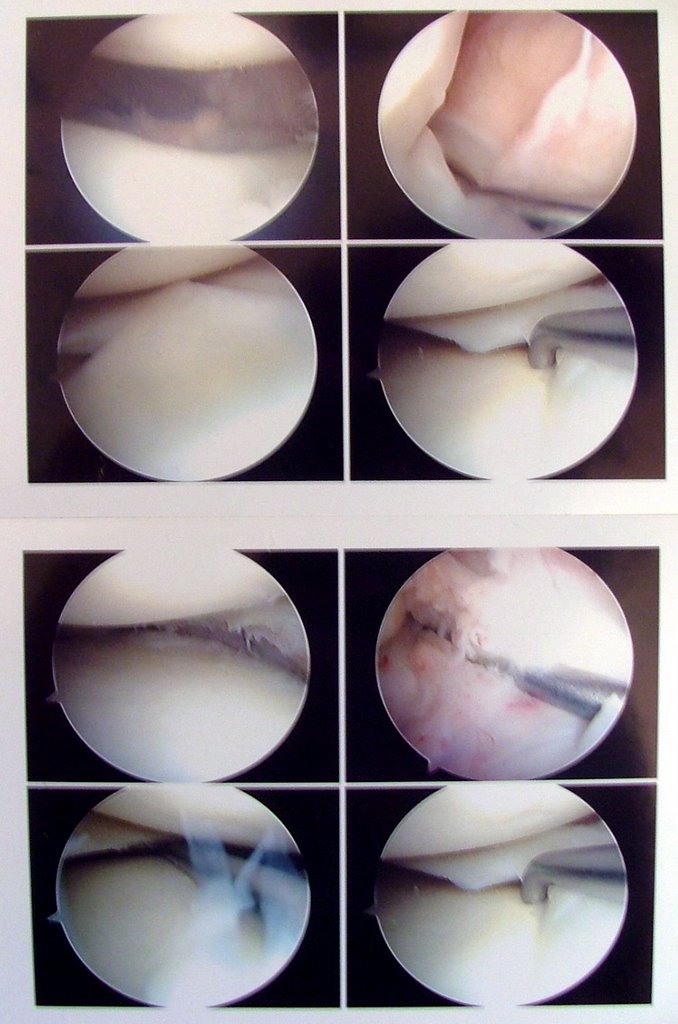
I’d love to tell you what’s going on in those pictures, but I’d be lying if I claimed to have a clue. The next thing I had a clue about was a nurse (who was German and must have been pretty as I started trying to talk German to her before I remembered that I can’t) gently waking me up and asking me how I was feeling.
I don’t remember being wheeled back to the day ward – I presume I fell asleep – but that’s where I ended up. I drifted in and out of sleep for an hour or two. I ate a sandwich. I chatted with the other patients as far as that was possible; it must have looked like a narcolepsy ward as we all kept drifting off mid-sentence.
What I did manage to glean was that the others had serious problems compared to mine. One was in the later (but far from final) stages of recovering from “An Alan Smith, but worse” while another had just had the same surgery as me, but only so they can then decide how best to go about repairing his torn cruciate ligament.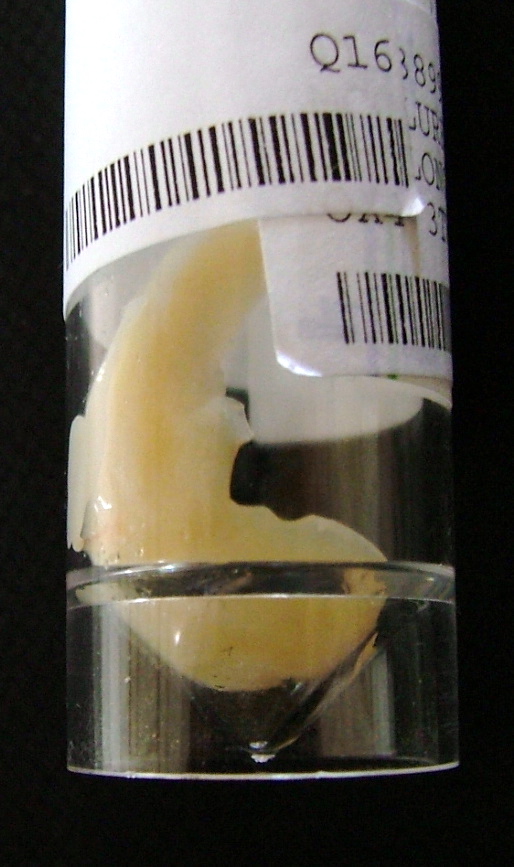 As I lay there thinking about how lucky I am that my recovery time will be so much shorter than either of theirs, I also thought about how, when it comes time to play the Olympic football match, I will definitely be playing in goal.
The surgeon arrived shortly after the last day patient was returned to his spot in the room and talked us each through how it had gone and what happens next. Mine went swimmingly. They removed what they had to remove (the “vast majority of the medial meniscus”), left what they could, and expected me to be in good shape when I come back to see them again in six weeks. At the moment (as you can see) I’m not in such great shape – at least not to look at – but I’m definitely improving each day and have finally laid off the painkillers that would have made an earlier blog entry even more impenetrably dull. I suspect that the first consultant’s guess that I could be doing a bit of light jogging after two weeks might turn out to be somewhat optimistic, but it won’t be too much more than that I hope.
 For now though, I’m hobbling about (with crutches if I’m going further than the fridge) very slowly and filled with even more admiration for the athletes in the Commonwealth Games than I was before I couldn’t bend my leg.
If the sight of all that naked, swollen, nasty flesh has you feeling slightly sick, there are some pictures of my niece looking cute at her christening last week here to make you feel better if you’re into that sort of thing.
It's Only the Commonwealths

Without doubt, the athletes take these games very seriously – apart from anything else, the opportunity to compete in a games on this scale can only benefit athletes preparing for the Olympics in 2008 – but they’re just not the same.
It was summed up for me in a TV interview I saw with Chris Hoy a few nights ago. He said all the right things throughout the interview until the very end.
“You just hope that all your training will stand you in good stead. You hope to remain calm enough to get out there and perform like you know you can on the night. The last thing you want is to freeze up on the night when this is something you’ve been training for… for four years… effectively.”
That stray “effectively” gave him, and the importance of these games, away. He won the Olympic gold medal in the one kilometre time trial in the velodrome in Athens two years ago. Try as he might to convince us that he has been training for the Commonwealth title for four years, I’m fairly sure that three years ago, when he was getting up early and training his massive heart out all day, it was Athens 2004, not Melbourne 2006, he was thinking of when he was pushing through the pain barrier.
Further testament came after he eventually finished third in the 1km time trial. He was interviewed again, still slightly out of breath from his race. He gave it his all, he said. He couldn’t have asked for more, he said. He felt he did a good time for the conditions and was happy enough with his performance, he said. He didn’t say he wasn’t that bothered and that it was a good building block for the Olympics in two year’s time, but he might as well have done.
Jason Queally was similarly magnanimous having finished second. Himself a former Olympic gold medallist and world champion, he seemed remarkably full of smiles for a man who had just had to settle for his third Commonwealth silver in a row.
They both praised the winner and said they were happy for him. It was hard not to be.
And therein lies my problem with the Commonwealth Games – they seemingly mean so much to some, while meaning much less to others. As delighted as I was to see the Australian’s reaction, there was still a bit of me whispering silently at the television “Calm down, mate; it’s only the Commonwealths.”
Having said all that, of course I’ve been glued to the TV since they started and will continue to be at every opportunity until they finish.
The Commonwealth Games always produce some wonderful stories and impressive feats - in beating England in the final to win the rugby sevens gold medal this morning, New Zealand maintained a remarkable unbeaten record in the history of that sport’s involvement in the games – and as cynical as I may sound about how important they are, for many young athletes (like Ben Kersten), this will be their first and biggest taste of a games of any sort.
They are special in their own way and, if they do nothing else, they highlight by way of contrast just how important the Olympics are.
For someone from Britain (or perhaps, in the spirit of the Commonwealth Games I should say ‘Northern Ireland’), another highlight is that when someone from the English team wins a gold medal, we don’t have to sit through that dreadful dirge of an anthem that entreats a God who has better things to do to save a woman who should be more than wealthy enough to be looking after herself.
Land of Hope and Glory is vastly superior, even if the ending sounds like it should segue into the theme from Star Wars.
***
My own athletic prowess has not improved any since last I wrote. I only have a few more days to wait before I finally get the surgery I need to fix my knee. A couple of weeks more taking it easy after that and then hopefully I'll be back to some kind of training in April.
On the plus side, I heard from one of the cyclists interviewed in Melbourne that he finds it extremely beneficial to his training to sleep for 12 hours a day. All this time I've been half an Olympic cyclist and I never knew it.
Bully's Special Prize
 It has been a slow time for Olympic events of late - I'm injured, I'm lazy, I'm smoking again - all of which is not helpful when you're still 114 events short of your target. At least I have good friends though, one of whom (Mr van de Poll) very kindly bought me some sporting equipment for my birthday in an effort to get me motivated again. I think you'll agree, the man is inspired (see above).
Unfortunately, said sporting equipment hasn't done much to motivate me away from my injured, lazy, smoking ways. The requirement to be in the pub when I'm using my new personailsed darts is slightly hampering my return to the straight and narrow, but what's a guy to do? I can't very well go letting John think I don't really appreciate the thoughtfulness of his gift now can I?
The more observant among you will notice from the tear in the flight featured above that I have at least been throwing said darts with great athleticism.
Surgery is still scheduled for next Tuesday. It will be a corner and I will turn it. I will stop smoking just as soon as I can go running every time I feel the urge to light up, and I will be back making a fool of myself in the name of raising money for Sobell House and entertaining you lot before you know it.
100th Post!
After 18 months of the challenge, this is the hundreth post. To celebrate, have some video footage of me falling out of a boat. The footage was shot by Tim last April in Nottingham. This was a racing canoe and the narrowest thing ever to be put in the water. I think I did well to make it the 40 yards I did before this happened.
Nice!
Did I say Friday?
"I love deadlines. I love the whooshing noise they make as they go by."
- Douglas Adams (1952-2001)

Lazy Bones
Every day when I get into work, just to ease myself into the day, I go online and surf to several of my favourite websites. Most days, there is something new there for me to look at – whether it’s a link to an interesting article (with an accompaniment of apposite comments from the members of the site) on Sportsfilter, a new statue photo on Stand By Your Statue, or a new set of amusing observations on one or other of my favourite blogs – it’s a rare day indeed when none of them have changed from the day before.
On those rare days however, I find myself feeling quite disappointed. I hadn’t realised until this morning that I may be inadvertently fuelling that sense of disappointment in others. This morning, I surfed to my own site – this site – and, forgetting momentarily that I am the sole contributor, felt disappointed that there wasn’t any new content since the last time I looked at it.
I don’t have much to tell you at the moment - I am still awaiting surgery on my knee (on 21st March), after which I will hopefully not take too long to get back to trying my hand at Olympic events – but it’s an unusual day indeed that I don’t have anything at all to say. As such, I have resolved to make this entry the first in what will hopefully become a Friday routine. No doubt, as the year progresses and I get back into training and eventing, there will be times when I need more than one post in the week, but from now on, loyal (and much abused) reader, regardless of other posts, there will always be one on a Friday.
Having said that I didn’t have much to tell you, I suppose there are a couple of things you might not know about (unless you know me personally – in which case you will be sick of hearing me bleating on about them).
This day last week, I got a call from BBC Radio Oxford at lunchtime to see if I would do a live interview with Sybil Ruscoe on the drivetime show at 4PM. Obliging sort (and media whore) that I am, I agreed to wander (or limp) up to the studio and spent a very pleasant half hour yacking on the radio with the sports-mad Ruscoe.
Statue John recorded the whole show in Real Player, and as soon as I can figure out how to edit out the bits I’m not in (and therefore make the file a manageable size), I will pop it online for you.
I’ve also started writing a monthly 200 words about what I’m doing for the Oxford Courier Journal – a local free newspaper. I’ll scan the first instalment over the weekend and put it on here. The second is due to be published soon.
Otherwise, all is fairly quiet. I’m getting frustrated with my injury now and 21st March seems a long time away. I’m assured that after the surgery I shouldn’t be out of action for more than three or four weeks, but it’s going to take time to build up muscle mass again, and I’ve been limping so long now, it seems odd to imagine walking any other way.
Essentially, I have fallen into the trap that all injured athletes must face. My knee injury should in no way have prevented me from lifting weights or even swimming with a leg float, but I have resorted instead to eating pies, smoking cigarettes and playing x-Box whilst lying on the sofa and feeling sorry for myself.
Part of the problem is getting around – I can get where I need to go, but the limping makes it take longer and tires me quickly – but in truth, that doesn’t seem like such a problem when it is a card game or a night on the beer I’m trying to get to instead of the gym or the pool.
There's a Hole in My Bucket
Having flown back from Dubai (where I failed miserably to get to the firing range) on Wednesday, I had an appointment with the knee expert yesterday. My MRIs were back and the diagnosis was complete. There's a hole in my bucket.
The image above demonstrates what a bucket handle tear of the medial meniscus looks like in cross-section from above. That's what I've probably had for quite some time, and have at this very moment.
The image below demonstrates what a displaced bucket handle tear of the medial meniscus looks like in cross-section from above. That's what happened when I knelt down to pull a plug out of a wall a few weeks ago.
My knee has improved a lot since that happened - in fact, my bucket handle tear is no longer displaced, which is obviously great - but I'm walking around on a time-bomb that may explode (or, to be more medically accurate, displace) at any moment.
In short, the cartilage has to come out, but it's not urgent. I've been given the all clear to go to the US and play golf next week as planned, but as soon as I get back, I need to get to the hospital and have an arthroscopy to remove the offending bucket and its dodgy handle.
I mentioned to the surgeon that I have rather a daunting athletic programme lined up in the months to come. He said that was fine, but only if it was a one off - I could probably make it through the training and running of a single marathon, but if I decided to take up marathon running long term, I'd be likely to have arthritis in my knee by the time I'm 35. Likewise, he said, contact sports like rugby or football would have to go too.
I almost found myself being upset by that, until I remembered that I loathe jogging and don't play either rugby or football.
I asked him if I could film the operation and post it on my website. He told me I was a freak, but he didn't say no.
I'm off this afternoon back to Belfast, then (on Sunday) I'm heading to the US with my dad to play some golf (bucket handle permitting) and do some hardcore relaxing. Having failed to find the time in Dubai to visit a shooting range, I will do my utmost to fire a gun while I'm in the states; I hear it's virtually mandatory.


A Shot in the Dark

In my current hobbled state, my choice of events to have a go at in the near future has become rather limited (to shooting and archery). Looking down the list of shooting events I still have to complete, I remembered a snippet of information I gleaned from the Oxford University Pistol Club (who only shoot air pistols), namely that two of the events are illegal to perform in this country.
As a direct result of the tragedy in Dunblane in 1996, a law was passed the following year making it illegal in the UK to buy or own a handgun. One consequence of the passing of that law was that British Olympic handgun shooting hopefuls had to find somewhere else to train. At the moment, many of the top shooters practice in Zurich.
I recently read this article by the Guardian’s Richard Williams, which suggests that Britain’s shooters should "stop whinging" about the pistol ban. His argument that a pistol is "fashioned for swift use at close quarters and for ease of concealment: for use, in fact, against another human being" is sound enough, but his suggestion for a solution to the problem of the handgun ban for competitive shooters is less so:
"there is nothing, it seems to me, to prevent the pistol-shooters from transferring their attention and their skills to long-barrelled weapons, thus satisfying the requirements of a perfectly sensible law while indulging their own enjoyment of firing bullets at targets."
Perhaps he would see the flaw in his logic if tomorrow the government introduced a law banning the writing of poorly thought-out columns in national newspapers and suggested he transfer his attention to writing novels in order to indulge his enjoyment of typing words on a keyboard.
Despite this jarring simplification, he raises an interesting point in the article. When the Commonwealth Games were held in Manchester, the shooting events took place (albeit under tight security), and when the games come to London, they will do so again.
I’m no expert on how guns work, but I have a basic understanding of the concept – there are two essential components, the gun and the bullet, which, when combined, turn two otherwise relatively harmless pieces of metal into a deadly weapon.
It’s a suggestion I’ve often heard from a friend who shot at school, and I’m rehashing it in its simplest form, but surely if you keep one lot of harmless metal in one location and the other lot of harmless metal in another location, and then ensure that the only time they ever come together is in the strictly controlled environment of a firing range, the problem would be solved. The shooters could practice their shooting without having to go to Switzerland, and the rest of us could sleep at night knowing that we hadn’t left the door open for another Thomas Hamilton to walk through.
I don’t have the time to wait for a change in the law though, so, when I head to Dubai next week with work, I may see if I can get myself over to the Jebel Ali shooting range and have a go at the 25m rapid fire pistol event. There’s a chance they may be able to help me get the skeet shooting out of the way too. I’ll keep you posted.
Knee update – the knee injury is improving and the swelling has pretty much gone down; my limp is now more man-with-stone-in-shoe than Gestapo officer. I have an appointment with the MRI department on Friday at lunchtime. Hopefully then I will learn the true extent of the damage and whether or not I’ll need to have surgery to fix it.
Limping into the New Year
Once again I’ve left it so long that this post should begin with a litany of apologies, excuses and resolutions to do better in future. Once again, that would be boring to write and more boring still to read, so I’ll save us all the trouble and skip to the latest update from the world of pseudo-Olympic foolishness.
Last weekend saw the publication of an article in the Oxford Times for which I did the interviews back in November while my attention was focused on telling the difference between a foil and a sabre. In all honesty, I’d forgotten to buy the newspaper at any point before Christmas and assumed the article had been published and, as usual, ignored.
This time though, as I was halfway out the front door on my way to the pub on a Friday evening, I got a call from Central News – ITV’s regional news programme. They had seen the article in the paper and wanted an interview the following morning that would feature on the lunchtime bulletin. Much to the detriment of my Friday night, I agreed to meet them (or just ‘him’ as it turned out) at the Iffley Road track at 10AM the next day.
It was cold, and wet, and despite my relative abstinence the night before my head hurt. I ran round the track a couple of times, and up and down the home straight a couple of times, and beside the camera a couple of times, and fairly quickly realised that I’m almost as out of shape as I thought I was.
Random-running-footage secured, we did a quick interview before I scurried off into the murky morning in search of a cup of tea, a copy of the previous day’s Oxford Times, and a video recorder at Jamie and Kate’s house.
The story in the newspaper was the usual cobbling together of words I may at some point have used. Much like hearing a recording of your own voice, seeing your words reported in print is only ever disappointing and slightly confusing. You’re sure they sounded better when you said them.
In a similar vein, my debut on ITV as an “And finally…” story was equally cringe worthy. All the well-structured, concise and important things I had to say went out the window the moment the camera was pointed at me and I mumbled something about the challenge being… challenging.
One thing of interest at the time, and even more so since, that I noticed about the TV pictures was the way I was running. Fortunately, the TV really does add pounds, so my Lycra running tights didn’t look quite as ridiculous on screen as they do in the mirror at home, but my running style did make me wonder if maybe I was carrying an injury I wasn’t aware of. I seemed to be labouring a bit on my right side.
Sure enough, having swum a few times at the start of last week and noticed a slight weakness in my right knee, it finally gave way on Sunday night. The knee clicked as I bent it, as it often does, but this time it also hurt, and when I tried to stand up again, I couldn’t.
To cut what has the potential to be a very long story a lot shorter, it would appear on first inspection by a knee surgeon that my medial meniscus (cartilage on the inside of my knee joint) may have torn. It’s possible I did the bulk of this damage months ago when I crashed my bike, and that since then my cartilage has been waiting like some biological time-bomb to explode at the least glamorous moment it could find.
When I fell off my bike, I did so during a three-minute cycle to the shops mere days after surviving 40km of competitive triathlon cycling without so much as a wobble. This time, my knee made it through the stresses and strains of some heavy-duty lunging while I fenced in November, only to snap like a dry twig when I knelt on the floor to remove the modem plug from its socket.
Under normal circumstances, I’d be clamouring for them to get on with repairing or removing the cartilage as soon as possible so I could get back to training for what I hope will be a summer jam-packed with Olympic endeavour. However, the mitigating factor of a long-planned trip to Florida in three weeks time to play golf has me sitting on the sofa with my leg elevated and iced in the hope that somehow it will get strong enough in the interim to allow me to still go.
The surgeon assures me it should be fine if I rest it between now and then. Once I’ve played golf and come home, he will then either repair or remove the cartilage. That’s all very encouraging, but I’m not sure he appreciates quite how violent my golf swing can be.
For the moment though, I’m going for that option, even if it does mean walking around like Herr Flick for the next few days.
Fencing Video
Matt Dodwell epées me to pieces. I'm a bit new to the video technology here, but it seems to work better the second time you run it for some reason. Things to look out for when you do: Matt's level shoulders compared to my continually tipping ones; Matt's neat parries of my useless lunges compared to my wild flailing at his feints; Matt's expert touch on my foot to score the point compared to my accusing look at that foot after he has done so.
Fencing
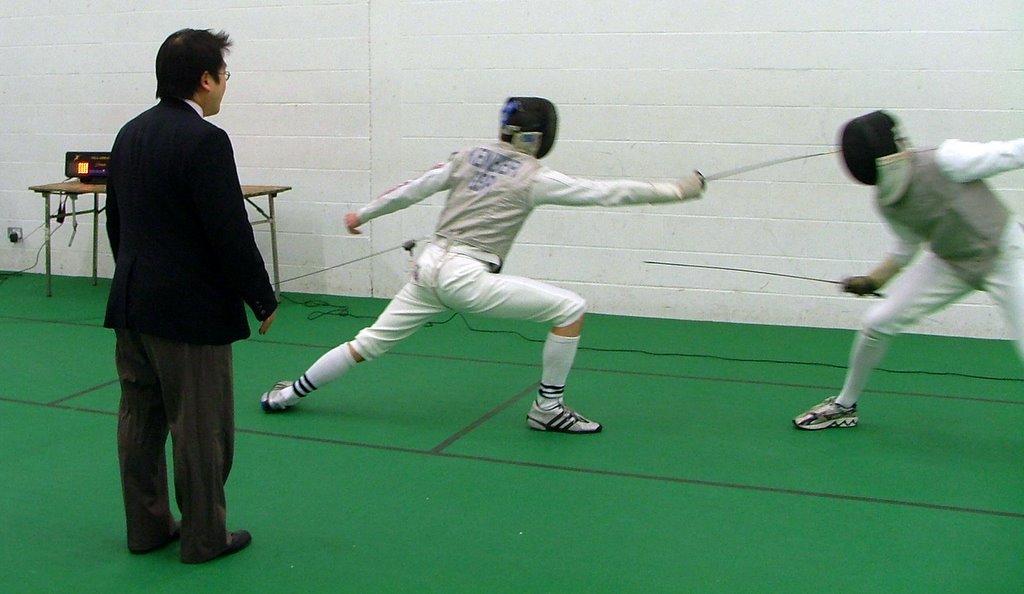
Fortunately the mask is very good at stopping you losing an eye.
I lunged. I parried. I feinted. I remised, reprised and reposted. And I lost. Heavily. Three times.
First up was the foil verses Jamie Kenber. They could make getting dressed for fencing an event in itself, but then I suppose it is rather important to do it right for safety’s sake. Suitably togged (and wired) up, I took my guard against the reigning British champion, with Ken, resplendent in blazer and tie, presiding.
“En garde!”… check… “Are you ready?”… are you joking?… “Fence!”…ok, here we g…oh… that’ll be one-nil then will it?
And repeat.
Fifteen times in a row.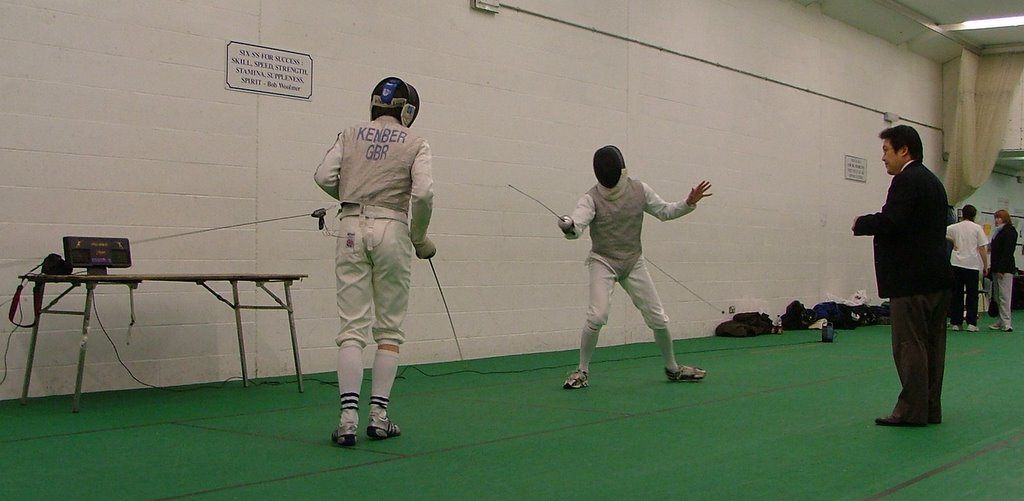
The British Champion waits for me to make a false move before striking. He didn't have to wait long.
To say that Jamie Kenber is rather good at foil is like saying that George Best wasn’t bad at football. Fair enough, I suspect any of the rest of the foilists in the room could probably have beaten me 15-0 too, but at least half the times he hit me he did it so fast and so accurately that the sound of the buzzer genuinely surprised me because I hadn’t felt a thing.
Afterwards, as I dismantled my foil outfit and started trying to work out how to put on my sabre gear, while Jamie put on his jeans and started trying to work out what to do with the rest of his evening, he confessed that he wasn’t quite at his best at the moment as he’s carrying a bit of a back injury. All I can say is God help the rest of you foilists when it clears up.
After a quick breather, it was on to the sabre verses Michael Coombes. Having spent pretty much the whole of the first fight like a rabbit trapped in some particularly transfixing headlights, I was determined to get a bit more aggressive in this one. “Fence!” cried Ken. I bounded forward and got slashed on the head for my trouble – time for a rethink.
Michael Coombes's attacks were relentless. So was my failure to do anything about them.
Time and again Michael came at me and I failed utterly to parry his attacks. Time and again as we shuffled back to our marks I did that thing that batsmen and golfers do after a bad shot – I replayed the parry in the air as I would have liked to have done it a moment before and shook my head ruefully. This was a fairly good indicator of how far behind the game my brain was working – I was just about ready to parry the previous attack as the next one began.
Finally, I dug my heels in and remembered the odd fragment that people had worked so hard to teach me over the previous three weeks. I initiated an attack of my own. It was easily parried, and the reposte would have severed my jugular vein had I not been wearing the mask, but it got me thinking that just maybe I might get a point.
With my next attack, I did! As had been the case with most of the other clashes, I’ve really no idea what happened, but the buzzer buzzed and Ken pointed at me and announced that the score was now 10-1 in Michael’s favour. I carried on with my attacking strategy. It didn’t work. I lost 15-1.
By now, I was exhausted, despite having done in total (if you don’t count getting into and out of the gear) about 3 minutes exercise. The layers of protective clothing are very reassuring when someone is waggling a sword at you, but it ain’t half hot under it all.
I stripped down out of the sabre gear and set about dressing for epée. My opponent this time was Matt Dodwell, silver medallist in the British Youth Championships and 3rd ranked junior in the country at the moment. He’s also a good couple of inches taller than me and has a reach like Michael Phelps touching the wall.
Matt Dodwell advances with his big long arms, preparing to stab me in my big fat head.
As I was walking back to the piste Michael, my previous opponent, took me to one side and offered some last minute advice. It was kind of him, and I wish I could have repaid that kindness by remembering what he’d told me before I found myself 7-0 down again. Finally I did remember – “just stick your arm out as far as you can when he attacks and you might get a simultaneous hit” – and did as I had been told. My reward was my second (and last) hit of the night.
In truth, it slightly backfired as a tactic. Much like when Liverpool score early in the Champions League, I couldn’t help but feel like I’d only succeeded in making the opposition cross. With his next attack, he fleched. A fleche is essentially running at your opponent and hitting them on the way past. He later told me it was one of the best ones he’s ever done. The fact that I offered such pitiful resistance perhaps contributed to that.
As Matt reaches in hit me on the foot, I desperately try to parry to avoid him ripping my very attractive socks.
From there on, he pulled out all the stops, hitting me with absolute impunity on the foot, the head, the arm, the chest and the throat. I mostly didn’t have a clue what was going on (that’s true in general, but particularly so whilst fencing), but Ken informed me afterwards that I’d been done very artfully by a real expert.
And so the fencing came to an end. I have enjoyed it thoroughly. I can see why it’s not a more popular spectator sport – it’s too fast to follow unless you’re an expert and you know what to look for – but from behind the mask, it’s very exciting.
I spent most of last night feeling like I was letting down all the people who had given me so much of their time in recent weeks. I felt like everything I’d learnt went out the window the moment Jamie Kenber stabbed me in the chest before I’d even reacted to being told to fence. My teachers had stoked me up with numerous techniques for parrying and attacking, and I’d practiced them at home (La Vache is cut to shreds) until I felt reasonably comfortable doing all of them. In the fights though, it was fairly pointless knowing how to parry a certain attack when my eyes couldn’t move fast enough to see the other guy’s sword most of the time.
But then I got home and watched some of the video footage. Their teaching wasn’t entirely wasted. My feet were quite often in the right place, and occasionally I did manage a parry, not to mention the two glorious points I scored. I was glad to see that my body managed to reproduce some of what I’d learnt, despite my brain’s strongest urging to my legs to turn tail and run.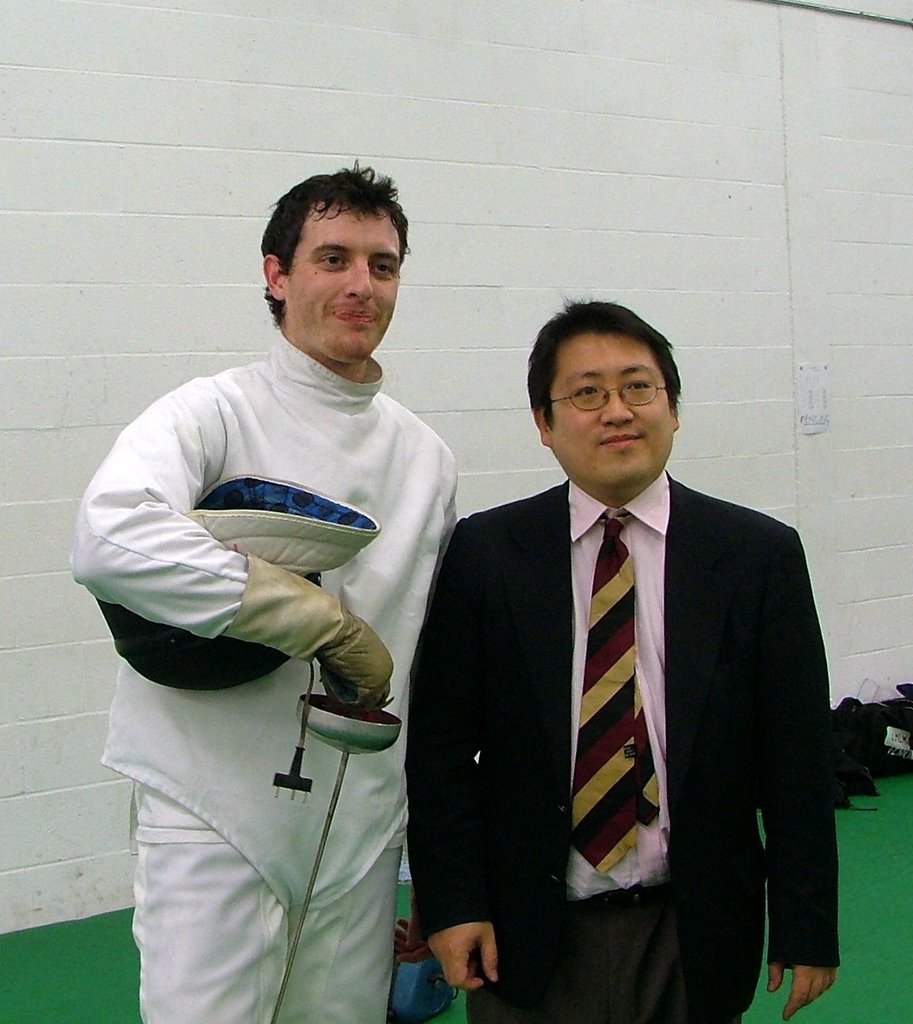
Ken pulled out all the sartorial stops in his role as president.
Huge thanks to the Oxford University Fencing Club – to Ken for his coaching, presidency and kind donation to Sobell House; to Jamie, Michael and Matt for spending time thrashing a novice; to Alex, Alec and particularly to Ellie for all their coaching and encouragement; and to all the rest of the members for putting up with a duffer taking up one of their pistes all night and for not laughing too much at his efforts.
Also, thanks as ever to the fan-base – to the other Johns, Kev and Tracey for taking the photos, shooting the video and making the sarcastic comments throughout. I’m nothing without you people.
Fencing Results
Foil
Lost to Jamie Kenber, 15-0
Sabre
Lost to Michael Coombes, 15-1
Epée
Lost to Matt Dodwell, 15-1
Fencing Preview

“The three swords used in fencing competitions are the foil, the epée and the sabre.
The foil has a flexible rectangular blade with a blunt point. Touches may be made with the point on the trunk of the body between the collar and the hipbones.
The epée, the traditional sword of duels, has a rigid triangular blade with a point that is covered by a cone with barbed points. Touches may be made on any part of the body.
The sabre is a flexible triangular blade with a blunt point. Both the point and the cutting edges can be used to score touches, which must be made on the body, above the waist, including the head and arms.
In all events, a wire is attached to the fencer’s sword. This wire runs through the fencer’s outfit to a scoring box. When contact is made on the opponent’s body, a light flashes on and a buzzer sounds to record a hit.
Over the years Olympic fencing tournaments have used a variety of formats incorporating both round-robin pools and double-elimination rounds. The format currently in use is a single-elimination tournament, such as is used in boxing and tennis.
Each match is played to 15. If the score is tied after nine minutes, one minute of sudden-death overtime is contested. Before the final minute, the referee determines, through a coin flip or drawing of lots, which fencer will win should no touch be made in the additional minute.”
[with thanks once again to David Wallechinsky and his wonderful book, The Complete Book of the Olympics]
The history of fencing in the Olympics is rich and dramatic. For all my chuntering on recently about my chances of getting sliced, diced, chopped, skewered, stabbed, slashed, hacked or in any other way run through, I was mostly just trying to make it sound exciting for you and was fairly confident that all the protective gear one has to wear would do its job. Then I made the mistake of doing some light research.
In the games in Moscow in 1980, during the semi-final of the team foil competition, the Soviet world champion Vladimir Lapitsky was accidentally run through the chest when his opponent’s foil broke his leather protective clothing. The sword severed a blood vessel but missed his heart.
In 1982, two years after winning gold in the individual foil competition in Moscow, Soviet Volodymyr Smirnov was fencing West German Matthais Behr in the world championships (which Smirnov held at the time) in Rome. During the fight, Behr’s foil snapped, pierced Smirnov’s mask, penetrated his eyeball and entered his brain. The 28-year-old Smirnov died nine days later.
Almost as bad is the number of times some light-hearted, albeit competitive, swordplay sparked such bad feeling that the protagonists resorted to actual duels in order to settle their differences.
After a dispute in 1924, the Italian-born Hungarian fencing master Italo Santelli, who was 60 years old at the time and coaching the Hungarian foil team, was so insulted by the Italian team’s accusations that he lied to an official in order to get them thrown out of the competition that he challenged Adolfo Contronei, the Italian captain, to a real duel.
They acquired permission from the government to have at it, but before they could meet, Santelli’s 27-year-old son, Giorgio, invoked the code duello and demanded that he fight in his father’s place. They met on the Italian-Hungarian border and fought with heavy sabres. After two minutes, the younger Santelli caught the Italian captain with a blow to the head that left a deep slash. The duel was stopped at that point by doctors who were in attendance.
The same games inspired another duel between an Italian and a Hungarian. This time, the former, Oreste Puliti, was a fencer and the latter, Kovacs, a judge who accused the Italian’s opponents of throwing their fights. Puliti was outraged by the accusations and threatened to cane Kovacs, and was thus promptly disqualified.
Two days later, the pair bumped into each other in a music hall. The Hungarian judge listened to the ranting Italian and then haughtily told him he couldn’t understand a word he had said, as he didn’t speak Italian. Puliti punched him in the face and asked if he had understood that any better.
The men were pulled apart, but a formal duel was proposed. Four months later, this time on the Yugoslav-Hungarian border and accompanied by seconds, swords and spectators, they got stuck in again. After an hour of slashing away at each other, the spectators separated them having grown concerned about the severity of their collective wounds. Their honour restored, the two men shook what was left of their hands and made up.
In fact, looking through the history of the Olympic fencing events, the only possibly useful tip I picked up came from the 1928 Amsterdam games. Frenchman Lucien Gaudin became one of only two people ever to have won both the individual foil and epée gold medals. His countryman and opponent in the final of the epée, Georges Buchard, later claimed that Gaudin had begged and pleaded with him to allow Gaudin to win their match – so much so that Buchard agreed to do so.
As for my opponents for Thursday night, I’ve only really met one of them.
Matt Dodwell fights epée, is the current British junior number 3 and won the silver medal in the British Youths Championships this year. He is left-handed. While this will make him more difficult to fence, I have the consolation that it will apparently “look better in the photographs”. I watched him briefly last week as he fenced Alec (who later put me through my paces). I’d love to be able to say that I spotted a weakness that I intend to exploit – other than a curious leaning towards a pint of cider rather than stout in the pub afterwards, he seemed a perfectly balanced individual - but the truth is that I’m not even good enough at fencing to realise what makes other people good. That said, I suspect the fact that he’s comfortably taller than me and has fenced at various levels for his country might just give him an edge.
I also watched Michael Coombes fence sabre last week. Michael was 3rd in the Public Schools Senior Boys Sabre Championships this year. Even with Alex telling me exactly what was going on as each touch was scored or missed, all I was seeing was a frantic mêlée of arms, swords and feet that every so often would stop when the scoring box would buzz for no reason I could discern. It got me wondering if perhaps this is the reason fencing is not a more popular event at the Olympics - I was fairly avidly glued to the TV for the duration of the last games, but I’m not sure that I saw even an edited highlight – perhaps the technicality of it all requires a higher understanding or intimate knowledge of the sport on the viewer’s part than is generally the case in order to appreciate what’s going on.
There are rules of priority that are hard to bear in mind when your mind is already full of where your feet should be or how bent your elbow is. These rules essentially mean that on some occasions, while it may look like one fencer has scored a clear hit, it is in fact the other swordsman who gets the point. As a beginner, after a while, it can begin to feel a little like a sport someone is making up the rules of as you go along in order to make sure you don’t win.
The only thing I did notice about Michael’s style that may be helpful was that he likes to move forward – then again, perhaps the chap he was fighting simply likes to retreat – either way, I’m going to adopt a tactic of running at him as fast as I can to see if I can upset his natural game. This tactic might rank up there for stupidity alongside my long held game plan should I ever find myself playing snooker against Ronnie O’Sullivan to hit the balls all over the table and disrupt the patterns he’s used to playing within.
My foil opponent is Jamie Kenber. I’m almost sure I’ve seen someone at the fencing club with that name on his back at least once, but I can’t bring his style to mind. All I really know about him is that he is ranked ninth in the senior British rankings and is the current British foil champion. In the final he beat one Richard Kruse, who fought for Britain in the Athens games. I made the mistake of looking in the Team GB official Olympic report tonight to see how Mr Kruse had done. He got to the quarterfinals, which by my (perhaps skewed) reckoning makes him one of the best eight foilists in the world. He lost out to the man who eventually took the bronze medal.
His performance was the best by a British fencer with any weapon since 1964 when Henry Hoskyns, a 33-year-old fruit farmer from Somerset, finished seventh in the foil and won the silver medal in the epée. Kruse's achievements were all the more impressive given that he had only recently graduated from university and was fighting professional opponents with superior back-up and training facilities. And then he came home and Jamie beat him. And now I have to fight Jamie. So that should be easy.
Perhaps I’ll try some of that begging and pleading after all.
Strictly Come Fencing
I have a confession to make. Anyone who knows me and has had the misfortune to find themselves on the dance floor when I take a notion to strut my stuff will be aware that I’m not a fan of conventional dancing. You can keep your regimented steps and synchronised movements; I’m usually the one in the middle annoying everyone with the randomness of my gangly gesticulations. This lack of fanaticism for all things Fred Astaire extends to watching other people indulging in such activity – Strictly Come Dancing? Strictly No Thank You.
And yet, perhaps worse than tuning in on a Saturday night to watch seasoned professional ballroom dancers guide gormless celebrities through a quickstep or a jive in an attempt to survive the dreaded public vote, I’ve caught myself several times this week not changing the channel when the nightly magazine programme that accompanies the weekly series appears on my television.
Strictly Come Dancing – It Takes Two (for that is what it is called) tracks the trials and tribulations of the clueless amateurs as the professionals try to teach them a new dance in preparation for the following week. Tonight, I caught myself watching it again and also noticed that I have been doing so rather more than someone with no interest in that sort of thing ought to – and certainly rather more than someone who has never watched the actual programme proper.
I’ll admit to having a slight soft-spot for the host, Claudia Winkleman, and that her penchant for a plunging neckline has done little to make me want to switch channels and watch ITN butcher the day’s news, but there’s something deeper going on. As I sit here writing with the show on in the background, I should instead be dancing up and down the living room wielding a sabre and attacking an ironing board. The reason I’m not practicing my fencing as I should be is that I’m enjoying watching other people going from a position of being all at sea to dancing a waltz as though they’ve been doing it for years.
Just now, I nodded with rueful recognition when Zoë Ball confessed to messing up her foxtrot because she forgot which foot she was supposed to start on. I felt Goughie’s pain when he grimaced with frustration at not being able to do the five things he’d been told to do all at the same time.
In an hour, I’m heading off for my last training session with the fencers before they slice and dice me in the three fights next week. Learning is repetition. If you’re the pupil, you do something wrong in a slightly different way over and over and over again until you get it right. Then you do it wrong again and swear a lot because, damn it, you had it mastered a minute ago!
If you’re the teacher, you tell the pupil the same thing in a slightly different way over and over and over again until something clicks and he gets it right. You commend him far too much for finally doing what you told him to do in the first place, and then you laugh at him when he messes it up again and gets cross.
I’ve said before, but will say again, that I greatly admire the patience being displayed by the people trying to teach me; it outlasts my own without fail and by a long, long way. The one thing I am learning better than anything else is that learning itself is much easier to do when you’re a child and repetition (as you will no doubt know if you have ever encountered a child who is asking for something) is just about your favourite thing in the world.
UPDATE:
Jamie Kenber (foil) is the current British Men's champion, beating British Olympian Richard Kruse in the final this year. He is currently ranked 9th in the senior rankings.
Matt Dodwell (epée) is current British Junior No.3 and was the silver medallist in the British Youth Championships this year. He is currently ranked 21st in the senior rankings.
Michael Coombes (sabre) was 3rd in the Public Schools Senior Boys Championships this year.
All three are members of the University of Oxford first team.
You can think of them as the three musketeers. I shall be thinking of them as the three guys who have very kindly offered to come along and chop me into little pieces next week.
Different Strokes

What a different place he world of high jump would be had Dick Fosbury not thought of having a go at it backwards.
I’m a dreamer. I’m reliably informed by John Lennon that I’m not the only one, but still, that’s what I am. One recurring daydream that started shortly after I came upon the notion of doing all this involves discovering that far from being blunderingly inept at all things Olympic, there might just be an event that I’ve never tried before but turn out to be astoundingly good at.
In idle moments I imagine the Great Britain pole vault coach scratching his head and looking at a clipboard as I fall back to earth having cleared the bar by a foot. He is confused and exclaiming “But… that’s a British record. By half a metre. You’re in the team for Beijing.”
I confessed this dreaming habit just now to my colleague and friend Statue John while we smoked very un-Olympic cigarettes in the alleyway beside our office. He confessed in his turn that he has spent many idle hours thinking about “doing a Fosbury” – coming up with a revolutionary technique for performing one of the events that ensures victory despite a lack of what is commonly held to be the usual physical requirements of an Olympic champion.
At the 1968 games Fosbury revolutionized the sport of high jumping with just such a new technique, which became known as the Fosbury Flop. Instead of leaping facing the bar and swinging first one leg and then the other over the bar in a scissoring motion - the dominant method of the time - Fosbury turned just as he leapt, flinging his body backward over the bar with his back arched, following with his legs and landing on his shoulders.
The best John and I could come up with was some new swimming technique that would allow you to win the 50m Freestyle despite having a massive beer gut, baggy swimming trunks and (John insisted) a lengthy mullet unrestrained by anything so naff as a swimming cap.
Certain events heavily regulate techniques – for instance, I’m fairly sure that John’s suggested new long jump technique involving landing headfirst and rolling forwards (anyone who has seen the A-Team will know that such a technique can carry a man far enough to land a safe distance from and exploding jeep) would not only result in a concussion but also be against the rules of the event.
But others (like freestyle swimming and most of the track events) just involve covering a set distance as quickly as possible. Michael Johnson has a fair claim to being one of the greatest track athletes of all time, and he modelled his running style on that of an ostrich. His coaches told him it wouldn’t work, but he refused to listen (his training partners had to tell him he had gone a bit far when he started burying his head in the long jump pit mind you).
So rack your brain, loyal reader, and post a suggestion – be it pole-vaulting with a pole twice as long as the ones the experts use, or paying homage to Dick Fosbury by running the hundred metres backwards – all suggestions will be heard. And then roundly mocked, no doubt.
On Guard!
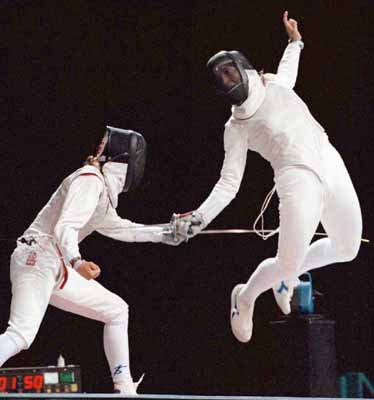
In between fights, fencers like to get together and practice their high jump technique.
Fencing is one of only four sports to have been included in all of the modern Olympic games. It’s also one of those things that every man who never really grew out of being a little boy would really rather like to good at. Whether you fancied yourself as Errol Flynn’s Robin Hood, Oliver Reid’s Athos, or (in my case) Guy Williams’ Zorro, sword fighting was something no young boy with access to a couple of sticks and a willing accomplice could resist.
Thanks (once again) to Kev Game and his remarkable ability to pull strings, I found myself last night in the Cricket Schools at the university sports centre, surrounded by sword-wielding experts dressed up like svelte bee-keepers. I was looking for Ellie, the kind soul who has offered to teach me the foil (one of the three fencing disciplines – the other two being epée and sabre).
Our plan, hatched by e-mail, had involved me coming along to a practice session and being put through my paces. It was a good plan, ruined only by my latest embarrassing injury. It was bad enough making it through forty arduous, high-speed kilometres of cycling in the triathlon without so much as a wobble only to come crashing to the ground a few weeks later cycling to the shops one Sunday evening, but this time, I may have outdone myself.
I’ve had a bit of a cough for a few days (I’m no doctor, but I suspect that walking home from a nightclub at five in the morning with my shirt open to the waist may have had something to do with it). The cough was just beginning to subside, but it was determined not to go without a fight. During one particularly violent outburst, I somehow managed to strain a muscle in my right side. It’s a tiny muscle – one I didn’t even know I had – but one that seems to be fairly heavily involved in just about every movement I try to make.
Fortunately for me (and my aching side), the first steps in learning to fence would seem to be just that – steps. Having found Ellie and marvelled at how much consideration she seems to have given my quest (“We’ll try to get you fighting left-handers if we can. It’s harder, but it will look much better in the photographs.”), I was introduced to Alex, a sabre specialist, who took me through some footwork.
One of the toughest things about this whole challenge is learning how to do new things. I don’t yet consider myself an old dog, but I do seem to struggle with the learning of new tricks. When I first started giving some serious thought to the challenges I would face in trying to have a go at all the Olympic events, I expected a lack of fitness to be by far the largest obstacle to my completion of most of them. Naively, it didn’t really occur to me that a lack of talent would also be a problem.
As I stumbled backwards and forwards trying to keep my distance from the young lady pointing a sword at my head and reminding me (very patiently) to keep my shoulders level, I suspect I looked more like a man caught up in his first barn dance than Errol Flynn toying with the Sheriff of Nottingham.
I am lucky to have once been good enough at a golf that the odd beginner occasionally asked me for advice. I would do my best to offer it patiently and politely (in the manner it had always been offered to me), but I was constantly fighting the urge to bellow, “Oh for God’s sake, just hit the bloody thing!” As such, I have unending admiration for everyone who has thus far offered me coaching (in any discipline) and managed to resist bellowing the same thing at me. Alex and Ellie are two more such people to add to the list.
Once Alex had finished teaching me how to dance up and down the piste, and even run me through (a poor choice of expression perhaps) how to go about striking my opponent with a sabre, she passed me back to Ellie who introduced me to the foil.
As it turns out, there are five different guards one could adopt when fighting sabre, but Alex must have realised fairly quickly what level she was pitching at and just taught me the easiest one. Ellie had no intention of letting me off so lightly with the foil and was quickly talking me through the nuances of sixte, quarte, septime and octave. Luckily, she also sent me home with a book full of pictures to jog my memory.
If the helmet masked my puzzled expression, I suspect my teacher quickly revised the detail of her teaching plan when we started talking about instincts. Having told me that essentially every movement in fencing is “instinct refined and honed”, she tried to demonstrate her point my slowly lunging towards my left side.
“What would your instinct tell you to do there?” she asked.
“Well – to move my sword across my body and deflect your sword.”
“Very good! Then what?”
“Then I’d probably reach over and punch you in the face with my other hand and wait for a fellow musketeer to break a chair over your back.”
Despite my cavalier attitude, we hatched a new plan, the broad (if optimistic) aim of which is to get me through all three fencing disciplines before the student body disappears at the end of Michaelmas Term (so the beginning of December). They have their work cut out, but they sent me home with a helmet and a sabre so that I could get some practice in at home as my side improves. As such, I take great pleasure in introducing you to my new practice partner. I think I’ll call him ‘La Vache’.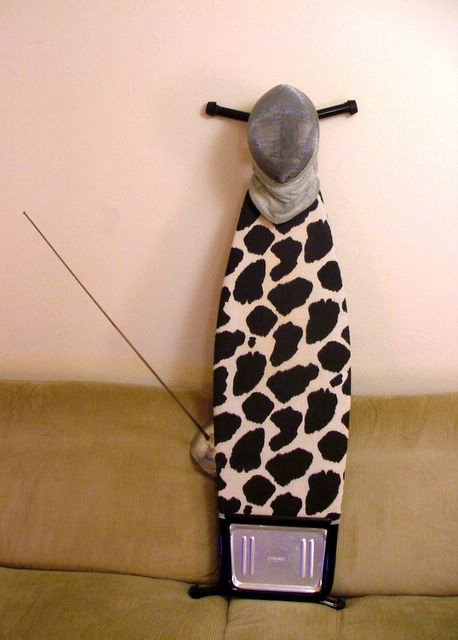
He may not look up to much, but the horns really freak me out.
In the eyes of the law, a sabre is considered a deadly weapon, and therefore not for carrying on the bus. Amazingly though, everyone was in agreement that the act of shoving half the blade into my umbrella was enough to render it legal and I set off for home with a helmet under my arm and a Bank of Scotland umbrella-sword at my side. I’m not so grown up that I won’t confess a certain feeling of satisfaction at paying my bus fare with a ten-pound note despite having change in my pocket. For once, the driver didn’t ask me if I had anything smaller.
Swedish Flatpack Inspiration
You may have noticed, avid reader, that inspiration and motivation wax and wane rather a lot around here. When I first set about this challenge, I envisaged many hurdles that I would have to literally and metaphorically clear, but I naively didn’t anticipate motivation to be one of them – or at least not as big a one as it’s turning out to be.
Of all the things that could motivate me – the suffering, bravery and determination of the beneficiaries of the charity money I’m raising compared to my own, the enormity of the task itself, the fact that I love sport – it’s funny that it took a recent trip to IKEA to kick-start my desire to train again.
My housemates, Jamie and Kate, are soon moving into their brand new home. They needed to go to IKEA with a van to get a couple of beds. I needed a new bed for the spare room. IKEA in Brent Cross is open until midnight. What else would we have done with our Friday night?
Meatballs and bed shopping out of the way, all that was left was to collect our purchases from the collection depot, load them into the van and head back up the M40 to Oxford. As we shut the doors of the van on our new purchases, it was just shy of midnight. By the look of some of the faces still milling about the collection depot awaiting their furniture, we had gotten off lightly.
As we manoeuvred about the car park trying to find the way out, we were approached by a couple of damsels in distress. Somehow, they had ascertained that we were from Oxford (I’m not sure if it was the “Oxford Vehicle Rentals” or the five-foot cartoon ox plastered all over the side of the van that gave it away).
“We’ve bought a wardrobe!” said damsel one.
“It doesn’t fit in our car!” said damsel two.
“Not a problem!” said the heroes, probably breaking some sort of white-van-man code of ethics in the process.
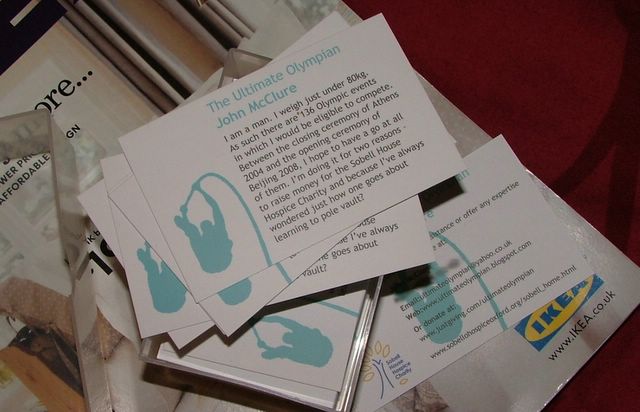
Before heading to IKEA that night, I had met Kev from Sobell House who had very kindly come into town to give me some new Ultimate Olympian cards for handing out to baffled newcomers to the cause. They have my mobile number on them, so I gave one to the damsels in case I wasn’t able to keep up with them on the trip back to their house.
By the time we reached the wardrobe’s new home, they had read the card and were most enthusiastic. Damsel one insisted upon giving us something for our trouble. I protested that we’d been coming back anyway. We settled on a donation for Sobell House instead.
As we drove home with our beds, I was filled with the warm glow of raising money for this cause I consider to be so worthwhile. I had been inspired to get my finger out and organise some more events in a way that Tim’s nagging could never have managed (don’t ever stop, Tim!). Perhaps most importantly, I was inspired to stop living this post-triathlon playboy lifestyle and get back into training.
I’ll admit that inspiration comes in waves and confess that I spent the next day at the Oval drinking and watching Australians fighting (and incidentally playing some sort of variant of rugby in the background), and then sat up until four playing poker and drinking some more. But in the course of the following week, I rode a few of those little waves of inspiration to the gym and the pool.
For now, I’m going to post this and then go downstairs and get Jamie to fill out an entry form for next April’s London Marathon while I do the same. If the fear doing that will instil doesn’t inspire me still further, I’ll begin to get slightly worried about my prospects of ever finishing this challenge.
Missing In-action
“It is wonderful how much news there is when people write every other day; if they wait for a month, there is nothing that seems worth telling.”
O. Douglas – Penny Plain (1920)
And so it is that I’m sitting here in my study staring at the screen and wondering what to tell you. I have excuses for my absence, as always, but mostly you’ve heard them before, if not from me then from some other wannabe athlete with too great a liking of strong drink.
Sobell House are trying to get thirty people together to run next year’s (London) marathon. You have to enter before 21st October using a form in one of the official magazines. If you get in and want to run for Sobell House with me and several other suckers who have already said they’ll do it, e-mail me and I’ll get your name on the list.
Inspired once more by panic and a large dose of fear, I have been training twice already this week. Hopefully, over the coming days, I will also get back into the habit of boring you all silly with my nonsense.
Crash Bang Wallop!

This is what a real bike crash looks like. Mine was slightly less impressive.
It was bound to happen sooner or later. I had hoped that when it did happen it would be spectacular, that I’d be in my full cycling gear, preferably in a race, and preferably surrounded by terribly concerned (and attractive) female spectators. I am disappointed to report therefore that my first major cycling crash since I was seven years old came at about nine o’clock on Sunday night as I nipped up to the shops in my jeans and a t-shirt.
I lifted my helmet off its peg on my way out, and then lobbed it back into the house using the same logic as the idiotic motorist who doesn’t bother with a seatbelt on short journeys, as though accidents can only happen after a certain distance has been covered. I didn’t bother with my gloves either. It had never really occurred to me until I was sliding along the road on my palms that the thickly padded gloves might serve a purpose other than preventing my hands getting sore from too long clutching the handlebars.
I wasn’t completely reckless in my approach. I did have my lights on, even if the only good they did was to stop the passing cars running over my bike as it lay in the middle of the road and I lay against a fence wondering why no one was stopping to see if I was all right.
As for spectacular, the crash itself couldn’t have been much more mundane. There is a right turn at the top of my road. To avoid having to step out of my toe-clips while waiting for a gap in the traffic, I tend to edge onto the footpath shortly before it and negotiate it slowly with the pedestrians. On Sunday night, as I came up to the point I usually cross the road, a car overtook me, so I had to wait for the next break in the kerb. At least, it looked like a break in the kerb.
I could hear another car coming up behind me, so I stood up on the pedals and put on a burst of speed to be able to cross to the footpath safely. I was probably doing about 30 km/h when I hit what turned out to be an ever so slightly raised kerb (no more than two inches, if that). Just as I hit it, I was standing hard on the right pedal. The bike skewed out to the left underneath me and my leg pushed on through and met no resistance.
Still with the bike between my legs, I hit the ground with my right knee and right shoulder. As I bounced and got my hands out in front of me, the bike hit the kerb again and bounced out into the road. I looked up and saw a fence I was clearly going to end up hitting. I tried to lift my right hand to fend it off, with the result that when I finally came to rest, my right arm was wrapped up behind my back and wedged into the fence by my shoulder. My helmet-less head stopped just in time.
I lay there watching the cars pass for a moment replaying in my head the strange noise I had made when I came off. It wasn’t a terrified screech or an agonised howl, it was the sort of noise you make when you hear about someone doing what I’d just done – a slight “tut” followed by a cringe and a sort of empathising “oooooooh” that implies “That’s going to hurt in the morning.”
I wasn’t worried that I’d done anything serious until I tried to move my right arm. It was when it wouldn’t move and I realised it was a lot further behind me than it had ever let on it was capable of going that I began to worry that my golf trip to France on Thursday might have been in jeopardy (always good to keep a sound sense of your priorities in a crisis I find). I sometimes sleep on my right arm and wake up in the night unable to feel it. The feeling as I lay there was exactly the same.
I rolled backwards to free it up, but it still didn’t move. I took hold of my right sleeve with my left hand and yanked my arm around to have a look at it. As I did, there was a delicate popping noise in my right shoulder and suddenly I had my right arm back and working again. I wondered if maybe I had dislocated it, but dismissed that as ridiculous. I wasn’t in any pain, and I’ve seen people on rugby pitches having shoulders returned to where they’re meant to be – if the pain is enough to make those hard nuts wince, it would surely have made me pass out.
I felt around under my shirt, half expecting to find something out of place, but in the end there was nothing that felt any weirder than usual. Shoulder and arm taken care of, I turned my attention to my knee. I bent it in and out from a sitting position a couple of times and it moved freely. I risked standing up, noting my grazed hands as I did so, and it supported my weight without complaint. It was bleeding, but I didn’t seem to have done any structural damage.
What I did next must have been a curious sight for the passing motorists (at least ten cars went past while I lay on the ground, not one of them even slowed down any more than necessary to avoid crushing my bike). Someone passing after I stood up would have seen a lanky man in torn and bloodied jeans and a t-shirt practicing his golf swing by the side of the road as his bike (with a slightly wonky front wheel) sat in the road. It was only when one such lucky passer-by honked his horn that I realised I should move the bike.
There’s lots of good news. My golf swing feels no worse than usual, so I’m still going to France. Ice packs on the shoulder very effectively reduced the swelling and eased the pain that arrived shortly after I got back to the house. On my way to work this morning (walking this time) I noticed that the wooden fence I hit is only about ten yards long and that either side of it is nothing but concrete wall.
It could have been a lot worse in a lot of ways, but thankfully it wasn’t. I got away with being a bit stupid and a bit uncoordinated. Next time, I’ll wear my helmet. And clean pants, just in case.
Show Me The Money!
After much fiddling about, I now have a Just Giving page through which you can all donate your hard-earned cash to Sobell House.
For the moment, I have slipped into a post-triathlon celebratory alcoholic binge. I’m going to France to play some golf next weekend, the end of that trip will hopefully signal a return to training as I’m hoping to run next year’s London marathon. The day I return from my holiday (5th September), Martin Keown is hopefully going to be launching the Sobell Raffle at the St Giles Fair in Oxford. If I can’t make it back from the airport in time to do it myself, Kev Game from Sobell House has promised to schmooze on my behalf with regard to the Olympic football match.
This coming (Bank Holiday) Monday signals the end of the first year of this challenge. Of 136 events, I will have completed just eleven. I should probably be slightly downhearted about that, but in all honesty I’m anything but. Several of the more taxing ones are out of the way (the 20km and 50km walks and the triathlon stand out) and the plans for a lot of the others are snowballing pretty much as I hoped they would.
Next summer, I hope to rent the Iffley Road track (scene of Sir Roger Bannister’s running of the first ever sub-four-minute mile) for a couple of weekends and stage a pair of Ultimate Olympian athletics meets. These will be open to all comers for a small fee (£5 an event probably) and I will do my best to entice some proper athletes along to help us gauge just how rubbish we are.
I plan to organise a couple of swimming galas along similar lines, and with any luck include the diving events on the same days so that all entrants get the added bonus of a good laugh at my expense.
Lots of you have been beavering away on my behalf with your contacts in various sports, and for that I thank you most sincerely – from former Olympic fencers to experts in shooting and rowing, the offers of help have been flowing in thick and fast.
If you’ve got an idea for an event, e-mail me. If you’ve got a friend who knows someone who has his or her hair cut by the mother of a former Olympian, e-mail me. If you want to wish me luck or hurl abuse at me, e-mail me. Thank you all for your help so far and for keeping me from abandoning my pursuit of the ridiculous.